Free trials available — no signup needed Try now →

ONE MAGAZINE

How to Get Real Telegram Members (Without Fake Engagement)
Social Media Growth Tips
May 19th, 2026 7 mins read

How to Get Real Telegram Members (Without Fake Engagement)

How to Get Real Telegram Members (Without Fake Engagement)

Ahmed T. · Operations Manager at OneSMM ·

Real Telegram members are human-operated accounts that join your channel through legitimate delivery methods and show baseline activity signals — profile photos, usernames, last-seen timestamps, and occasional post views. Premium-tier services deliver these at $1.50-$4.00 per 1,000 with 30-90 day retention guarantees, compared to bot accounts at $0.05-$0.30 per 1,000 that carry zero engagement and a high ban risk. According to Telegram channel benchmarks, a healthy view-to-member ratio falls between 25-30%, and channels with real members average 20-40% view rates, while bot-filled channels drop below 2%.

Here's the hard truth about fake members: you can always spot them. And when Telegram spots them, your channel gets hurt.

But "real members" isn't a simple binary. There are different levels of engagement and authenticity. A real person who's disinterested is different from a real person who's passionate about your content. And that difference matters massively for your channel's growth.

This guide explains what "real" actually means—and how to make sure every member you get falls into that category. If you haven't already, read our checklist for avoiding fake growth services as a prerequisite.

Real vs. Fake: The Essential Difference

Fake Members (Bots)

These are accounts created by automation tools, with no human behind them.

Characteristics:

  • Generated usernames (numbers, random strings)
  • No profile picture, or stolen picture from elsewhere
  • No bio or generic bio
  • Zero activity history (no other channels, no messages)
  • Never engage with your posts
  • Stay subscribed for days/weeks then vanish
  • Created all around same time

Why they're harmful:

  • Telegram's algorithm detects suspicious patterns and penalizes your channel
  • They tank your engagement rates (thousands of members, zero interactions)
  • You look fake to potential real members
  • They provide zero value (can't monetize a bot audience)
  • Violates Telegram's Terms of Service

Real Members (Human Accounts)

These are actual people with real Telegram accounts.

Characteristics:

  • Real or realistic usernames
  • Profile picture (selfie, avatar, or real image)
  • Bio or description in profile
  • Activity history (subscribed to other channels, posts history)
  • Potential to engage with your posts
  • Stay subscribed when content resonates
  • Created at different times

The catch: Not all real members are equally valuable. A real member who ignores your posts is different from one who engages daily.

The Real Member Spectrum

Real members exist on a spectrum based on engagement and interest:

Type Engagement Level What They Do Retention
Ideal Member High Comments, reacts, shares, reads every post Stays indefinitely
Active Member Medium Reads posts, sometimes reacts or comments Stays 6+ months
Passive Member Low Reads occasionally, never engages Stays 2-4 weeks typically
Wrong-Fit Member None Doesn't read, never engages, leaves quickly Leaves within 3-7 days

The truth about growth services: Quality services try to deliver members from the Ideal/Active spectrum. Cheap or fake services deliver Wrong-Fit members (or bots). If retention is already a problem on your channel, check our analysis of why Telegram members drop for the content-side fixes. For a deep dive into what "real" means across economy, standard, and HQ tiers — including how to inspect quality after delivery — see our guide on buying real Telegram members.

How to Spot Real Members in Your Channel

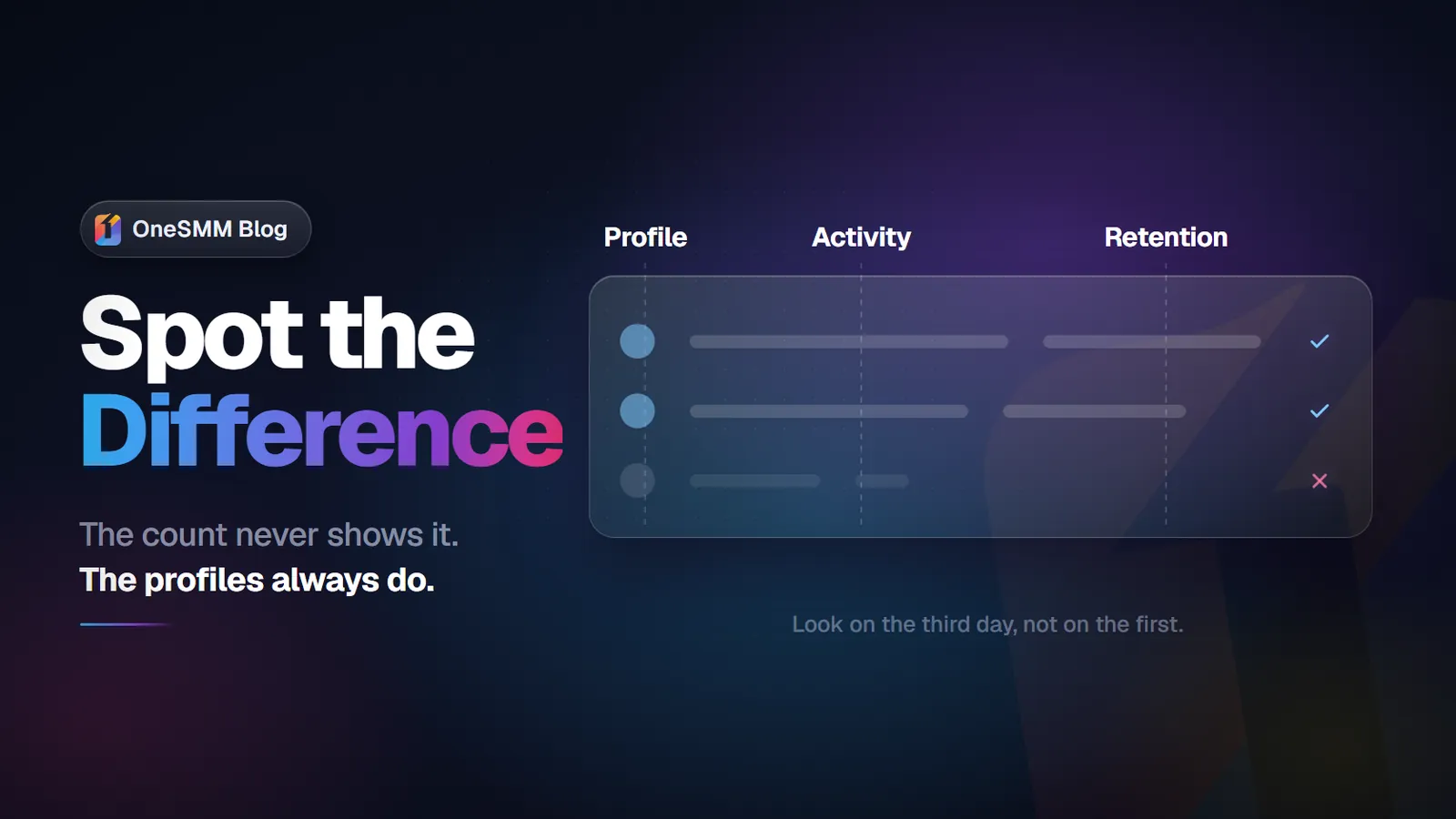
The Profile Check

Click on a new member's profile. Real members have:

  • ✅ A profile picture (real photo, not generic avatar)
  • ✅ A username that looks like a real person's name
  • ✅ A bio (sometimes in Cyrillic, Arabic, or other languages—still real)
  • ✅ Subscription history (you can see they follow other channels)
  • ✅ Post history (they've shared content or commented)

Bots have:

  • ❌ No picture or a stolen/generic picture
  • ❌ Username like "user123456" or "@abc_def_ghi"
  • ❌ No bio or generic bot bio
  • ❌ No subscription history
  • ❌ No post history at all

Quick test: Review 20 new members. If more than 3-5 (15-25%) look obviously fake, you have a bot problem.

The Engagement Check

Look at who engages with your posts:

  • Real engagement: Specific comments like "Great point about [X]" or emoji reactions from actual accounts
  • Fake engagement: Generic comments like "Nice!" from suspicious accounts, or no reactions at all despite thousands of members

Quick test: Post something and watch who reacts. If 0.1% engage (bot-level), you have fake members. If 1-3% engage (normal), your members are real.

The Retention Check

Track member count over 30 days:

  • Real members: Steady retention of 40-70% (depends on content quality)
  • Fake members: Sharp drop-off. 1000 members become 100 within 2 weeks.

How Real Members Get Delivered (The Legitimate Way)

Quality growth services deliver real members through three main methods, all of which work within Telegram's public API framework:

Method 1: Targeted Recommendations

How it works:

  • Service identifies real Telegram users interested in your topic
  • They send those users a message: "Check out this new channel about [Topic]"
  • User clicks the link, sees your channel, decides if they like it
  • They join voluntarily (or don't)

Result: Real people, some of whom are actually interested. 30-50% retention because they self-selected.

Timeline: 3-7 days for members to arrive (gradual, not instant)

Method 2: Ad Network Placements

How it works:

  • Service pays for placements in Telegram ad networks or groups
  • Real users see your channel in a relevant group or channel
  • They click and join if interested

Result: Real members with some interest in your niche. 40-50% retention.

Timeline: 5-14 days for members to arrive

Method 3: Organic Referral Networks

How it works:

  • Service has network of complementary channels
  • They cross-recommend your channel (and you recommend theirs)
  • Real members from related channels join

Result: Real members, usually high-quality because they're from related channels. 50-70% retention.

Timeline: 7-21 days for members to arrive

Red Flags That You're Getting Fake Members

  • 🚩 All members arrive in one day (thousands instantly)
  • 🚩 New members have suspicious usernames (random numbers, no real names)
  • 🚩 Zero engagement despite thousands of new members
  • 🚩 Members have no profile pictures
  • 🚩 Members vanish after 1-2 weeks (80%+ churn)
  • 🚩 Your engagement rate drops after purchase
  • 🚩 Service provides them in batches that look uniform
  • 🚩 Telegram sends you a warning about suspicious member patterns

How to Ensure You Get Real Members

Step 1: Choose the Right Service

Before buying, verify:

  • ✅ Service explains their method clearly (not vague "growth hacking")
  • ✅ Service acknowledges member retention won't be 100%
  • ✅ Service prices fairly ($2-10 per member, not $0.10)
  • ✅ Service shows case studies with realistic engagement rates

Step 2: Do a Test Order

Buy a small package (100-500 members) and monitor:

  • How long does delivery take? (Should be 3-7 days, not instant)
  • Do profiles look real? (Check 20 profiles for red flags)
  • Do they engage? (Track engagement rate change)
  • How many stay after 30 days? (Should be 40%+ for real members)

Step 3: Monitor Ongoing

After each purchase, track:

  • Member retention by week (not all at once = good sign)
  • Engagement rate stability (shouldn't drop)
  • Any Telegram warnings or penalties (check channel settings)
  • Complaints from followers about quality

Why Real Members Matter for Long-Term Growth

The difference between real and fake compounds over time:

  • Real member strategy: Slow but sustainable. Build engaged community. Monetizable.
  • Fake member strategy: Fast but destructive. Tank engagement. Unmone tizable. Risk channel penalties.

Over 12 months:

  • Real growth: 10,000 members (5000 organic + 5000 purchased real), 2% engagement, viral potential
  • Fake growth: 20,000 members (15,000 bots), 0.1% engagement, no monetization potential, risk of penalty

The channel with 10,000 real members is worth 10x more than one with 20,000 fake members.

The Ethical Angle (Why This Matters Beyond Metrics)

Real members are real people. When you buy real members, you're inviting actual humans to see your content. They're a real audience with real potential value.

Fake members are deceptive. To them. To Telegram. To yourself. And they don't lead anywhere good.

Building with real members feels slower but is incomparably better. And it's the only way to actually build something sustainable.

The Simple Quality Check Before Every Purchase

Before committing to any growth service, ask three questions. First: does the service explain where members come from? Legitimate services describe their delivery method — whether that's ad network placements, cross-channel recommendations, or targeted outreach. Services that offer no explanation are selling something they don't want you to examine.

Second: what is the expected retention rate, and is it stated explicitly? Real member services typically quote 30–60% 30-day retention. Any service claiming 90%+ retention at budget prices is either delivering bots that Telegram hasn't swept yet, or making claims they can't support. Third: what is the delivery speed? Real members arrive over days, not hours. Thousands of new members within 24 hours of placing an order is a reliable signal of bot delivery regardless of what the service claims.

Three questions. If all three answers are satisfactory and transparent, the service is worth testing at a small scale before committing to volume orders. For a dedicated deep dive on buying real Telegram members, we cover pricing benchmarks and provider evaluation in full.

Get Real Members That Actually Stay

onesmm delivers real Telegram members with 40-60% 30-day retention. Transparent methods, authentic growth, zero bots. Build it right from the start.

Read More
How to Avoid Fake Telegram Growth Services (What Scams Look Like)
Social Media Growth Tips
May 19th, 2026 7 mins read

How to Avoid Fake Telegram Growth Services (What Scams Look Like)

How to Avoid Fake Telegram Growth Services (What Scams Look Like)

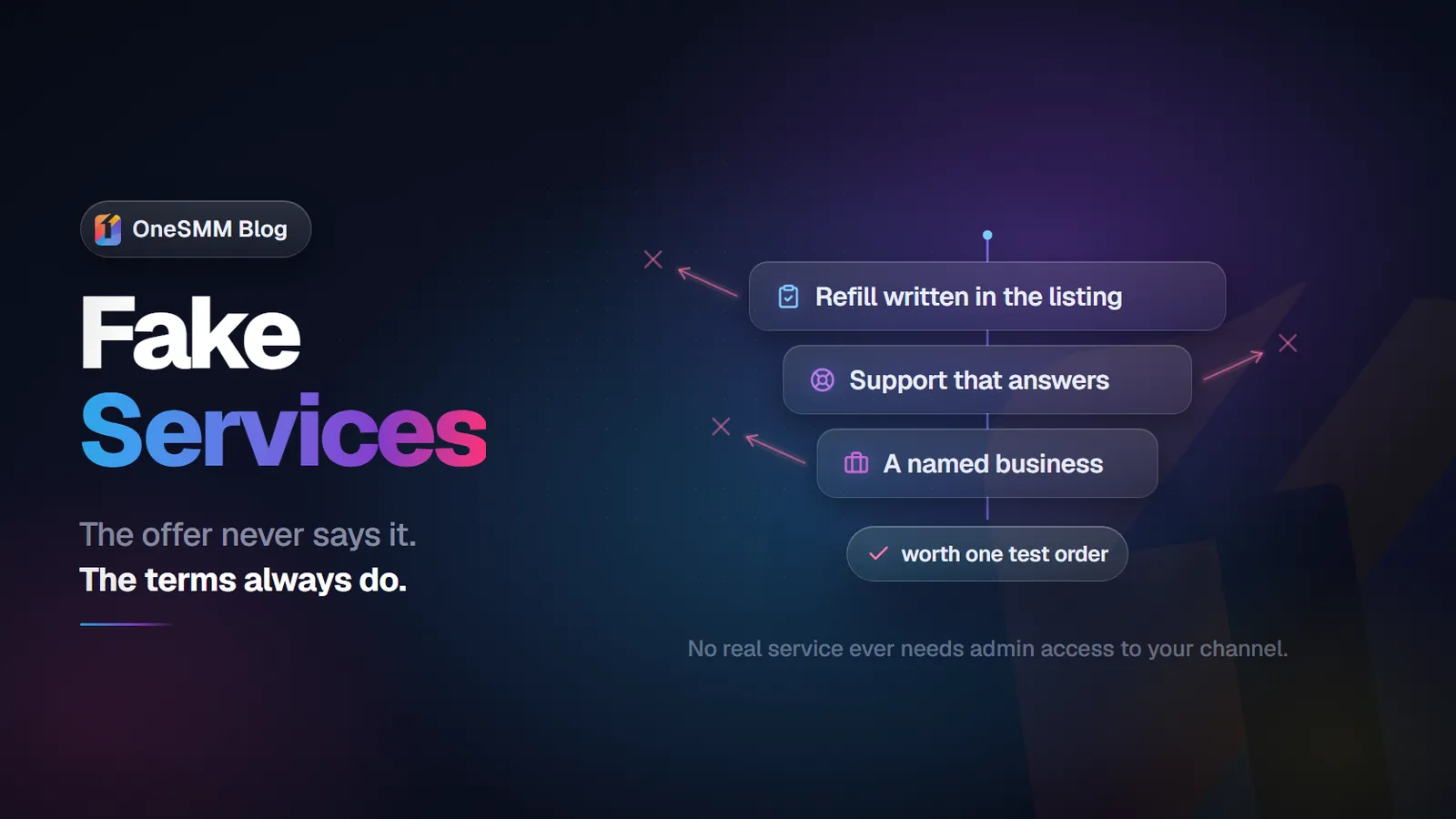
The Telegram growth service space has a problem: it's full of scams.

Fake bot services. Bait-and-switch pricing. Money stolen after "promising results." Channels compromised with suspicious member patterns that trigger Telegram's algorithms.

The worst part? Scammers are getting sophisticated. They look legitimate on the surface. A decent website. Testimonials. Pricing. But underneath, they're just harvesting money and delivering nothing.

This guide shows you exactly what scams look like—so you never fall for one.

Understanding the Scam Landscape

There are three types of fake growth services:

Type 1: Bot Services (The Most Common)

These deliver fake accounts—literally bots, not real humans.

How they work:

  • You buy 1000 "members" for $50 (way cheaper than legitimate services)
  • Thousands of fake accounts flood your channel
  • They never engage, they're basically decorative
  • If Telegram detects this, they can penalize or ban your channel

Why people fall for it: The price is irresistible. And it works instantly (because bots are instant).

Type 2: Theft/Scam Services (Less Common, More Harmful)

These are straight-up theft. You pay, nothing happens, money disappears.

Variations:

  • Payment goes through, service vanishes before delivering members
  • They request your channel admin access, then hijack the channel
  • They ask for "proof of identity" or "payment verification," steal your info

Why it's dangerous: You lose money and potentially lose control of your channel.

Type 3: Low-Quality Services (The Sneaky Ones)

These deliver "real" members, but from the wrong audience or through deceptive methods.

How they work:

  • They deliver real accounts, but not people who care about your niche
  • Members leave after a few days
  • Or they get members through spam techniques that trigger Telegram warnings

Why it's deceptive: You think you're getting real growth, but retention is terrible.

Red Flags: The Complete Checklist

Red Flag 1: Unrealistic Pricing

Sign: 1000 members for $20. Or "any package for 70% off."

Reality check: Real members cost money. Legitimate services charge $2-10 per member depending on niche. If it seems too cheap, it's bots.

What to look for: Transparent, market-rate pricing. Usually $50-500 per package. Clear price per member.

Red Flag 2: Guaranteed Results

Sign: "Guaranteed 10,000 members!" or "Money-back guarantee if you don't get exactly [X] members."

Reality check: Real growth varies. Your content quality, niche size, and timing all affect results. Anyone promising guarantees doesn't understand how growth actually works.

What to look for: Services that say "typical results" or "most clients get" but acknowledge variation.

Red Flag 3: No Clear Business Model

Sign: Can't explain where members come from. Vague descriptions like "growth hacking" or "secret methods."

Reality check: Legitimate services can explain: We target real Telegram users interested in X, send them your channel link. Simple.

What to look for: Services that clearly explain their method. Nothing mysterious about it.

Red Flag 4: Pressure to Act Fast

Sign: "Limited time offer! 50% off if you buy in next 24 hours!" or "Only 2 slots left!"

Reality check: Legitimate services are confident their product speaks for itself. They don't manufacture artificial urgency.

What to look for: Services that let you think about the decision. No countdown timers. No false scarcity.

Red Flag 5: Requesting Channel Admin Access

Sign: "We need admin rights to your channel to deliver members."

Reality check: They don't need your password or admin access. Legitimate services use Telegram's public APIs or send member links.

What to look for: Services that work without touching your channel admin settings.

Red Flag 6: No Customer Support

Sign: Can't find an email address, chat, or support contact. If you contact them with a question, no response.

Reality check: Real services have support because they stand behind their product.

What to look for: Responsive support. Email replies within 24 hours. Chat support available.

Red Flag 7: Generic/Stolen Testimonials

Sign: "Amazing results! 5 stars!" with no real details. Or testimonials that could apply to any service.

Reality check: Real testimonials are specific: "I went from 500 to 2500 members in 3 months with engaged followers."

What to look for: Specific before/after numbers. Real names and channels (you can verify them).

Red Flag 8: Inconsistent Information

Sign: Pricing changes depending on where you look. Different promises on website vs. sales email vs. chat.

Reality check: Legitimate services have consistent messaging across all channels.

What to look for: Same story everywhere. Website matches what the sales team says.

Red Flag 9: No Visible Track Record

Sign: No case studies. No public channels using them. Impossible to find any evidence they've actually helped anyone.

Reality check: Established services have a track record. You can find channels they've helped.

What to look for: Case studies with real channel names. Testimonials you can verify. Evidence of real results.

Red Flag 10: They Request Payment Via Untraceable Method

Sign: "Send Bitcoin" or "Wire transfer to this account" with no official invoice or receipt.

Reality check: Legitimate services use standard payment methods (Stripe, PayPal, credit card) so you have recourse if something goes wrong.

What to look for: Mainstream payment processors. Clear invoicing. Refund policy.

How to Verify a Service Is Legitimate

Step 1: Google + Research (15 minutes)

  • Search "[Service Name] + review"
  • Look for independent reviews (not on their website)
  • Check Reddit communities about Telegram growth
  • Look for any complaints about scams

Step 2: Contact Support (24 hours)

  • Ask a detailed question: "How exactly do you deliver members? What's your targeting method?"
  • Time their response (should be within 24 hours)
  • Evaluate their answer (specific or vague?)
  • If they avoid answering, that's a red flag

Step 3: Ask for References (48 hours)

  • Request case studies with real channel names
  • If they can provide them, look at those channels (check member count, engagement, activity timeline)
  • If they can't provide references, that's a red flag

Step 4: Do a Micro-Test (Covered in Earlier Guide)

  • Buy smallest package available ($50-100)
  • Monitor delivery, quality, and retention
  • If test passes, safe to scale
  • If test fails, don't order again

Specific Scams to Avoid (Real Examples)

Scam Pattern 1: The Bait-and-Switch

How it works:

  1. Service advertises "real members" at fair price
  2. You buy
  3. You receive obvious bots (instant delivery of thousands)
  4. You complain. They say "this is normal" or ghost you

How to avoid: Test with small order. If instant delivery of thousands, it's bots. Don't scale up.

Scam Pattern 2: The Hijack

How it works:

  1. Service asks for "channel verification" or "admin access"
  2. You give them access (thinking it's normal)
  3. They add themselves as admin, change settings, add other accounts
  4. You lose control of your channel

How to avoid: Never give password or admin access to anyone. Ever. Legitimate services don't need it.

Scam Pattern 3: The Ghost

How it works:

  1. You pay for members
  2. Service disappears (website goes down, email stops responding)
  3. You have no way to contact them or get refund

How to avoid: Use credit card or payment method with purchase protection. Check if service has been around for 1+ year (new services are higher risk).

Scam Pattern 4: The Low-Quality Dump

How it works:

  1. Service delivers "real" members, but from wrong audience
  2. Members don't engage, leave within days
  3. Your engagement metrics drop, channel looks worse
  4. Service keeps your money, claims "results depend on content"

How to avoid: Monitor retention in micro-test. If 50%+ of members leave within 30 days, quality is poor.

What Legitimate Services Look Like

After learning what to avoid, here's what to look for:

  • ✅ Clear, market-rate pricing ($2-10 per member)
  • ✅ Transparent explanation of how they deliver members
  • ✅ Real case studies with specific numbers and channel names
  • ✅ Responsive customer support (replies within 24 hours)
  • ✅ No requests for passwords or admin access
  • ✅ Standard payment methods (credit card, PayPal, Stripe)
  • ✅ Acknowledges that results vary based on content quality
  • ✅ Allows you to test with small order
  • ✅ Has been operating for 1+ year with consistent brand presence
  • ✅ Explains member retention expectations realistically (40-60%)

If You've Been Scammed

If you've already fallen victim:

  1. If via credit card: Dispute the charge with your bank/credit card company. Request chargeback.
  2. If via PayPal: Open a dispute in PayPal. Provide evidence the service didn't deliver.
  3. If via wire transfer: Contact your bank immediately. May be recoverable if still in transit.
  4. If account compromised: Change Telegram password immediately. Check for unauthorized admin changes. Remove suspicious accounts.
  5. Report to Telegram: Tell Telegram about the service via their support. They track scammers.

The Bottom Line

The Telegram growth service space has real options and fake ones. The difference is usually obvious if you know what to look for.

Run through the red flags checklist. Do a test order. Check for real case studies. If something feels off, it probably is.

A good rule: If a service seems too good to be true, it is. Real growth takes effort, time, or money. No service gives you all three for cheap.

Want a Service You Can Verify?

onesmm's transparency is our brand. Real members, real numbers, real support. Try a test package and verify for yourself.

Read More
Why Telegram Members Drop (And How to Build Stable Audience)
Social Media Growth Tips
May 19th, 2026 7 mins read

Why Telegram Members Drop (And How to Build Stable Audience)

Why Telegram Members Drop (And How to Build Stable Audience)

Ahmed T. · Operations Manager at OneSMM ·

Telegram member drop is the measurable decline in channel subscribers over a given period, typically expressed as a monthly churn rate. Healthy channels experience 2-5% natural attrition per month as users clean up subscriptions, but drop rates above 10% signal a structural problem — usually audience mismatch, posting frequency issues, or low-quality members from unreliable growth services. According to SocialPlug's Telegram statistics, a healthy channel engagement rate falls between 25-30% of subscriber count, and channels that maintain that ratio while posting 3-7 times per week consistently see the lowest unsubscribe rates across all size brackets.

You hit 5,000 members last month. This month you're at 4,800. It feels like you're losing the battle.

The frustrating part? You don't know why. Members aren't telling you they're leaving. They're just silently unsubscribing.

Here's what most creators don't realize: Telegram doesn't tell you why people leave. So you have to detective work it out. And once you know the real reason, fixing it becomes straightforward.

This guide reveals the actual reasons members drop—and the system to reverse the trend. If you suspect the issue is fake or low-quality members from a growth service, our guide on real members vs. fake explains how to tell the difference.

The First Truth: Churn Is Normal

Before we solve the problem, understand: losing members isn't always bad. It's normal.

Even healthy, growing channels lose 2-5% of members per month. With over 1 billion monthly active users on Telegram as of 2025, the average user is subscribed to dozens of channels and periodically cleans out subscriptions. Their interests change. They get busy. That's unavoidable attrition.

What you should measure: Net growth, not raw numbers.

  • Add 100 members, lose 10 = +90 net (healthy)
  • Add 100 members, lose 50 = +50 net (warning sign)
  • Add 50 members, lose 80 = -30 net (serious problem)

If your net growth is negative or flat, you have a serious retention problem. Let's diagnose it.

The Three Reasons Members Unsubscribe

Reason 1: They Joined for the Wrong Reason (Audience Mismatch)

This happens when your channel description promises one thing, but you deliver another.

Common scenarios:

  • You describe yourself as "Daily crypto news" but post about trading tips, alt-coins, and random market gossip
  • Someone joins for educational content but gets mostly promotional links
  • They expect daily posts, get one per week, and assume you've abandoned the channel
  • They join for free content but then you mostly post about your paid service

How to identify this: New members leave fastest (usually within 1-2 weeks). This signals they joined expecting something different than what they found.

Reason 2: Your Content Quality Dropped (Relevance Problem)

Members stay when you deliver value. They leave when value stops.

Common scenarios:

  • You posted amazing content for 3 months, then got lazy
  • Your topic changed mid-stream (you were "marketing tips" but now you're "my personal life")
  • Your content became repetitive (same advice in different words)
  • Quality degraded (shorter posts, less effort, less research)
  • Too much self-promotion (your posts became sales pitches)

How to identify this: A sudden spike in unsubscribes after a change in posting style or content. Members stop engaging, then unsubscribe. If this is happening alongside low-quality or fake growth service deliveries, the two problems compound.

Reason 3: You're Posting Too Much (Or Too Little)

This is a volume problem, not a quality problem.

Posting too much:

  • You post 5 times per day, members' Telegram becomes spam
  • They mute you, then unsubscribe to avoid clutter
  • Common mistake: New channels think more posts = faster growth. Wrong.

Posting too little:

  • You post once per month, members forget you exist
  • They clean out their subscriptions and remove you
  • Momentum dies. New members have no regular experience to evaluate

Sweet spot: 3-5 times per week for most niches. Enough to be present, not enough to be spammy.

How to Diagnose Your Specific Churn Problem

Step 1: Calculate Your Churn Rate

Pick a 30-day period. Count:

  • New members added: Let's say 500
  • Members lost: Let's say 50
  • Net growth: 450
  • Churn rate: 50 / (starting members) × 100

If your starting count was 5000:

50 / 5000 = 1% churn. (Normal)

If you lost 250 instead:

250 / 5000 = 5% churn. (Problem)

  • Below 3% churn: Normal. Keep doing what you're doing.
  • 3-5% churn: Elevated. Investigate.
  • Above 5% churn: Serious problem. Immediate action required.

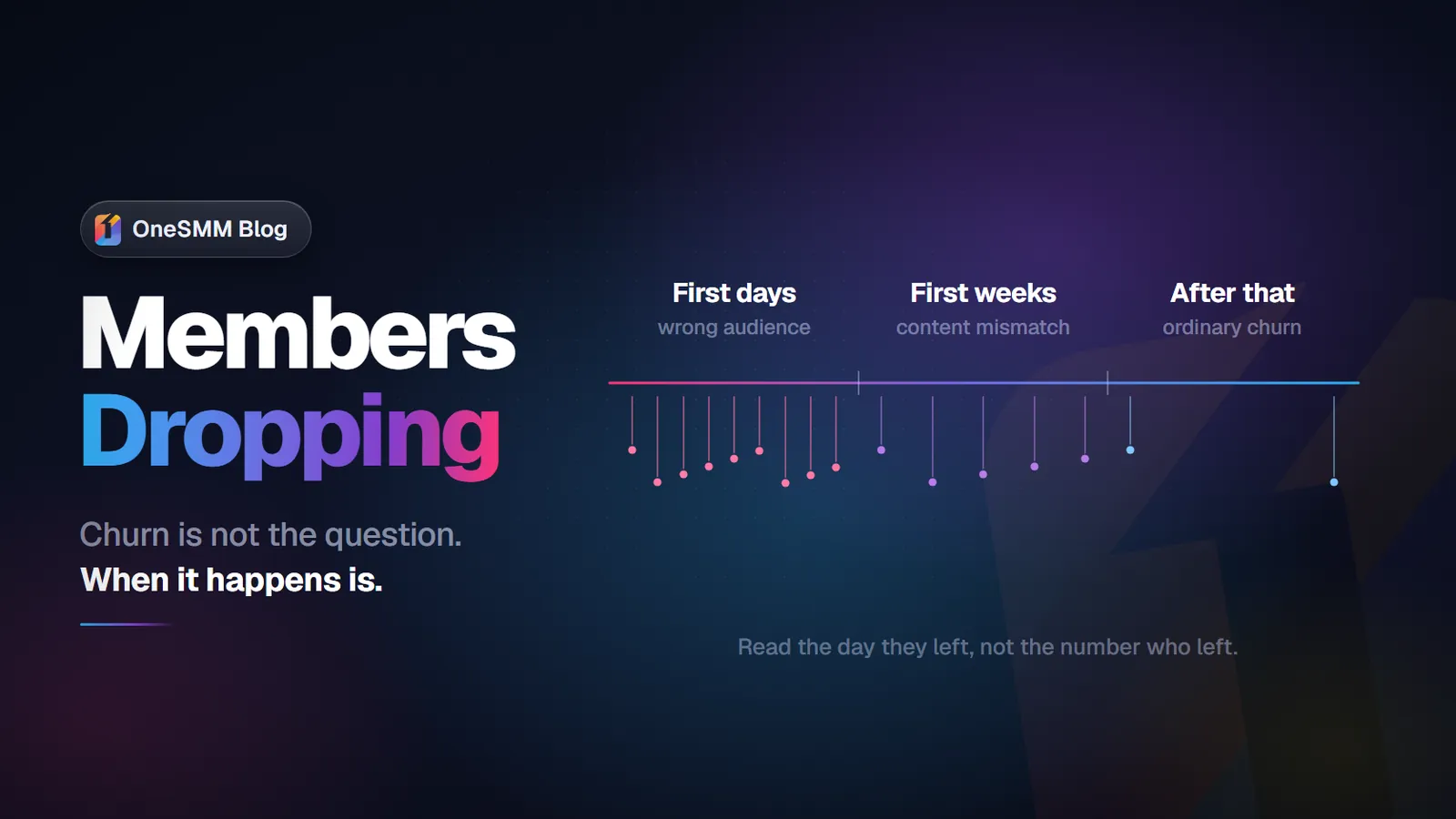
Step 2: When Are People Leaving?

The timing tells you the reason:

People leave within first 2 weeks: Audience mismatch. They joined expecting something different.

Fix: Make channel description crystal clear. Set proper expectations in first post.

People leave after 2-8 weeks: Content quality or relevance issue. Initial excitement wore off, content didn't deliver.

Fix: Improve content quality, ensure consistency, remove promotional/off-topic posts.

People leave gradually over months: Either content degradation or posting volume issue.

Fix: Audit posting frequency and content type. Are you consistent? Is quality high?

Step 3: What Do Your Best Posts Tell You?

Analyze your top 10 posts by engagement. What do they have in common?

  • Are they all one type of content? (News, tips, stories, analysis)
  • Are they longer or shorter?
  • Do they ask questions or provide statements?
  • Are they about one specific sub-topic?

Your best posts are your north star. Make more like them. The posts that get engagement keep members engaged.

Solutions by Problem Type

If Members Leave Within 2 Weeks (Audience Mismatch):

Fix 1: Clarify Your Channel Description

Your description should answer:

  • What is this channel about? (Specific topic, not vague)
  • What will members get? (Daily news? Weekly tips? Community discussion?)
  • What won't they find here? (Sales pitches? Unrelated topics? Debates?)
  • Who is this for? (Beginners? Experts? Business owners?)

Example:

  • ❌ BAD: "Updates and content about marketing"
  • ✅ GOOD: "Daily B2B marketing tactics for solo entrepreneurs. How-to guides, case studies, and proven strategies. No sales pitches, pure value."

Fix 2: Clarify Your First Message

When someone joins, they see your bio. Then they see your most recent posts. Those first impressions matter.

  • Pin a welcome post that explains what to expect
  • Set posting schedule in the welcome (e.g., "New posts Monday, Wednesday, Friday at 9am")
  • Tell them exactly what kind of value they'll get

Fix 3: Remove Misleading Content

Any posts that contradict your stated focus should be removed or reframed:

  • Too many promotions? Remove some or clearly label as "sponsored"
  • Off-topic content? Delete it. It confuses your positioning.
  • Low-effort reposts? Replace with original content.

Expected impact: Dramatically lower churn in first 2-4 weeks. Better audience fit = better long-term growth.

If Members Leave After 2-8 Weeks (Content Quality Issue):

Fix 1: Audit Recent Posts for Quality

Look at the last 20 posts. Grade each one:

  • A-Grade: Helpful, specific, well-researched, relevant
  • B-Grade: Okay, useful, but could be better
  • C-Grade: Low effort, vague, promotional, off-topic

Count your grades. If more than 30% are C-Grade, quality is the problem.

Fix 2: Implement Quality Standards

Before posting, ask:

  • Is this helpful/interesting/valuable?
  • Is it relevant to my channel's focus?
  • Did I put real effort into this?
  • Would someone forward this to a friend?

If the answer to all four is yes, post it. If not, save it as draft or delete it.

Fix 3: Create a Content Plan

Don't wing it. Plan what you'll post and when:

  • Monday: Analysis of something happening in your niche
  • Wednesday: How-to or actionable tip
  • Friday: Story, case study, or example

Consistency in structure + high quality in execution = retention.

Expected impact: 20-40% reduction in churn within 30 days.

If Members Leave Gradually (Volume or Consistency Issue):

Fix 1: Audit Your Posting Schedule

Check the last 60 days:

  • How many posts per week on average?
  • Is the schedule consistent?
  • Are there long gaps without posts?

Target: 3-5 posts per week, consistent schedule

Too much (10+ per day): Cut back. Quality over quantity.

Too little (1 per week or less): Increase frequency. Members need regular value to stay engaged.

Fix 2: Commit to Consistency

Set a schedule and stick to it for 90 days. Members will get used to expecting your posts, and retention will improve.

The Long-Term Retention System

Once you've fixed the acute problem, use this system to maintain healthy retention:

  1. Monthly churn audit: Calculate churn rate. Watch for spikes.
  2. Quarterly content review: Analyze best-performing posts. Double down on what works.
  3. Engagement tracking: Monitor comments and reactions. Are people interacting?
  4. Community surveys (optional): Ask long-term members: "What do you love about this channel?" and "What could we improve?"

Most channels don't do this. That's why they experience unexpected churn. You'll be ahead by actually measuring. For services that prioritize retention-friendly delivery, look into non-drop Telegram member services. If you want to eliminate manual monitoring entirely, an auto-refill Telegram member service automatically replaces dropped accounts within the warranty window.

The Math of Stable Growth

Healthy channel math looks like this:

  • Add: 200 new members per month (organic + paid)
  • Lose: 40 members per month (2% churn)
  • Net: +160 members per month

Over a year, that's 1,920 new net members. That's real, sustainable growth.

Compare to a channel with 5% churn:

  • Add: 200 members
  • Lose: 100 members
  • Net: +100 members per month

Same effort to acquire members, but double the churn means half the net growth. That's the difference between a thriving channel and a stalled one.

Key Insight: Retention is more powerful than acquisition. A 2% improvement in churn rate does more for growth than a 50% increase in new member acquisition.

When to Use Growth Services with Retention Focus

Growth services make sense once you've fixed your retention:

  • ✅ Channel description is clear → Growth services find the right audience
  • ✅ Content quality is high → New members stay and engage
  • ✅ Posting is consistent → New members experience what they expect
  • ✅ Churn rate is below 3% → You're not throwing money away on members who leave

Ready to Accelerate Growth?

Once you've nailed retention, onesmm can help you add 500-2000 engaged members per month. Because growth only works when people actually stay.

Read More
Why Your Telegram Channel Isn't Growing (And How to Fix It)
Social Media Growth Tips
May 19th, 2026 7 mins read

Why Your Telegram Channel Isn't Growing (And How to Fix It)

Why Your Telegram Channel Isn't Growing (And How to Fix It)

You're posting. You're engaging. But growth has stalled. Your channel sits at 800 members. Or 2000. Or 5000. But it feels stuck, and you can't figure out why.

Here's the uncomfortable truth: Telegram channels don't stall because of bad luck. They stall because something is broken. And once you diagnose the real problem, fixing it is straightforward.

This guide walks you through the exact diagnosis process—and then the specific fixes for each problem.

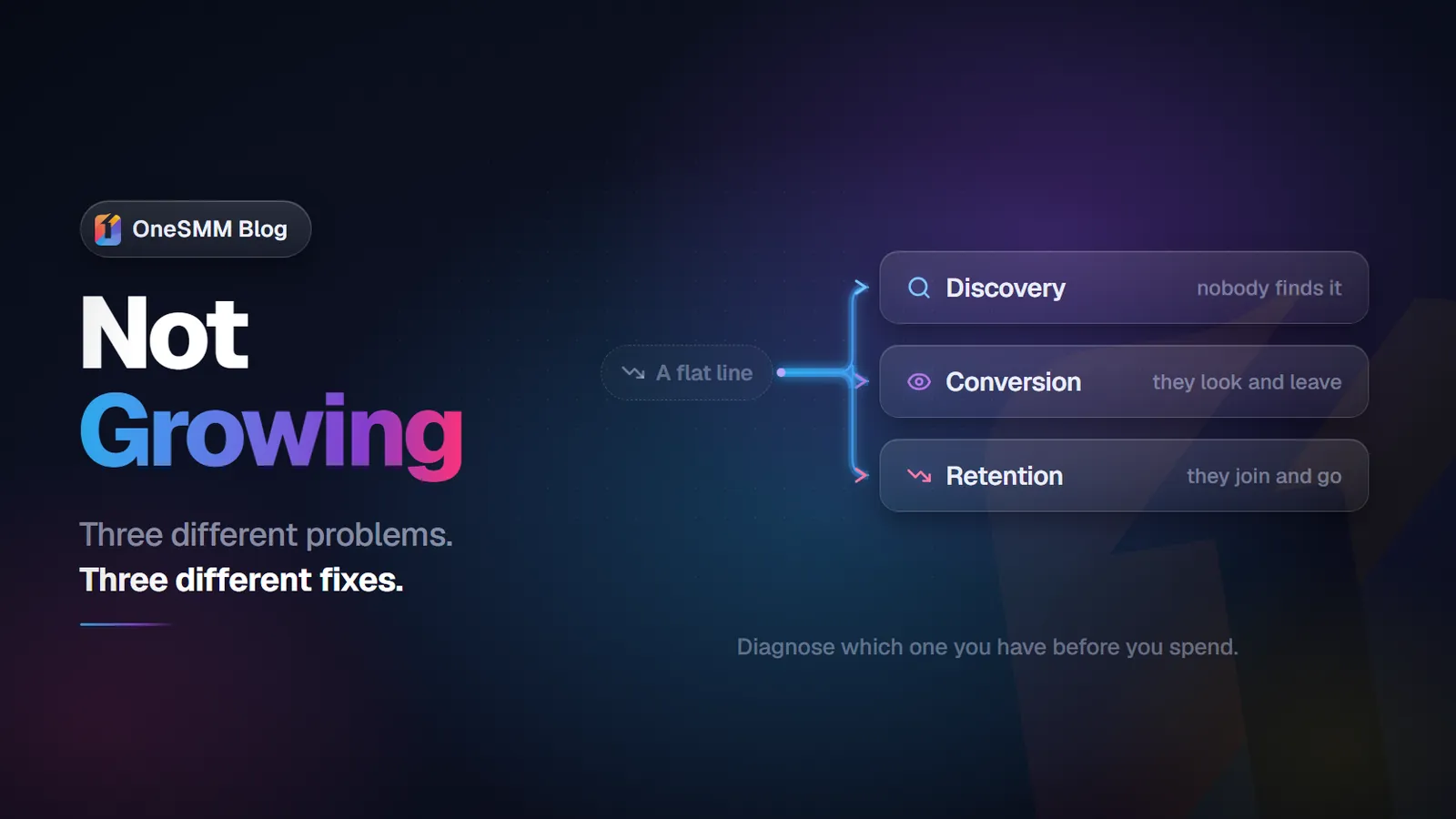
The Three Reasons Telegram Channels Stop Growing

Problem 1: No One Knows You Exist (Discovery Issue)

This is the most common problem for channels under 5000 members.

Signs you have a discovery problem:

  • Your channel gets 5-20 new members per week organically
  • When you ask how people found you, they shrug (no clear pattern)
  • Most growth comes from you manually sharing links or promoting
  • No one outside your immediate network knows about the channel

Root causes of discovery problems:

  • Unclear channel name: "Updates" vs. "Tech News for Startups"—the second one is discoverable
  • Weak channel description: Generic bios don't tell people what to expect
  • No external promotion: Channel only exists on Telegram. Not linked anywhere else.
  • Wrong hashtag strategy: Using irrelevant or too-broad hashtags
  • No partnerships: Not mentioned in any groups or by other channels

Problem 2: People Join But Leave (Retention Issue)

Growth isn't the problem. Keeping people is.

Signs you have a retention problem:

  • You get 50+ new members per week, but don't hit your target
  • New members stay for 1-2 weeks then unsubscribe
  • Engagement is low (under 0.5% interaction rate)
  • You rarely see repeat commenters or engaged followers

Root causes of retention problems:

  • Inconsistent posting: You post daily for a week, then disappear for 2 weeks
  • Poor content quality: Posts are vague, unhelpful, or off-topic
  • Wrong audience expectations: Your channel description promises one thing, but you deliver another
  • No community building: You broadcast but don't interact with followers
  • Spam or low-value posts: Too many links, promotions, or reposts

Problem 3: You're Optimizing for the Wrong Metric (Strategy Issue)

This is subtle, but devastating.

Signs you have a strategy problem:

  • You know who your audience should be, but your content doesn't match
  • You're trying to be everything to everyone (news + tips + jokes + promotions)
  • Your best-performing posts aren't about your main topic
  • You measure success by member count, not engagement or impact

Root causes of strategy problems:

  • No clear positioning: What is your channel about in one sentence?
  • Scattered content focus: Each post is about something different
  • Wrong audience analysis: You're attracting the wrong people, so growth becomes irrelevant

How to Diagnose Your Specific Problem

Step 1: Check Your Growth Pattern

Look at your member growth over the last 3 months:

If growth is flat (under 20 members/week consistently): You have a Discovery problem. People don't know you exist.

If growth is volatile (50/week one week, 5/week the next): You have a Content or Strategy problem. Sometimes you hit, sometimes you miss.

If growth is declining (was 100/week, now 20/week): You have a Retention problem. You're still attracting people, but they're leaving faster.

Step 2: Calculate Your Retention Rate

Pick a week where you gained exactly 100 new members (or scale the math).

Count how many of those 100 are still subscribed after 30 days.

  • 70-100 still there: Excellent retention. Problem isn't retention.
  • 40-70 still there: Normal retention. But you can improve.
  • Below 40 still there: Poor retention. This is your main problem.

Step 3: Check Your Engagement Rate

Look at last week's posts. For each post, count: comments + reactions + shares.

Add those up. Divide by your member count. Multiply by 100.

Example: 50 total interactions across 5 posts / 2000 members = 0.5% engagement

  • Above 2%: Strong engagement. Your content resonates.
  • 1-2%: Average. There's room to improve.
  • Below 1%: Weak. People aren't interested in your posts.

Solutions by Problem Type

If You Have a Discovery Problem:

Fix 1: Optimize Your Channel Name & Bio

  • Channel name: Should include your topic. "Tech News Daily" vs. "Updates"
  • Description: First sentence answers: What is this channel about? Who is it for? What will they gain?
  • Example description: "Daily tech news for startup founders. Get trending stories, analysis, and funding news before anyone else. Join 5000+ founders."
  • Expected impact: 10-20% increase in organic discovery from search/recommendations

Fix 2: Build External Traffic Sources

  • Add link in social bio: YouTube, Twitter, Instagram, TikTok profiles should link to your Telegram
  • Create one viral post per month: Make something worth sharing, put your Telegram link in it, cross-post across platforms
  • Join 5-10 strategic groups: Not spam. Contribute value, then mention your channel when relevant
  • Expected impact: 50-200 new members per month from external sources

Fix 3: Leverage Hashtags Right

  • Research 5-10 relevant hashtags: Tags people actually search for in your niche
  • Use 2-3 per post: Not every hashtag. Just the most relevant.
  • Use consistently: Helps Telegram categorize your content
  • Expected impact: 5-10% increase in discovery

If You Have a Retention Problem:

Fix 1: Create a Posting Schedule

  • Decide your frequency: 1x daily, 3x weekly, 5x daily. Pick something you can sustain.
  • Set specific times: Members learn to expect your posts. Consistency matters more than time of day.
  • Stick to it for 30 days: Then measure if engagement improves
  • Expected impact: 15-30% improvement in retention within 30 days

Fix 2: Improve Post Quality

Before posting, ask:

  • Is this helpful/interesting/valuable to my audience?
  • Does this match my channel's stated purpose?
  • Would I want to see this if I was a follower?

Remove or don't post:

  • Purely promotional content
  • Off-topic tangents
  • Low-effort reposts from other channels
  • Vague posts without context

Expected impact: 20-50% improvement in engagement and retention

Fix 3: Engage With Your Community

  • Read every comment: Not just posts, but what people say in responses
  • Reply to thoughtful comments: Personal replies make people feel seen
  • Ask questions in posts: "What's your take on this?" increases interaction
  • Create discussion posts: Once per week, ask something that encourages conversation
  • Expected impact: 10-25% increase in engagement, better retention

If You Have a Strategy Problem:

Fix 1: Define Your Focus

Answer these questions:

  • What is my channel about in one sentence? (Not "updates" or "content"—specific topic)
  • Who specifically is this for? (Not "everyone interested in X"—but "startup founders in B2B SaaS")
  • What will they get that they can't get elsewhere? (Your unique angle)

Write this down. Make it your north star.

Expected impact: All future content becomes more coherent. Growth accelerates because focus attracts the right audience.

Fix 2: Audit Your Content

Look at your last 50 posts. For each one, ask: "Does this fit my focus?"

  • Yes → Keep doing this type of content
  • No → Stop making this type of content
  • Maybe → Analyze if this got engagement. If yes, maybe reconsider your focus.

Expected impact: 15-30% improvement in engagement because content becomes more coherent

Quick Diagnostic: Which Problem Do You Actually Have?

Low growth (under 20/week) + High engagement (over 2%)? → Discovery problem

Medium-high growth (50+/week) + Low retention (under 40 after 30 days)? → Retention problem

Inconsistent growth + Scattered engagement? → Strategy problem

All metrics are weak? → You have multiple problems. Start with strategy (fix your focus), then retention (fix your content), then discovery (fix your promotion)

The 30-Day Action Plan

  1. Week 1: Diagnose using the framework above
  2. Week 2: Implement the primary fix for your problem
  3. Week 3: Measure results, tweak approach if needed
  4. Week 4: Plan next steps (next problem to fix or scale what's working)

Don't try to fix everything at once. Fix one thing, measure it, move to the next.

When Growth Services Make Sense

Once you've fixed the root problem, growth services become an accelerator:

  • ✅ Discovery problem fixed → Growth services bring more visibility
  • ✅ Retention problem fixed → Growth services bring members who stay
  • ✅ Strategy problem fixed → Growth services fill seats in your proven channel

But trying growth services before fixing these is like adding water to a leaky bucket. It doesn't help.

Ready to Scale?

Once you've diagnosed and fixed the core problem, onesmm can help you accelerate from hundreds to thousands of engaged members per month.

Read More
How to Test Telegram Growth Services Before Paying (Safe Strategy Guide)
Social Media Growth Tips
May 19th, 2026 7 mins read

How to Test Telegram Growth Services Before Paying (Safe Strategy Guide)

How to Test Telegram Growth Services Before Paying (Safe Strategy Guide)

Ahmed T. · Operations Manager at OneSMM ·

A Telegram growth service test is a small-scale trial order — usually 100 to 500 members at under $5 — placed specifically to verify delivery speed, member quality, and retention rate before committing to a larger purchase. With over 1 billion monthly active users on Telegram and growing competition among growth services, a proper test measures three metrics over 72 hours: what percentage of delivered accounts have profile photos and usernames, whether they trigger any Telegram spam flags, and how many remain subscribed after the initial delivery window. Most legitimate panels offer test orders or free trials of 50-100 members for exactly this purpose.

You're skeptical. Good. You should be. The Telegram growth service space is full of scams, bots, and overhyped promises.

So before you spend a single dollar, you need a way to test if a service actually delivers what it claims. This guide gives you the exact framework to validate any growth service—without risking your channel or your money.

Why Testing Matters (What You're Actually Risking)

Buying the wrong growth service can hurt your channel in ways that take months to recover from:

  • Bot members: Fake accounts that tank your engagement rate and hurt your channel's credibility
  • Algorithm penalties: Telegram notices suspicious member patterns and deprioritizes your content
  • Money wasted: Paying for members who leave within days
  • Scams: Worst case, you lose money and your channel gets compromised

The right service? It brings real, engaged members who stay and interact. The difference is massive, but you need a way to spot it before committing. Our guide to spotting fake growth services covers the warning signs in detail.

The Pre-Testing Checklist: Does This Service Even Deserve a Test?

Before you test anything, verify the service itself passes basic credibility checks:

Red Flag 1: No Clear Pricing

If they don't publish clear pricing, they're hiding something. Legitimate services show exactly what you get for what price.

Red Flag 2: Promises of "Guaranteed" Growth

"Guaranteed 10,000 members" doesn't exist. Real growth varies based on content quality, niche, timing. Anyone promising guarantees is lying.

Red Flag 3: Pressure to Act Fast

"Limited time offer! Buy now!" is a manipulation tactic. Real services are confident their product speaks for itself. They don't use artificial scarcity.

Red Flag 4: No Real Contact or Support

Can't find an email, chat, or support contact? Can't find reviews or case studies? Walk away.

Red Flag 5: Too Cheap

If members cost $0.10 each when the industry standard is $2+, you're buying bots. Real members cost real money.

If the service fails any of these checks, don't test it. You're wasting time. Only test services that look legitimate on the surface. For a deeper look at what separates real members from fake ones, read the companion guide. If you are testing services specifically for group growth, our guide on buying Telegram group members covers the differences from channel delivery.

The 3-Phase Testing Framework

Phase 1: Research & Verification (Week 1)

Step 1: Check for Real Reviews

  • Google the service name + "review"
  • Look for honest reviews (not on their own website)
  • Reddit communities, tech forums, Telegram communities discussing growth services
  • What do real users say about quality, support, retention?

Step 2: Verify Their Claims

  • Do they show real case studies with real channels?
  • Can you see before/after member counts and engagement?
  • Red flag: Generic case studies that could apply to anyone

Step 3: Test Their Support Before Buying

  • Send them a question via their support channel
  • Do they respond quickly and helpfully?
  • Or do they send generic replies?
  • Support quality indicates how they'll treat you if something goes wrong

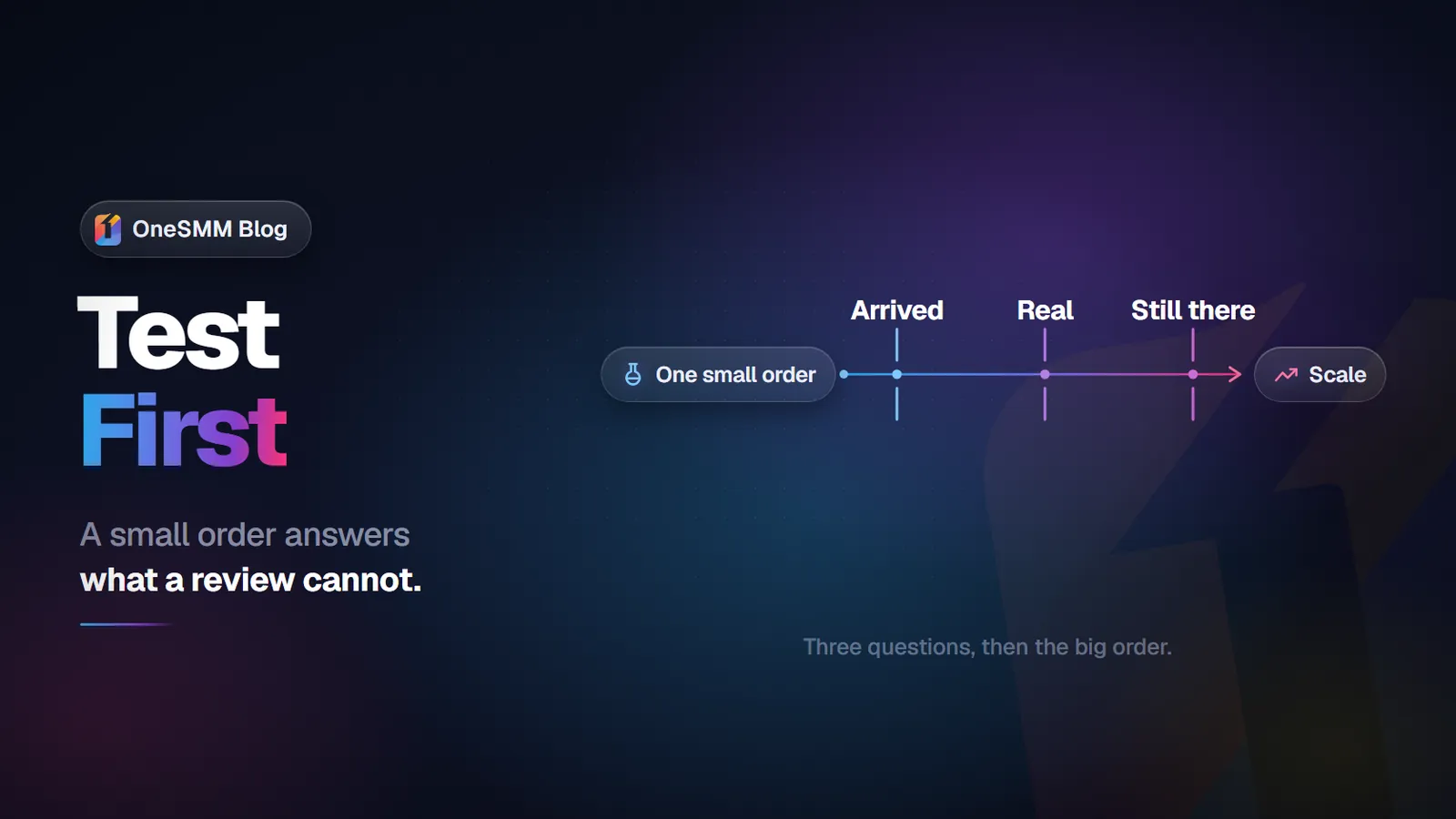
Phase 2: Micro-Test (Week 2, ~$50-100 budget)

Order a small test package. Most reputable services let you buy 100-500 members as a first order. This is your risk-controlled test.

What to measure in your test:

  • Speed: How long before new members arrive? (Usually 1-7 days)
  • Quality: Do the new members look real? (Check profiles, see if they have other channels, real names vs. bot-like names)
  • Engagement: Do they interact with your posts? (Check first week engagement rate change)
  • Retention: After 30 days, how many are still there?
  • Support: Any issues? How responsive is the service?

The test results you want to see:

  • ✅ Members arrive gradually over 3-5 days (not all at once—that's a bot signal)
  • ✅ Member profiles look realistic (bio, profile picture, activity history)
  • ✅ 10-20% of new members engage within first week
  • ✅ After 30 days, 40-60% of new members are still active subscribers
  • ✅ Your overall engagement rate doesn't drop (or drops minimally)

The test results that mean "stop immediately":

  • ❌ All members arrive on same day (bots)
  • ❌ Profiles are obviously fake (no bio, bot-like usernames, no profile pictures)
  • ❌ Zero engagement from new members
  • ❌ 80%+ of members disappear within 30 days
  • ❌ Your engagement rate drops sharply

Phase 3: Evaluation & Decision (Week 3)

Compare your test results to expectations:

If the test went well (members look real, reasonable retention, engagement stable or improved):

  • ✅ The service is likely legitimate
  • ✅ Safe to scale to bigger orders if you want
  • ✅ Monitor future orders the same way

If the test was mediocre (some concerns but not complete failures):

  • ⚠️ Try one more test with feedback to the service
  • ⚠️ Ask them to explain retention/quality metrics
  • ⚠️ If they can't articulate their quality standards, move on

If the test failed:

  • ❌ Stop using them
  • ❌ Request a refund
  • ❌ Move on to next option

Safety Metrics: What Numbers Actually Tell You

The Engagement Rate Test

Before testing: Calculate your current engagement rate. (Total interactions this week / member count × 100)

After buying members: Calculate again 7 days later.

Expected: Similar or slightly better (because you now have more followers to engage)

Red flag: Drops by more than 20%. This signals the new members aren't real or aren't engaging.

The Bot Check

Manually review 20 new members:

  • Do they have profile pictures? (Real accounts: 80%+ have pictures)
  • Do they have bios? (Real accounts: 40%+)
  • Are they subscribed to other channels? (Real accounts: 60%+)
  • Do names look realistic? (Real accounts: mix of first names, full names, no obvious bot patterns)

Count how many look obviously fake. If more than 3 out of 20 (15%), quality is questionable.

The Retention Calculation

Note exactly how many members the service delivered on day 1. (Let's say 250)

Count how many of those specific members are still there after 30 days. (Let's say 150 still there)

Retention = 150/250 = 60%

Target: 40-50%+ for quality services. Below 30% means members leave fast (likely low quality or not a good fit for your content).

The Red Flags You Can't Ignore

  • Service demands your password: Legitimate services never ask for passwords. They use Telegram's official Bot API.
  • Sudden spike in members (1000+ in one day): Real growth services spread deliveries over time. Spikes indicate bots.
  • Service stops responding after purchase: They only care about the sale, not the result. Bad sign.
  • Your channel gets flagged/restricted by Telegram: Telegram penalizes channels with suspicious member patterns. If this happens, the service was using bots.
  • Friends/followers ask "why are these people following you?": Bots are usually obvious to people who know you

How Long Should Testing Take?

The full testing cycle takes 30 days:

  • Days 1-7: Research, pre-checks, contact support
  • Days 8-15: Micro test (order small package, members arrive)
  • Days 16-30: Monitor retention and engagement
  • Day 31: Make go/no-go decision

This feels slow, but it's the only way to get real data. Quick decisions = bad outcomes.

What If You Can't Test Because You're Too Small?

If you have fewer than 1000 members, testing is harder because small metric changes are harder to measure. In that case:

  • Skip paid services for now
  • Focus on organic growth (it's more valuable when you're small anyway)
  • Once you hit 1000+ members, revisit services
  • Then do the full testing framework

There's no shame in bootstrapping organic growth first. It builds better foundations. Our beginner decision guide walks through exactly when growth services start to make sense. When you do decide to order, our practical walkthrough on how to buy Telegram members correctly covers the ordering workflow step by step.

Should I test multiple services?

Only if the first passes all tests and you want options. Testing takes time. If one service works, stick with it until you have a clear reason to switch.

Can I test for free?

Most services don't offer free trials. Some offer very small packages (100 members for $20-50). That's your free trial equivalent.

What if retention is 30%? Is that bad?

It depends on context. If your overall engagement is solid and members are clearly real, 30% retention might be fine (it means 30% found long-term value). If combined with signs of bots, 30% is a failure.

The Bottom Line

Never trust a service's promises. Trust data. And the only data that matters is what happens on your channel after you buy.

The testing framework above takes 30 days and costs $50-100. That's a small price for knowing whether a service is worth scaling to bigger orders ($500+).

Most people skip testing and waste thousands. Don't be that person. Test first. Scale after validation.

Want a Service You Can Trust?

onesmm is built on transparency and real results. Try a small test package—real members, real engagement, real support. See for yourself.

Read More
What Actually Works for Telegram Growth in 2026? (Organic + Service Strategies)
Social Media Growth Tips
May 19th, 2026 7 mins read

What Actually Works for Telegram Growth in 2026? (Organic + Service Strategies)

What Actually Works for Telegram Growth in 2026? (Organic + Service Strategies)

Ahmed T. · Operations Manager at OneSMM ·

A Telegram growth strategy is any systematic method — organic, paid, or hybrid — used to increase a channel's subscriber count and engagement rate in a measurable way. In 2026, effective strategies combine content-driven organic reach with panel-based acceleration, where services deliver 1,000 to 50,000 targeted members at rates starting from $0.80 per 1,000. The key shift this year is that Telegram's search algorithm now rewards channels with consistent posting frequency and high view-to-member ratios above 30%.

There's an endless list of Telegram growth "hacks" floating around. Join groups. Use hashtags. Post at certain times. Cross-promote. Honestly? Most of them don't work anymore.

Telegram now has over 1 billion monthly active users as of March 2025, making it more competitive than ever. Old tactics that brought 100 members per week in 2024 might bring 10 today.

So what actually works in 2026? Here's what the data shows—and how to combine organic and paid strategies to build real growth. If you're still deciding whether paid growth is right for you, start with our decision guide on when to use growth services.

The Fundamental Truth About Telegram Growth

Telegram doesn't have an "algorithm" that promotes content the way Instagram or TikTok does. That's both a blessing and a curse. While Instagram's organic reach has fallen to roughly 3.5% of followers, Telegram posts reach all subscribers directly.

Telegram's growth model works like this:

  • Discovery: Users find you through direct links, group recommendations, or search
  • Retention: They join if your first few messages are compelling
  • Engagement: They stay if you deliver consistent value
  • Viral: They recommend you to others if your content is remarkable

This means growth isn't about gaming an algorithm. It's about creating something worth sharing. That principle doesn't change, but the tactics to get there do.

Organic Strategies That Actually Work in 2026

1. Strategic Group Placement (Still Relevant)

Telegram groups are still where discovery happens. But the key word is "strategic." Here's what works:

  • Find groups where your audience lives: Not generic "telegram growth" groups. Find groups filled with people interested in your specific niche (finance, tech, language learning, etc.)
  • Contribute value first: Answer questions, share insights, build credibility. Only mention your channel if it's genuinely relevant.
  • Post your channel link once every 2-4 weeks: Not daily. Quality groups ban spam. One good mention per month is better than 10 low-quality daily posts.
  • Reality: Expect 20-50 new members per good group placement per month. Not explosive, but sustainable.

2. Content-First Growth (The Overlooked Method)

The fastest way to grow is often the one creators skip: making content so good that people naturally share it.

  • Unique angle: Your content offers something people can't find elsewhere
  • Actionable insights: Your posts teach something specific people can implement today
  • Shareable format: Short, memorable, quotable, or visually compelling
  • Consistent quality: Every post is worth the time to read
  • Reality: One viral post can bring 500-2000 members. But you need 50-100 posts before you hit that one.

3. Cross-Promotion Networks (When Done Right)

Partnering with complementary channels is still effective, but it requires fit:

  • Same audience, different angle: A tech channel partners with a startup advice channel, not a fitness channel
  • Mutual benefit: Both channels genuinely win from the partnership
  • Real shout-outs: "I recommend this channel because..." vs. generic promotions
  • Reality: Each cross-promotion typically brings 50-150 new members if audiences align well

4. External Traffic (The Underrated Strategy)

Some of the fastest-growing channels drive traffic from outside Telegram:

  • YouTube: 1000 YouTube subscribers who follow your Telegram = 500-800 members
  • TikTok/Instagram: Link your Telegram in bio. Even 1-2% conversion rate builds momentum
  • Reddit/Twitter: Relevant community posts that link to your Telegram (where allowed)
  • Email list: If you have existing audience elsewhere, a simple email can drive 100+ members
  • Reality: This is slow but sustainable. 100-300 new members per month from multiple external sources

5. SEO & Search (Growing Fast in 2026)

Telegram search is becoming more important:

  • Optimized channel name: "Financial News" ranks better than "Finn's Updates"
  • Clear bio: Describe what you do in the first sentence
  • Hashtag consistency: Use 2-3 relevant hashtags in all posts
  • Reality: Search-driven discovery brings 20-100 new members per month depending on keyword competitiveness

Paid Strategies That Work in 2026

Strategy 1: Genuine Growth Services (Real Members)

Quality services deliver actual Telegram users to your channel. Not bots. Real people. Our guide on buying real Telegram members explains exactly what "real" means across different service tiers and how to verify quality after delivery.

  • How it works: Service targets real Telegram users interested in your niche, sends them your channel link
  • Cost: $2-10 per member depending on quality and niche
  • Timeline: 500-2000 members per month
  • Retention: 30-50% stay if your content is good (same as organic traffic)
  • Key metric: Don't just count new members. Track engagement. Bad services bring members who never interact.

Strategy 2: Telegram Ads Network (Emerging in 2026)

Telegram's advertising platform has matured significantly. According to Business of Apps, Telegram generated $125 million in ad revenue in H1 2025 alone, and channel owners with 1,000+ subscribers now receive 50% of ad revenue displayed on their channels:

  • How it works: Pay to promote your channel within Telegram's ad network
  • Cost: Variable, starting around $10-50/day minimum
  • Reach: Thousands of users based on interests/location
  • Reality: Still new. Results vary. Best for established channels with strong conversion rates.

Strategy 3: Influencer Partnerships (Paid Shout-outs)

Pay established channels to mention yours:

  • Cost: $50-500+ per shout-out depending on channel size
  • New members per shout: 50-500 depending on audience fit
  • Key metric: Engagement rate matters more than follower count
  • Reality: Best for channels with engaged audiences (1000+ members with 2%+ engagement)

Comparison: Organic vs. Paid Growth

Factor Organic Paid Services
Speed Slow (50-200/month) Fast (500-2000/month)
Cost Time investment $150-500/month
Quality Higher engagement rates 30-50% retention (if quality service)
Sustainability Builds long-term authority Needs strategy behind it
Risk Low (organic only) Medium (depends on service quality)
Timeline to 10K 6-12 months 2-4 months

The Hybrid Approach (What Actually Works Best)

The most successful channels in 2026 don't choose organic OR paid. They use both:

Months 1-2: Organic Foundation

Build solid content, find your niche, reach 1000+ organic members. This proves your channel has value.

Months 3-5: Hybrid Growth

Organic strategies + paid growth service. Now you're accelerating momentum, not manufacturing it.

Months 6+: Scale & Optimize

Once you hit 5000+ members, you can reduce paid service spend. Organic discovery kicks in harder at scale.

The Metrics That Actually Matter

Don't just count members. Track these:

  • Engagement rate: (Comments + reactions) / member count. Target: 1-3% for average channels
  • Retention rate: What % of new members are still there after 30 days? Target: 30%+ from paid sources, 50%+ from organic
  • Growth cost: Total money spent / new members acquired. Track this monthly to optimize
  • Viral coefficient: How many new members come from existing members recommending you? Higher = better long-term growth

Common Growth Mistakes to Avoid

  • Focusing only on numbers: 10,000 inactive members is worse than 1,000 engaged ones
  • Using cheap bot services: They destroy your credibility and violate Telegram's terms. Not worth it. See why channels stop growing once bad members pollute engagement metrics.
  • Ignoring your conversion rate: If new members leave within a week, paid growth is just expensive marketing
  • Inconsistent posting: You can buy new members. You can't buy engagement if your content is sporadic.
  • Betting on one strategy: The most resilient channels use multiple growth levers. For terminology clarity — Telegram uses "subscribers" and "members" interchangeably, but if you search for buying Telegram followers, it means exactly the same thing.

Your 2026 Telegram Growth Roadmap

Here's what works, prioritized:

  1. Create compelling content consistently (non-negotiable baseline)
  2. Optimize for search & discovery (name, bio, hashtags)
  3. Build strategic group presence (50-200 members/month)
  4. Leverage external traffic sources (YouTube, TikTok, email)
  5. Use quality growth services (once you have 1000+ members and proven content)
  6. Build partnerships & cross-promotion (50-200 members/month each)

This isn't a shortcut. It's a system. And systems beat gimmicks every single time. For the full phase-by-phase playbook, read our framework on scaling from 1K to 100K members.

The Metric That Tells You Whether Your Strategy Is Working

Most Telegram creators track the wrong number. Member count is easy to see but slow to reflect strategy quality. The metric that actually tells you whether your approach is working is your organic growth rate — the number of new members joining per week who came through search, recommendations, and shares rather than direct promotion or paid services.

If your organic growth rate is increasing month over month, your strategy is working. Content is resonating, people are recommending you, and the algorithm is sending discovery traffic. If organic growth is flat or declining despite posting consistently, something in the content-niche fit or the channel's engagement health needs attention before adding more members through paid means will help.

Track it monthly: (New members from organic sources) / (Total new members). A channel where 40%+ of new members arrive organically is compounding well. One where 5% are organic is dependent on paid acquisition and will slow or reverse the moment spending stops. To improve organic discovery, optimizing each post for maximum reach is one of the fastest levers you can pull.

Ready to Scale Fast?

Once you've nailed your organic strategy and have solid engagement, onesmm's growth service can accelerate your timeline from 6-12 months to 2-4 months. Real members. Real growth.

Read More
When Should You Use Telegram Member Growth Services? (Beginner Decision Guide)
Social Media Growth Tips
May 19th, 2026 7 mins read

When Should You Use Telegram Member Growth Services? (Beginner Decision Guide)

When Should You Use Telegram Member Growth Services? (Beginner Decision Guide)

Ahmed T. · Operations Manager at OneSMM ·

A Telegram member growth service is a panel-based tool that delivers subscribers to your channel or group on demand, with most providers offering packages from 100 to 100,000 members at rates between $0.50 and $5.00 per 1,000 depending on account quality and retention guarantee. With Telegram now surpassing 1 billion monthly active users, these services work by routing real or high-retention accounts through automated delivery systems, typically starting within minutes of order placement. The decision of when to use one depends on your channel's current stage, content quality, and growth goals.

You're thinking about using a Telegram growth service to boost your channel members. But here's the question that actually matters: Is now the right time?

The truth is, growth services aren't a magic bullet for every situation. Some channels benefit massively from them. Others waste money and never recover. The difference comes down to one thing: understanding where your channel actually stands and what it needs next.

This guide walks you through the exact decision framework you need to know whether growth services are worth your investment—and if they are, when to use them.

The Real Problem Most Creators Face

You've built a Telegram channel. You post consistently. But growth feels stuck. So you start researching solutions, and you find dozens of services offering fast member growth. The prices are cheap. The promises are big. But you're rightfully hesitant—because buying members feels like cheating.

Here's the uncomfortable truth: it's not about cheating. It's about whether your channel is actually ready for what growth services do.

Growth services add members fast. But if your channel isn't set up to convert those new members into engaged followers, they'll leave just as quickly. That's the core issue—not the ethics of using services, but the strategic timing. Before spending anything, you should know how to test a growth service safely.

Three Stages of Channel Growth (And Where Growth Services Help Most)

Stage 1: The Validation Phase (0-1000 Members)

At this stage, you're still figuring out if your content resonates. Your engagement rate matters more than your raw member count. Here's what to do:

  • Skip growth services for now. You need real feedback, not inflated numbers
  • Post regularly (3-5 times weekly minimum)
  • Engage deeply with every comment and interaction
  • Test different content formats to find what lands
  • Aim for 3-5% engagement rate before considering any paid growth

You'll know you're ready to move past this stage when: Members feel like they want to be there, you see patterns in what performs, your community starts having conversations.

Stage 2: The Traction Phase (1000-10,000 Members)

This is the sweet spot for growth services. Here's why: You've validated product-market fit (your content works), but you're not yet at the size where people naturally find you. Growth services become a lever to accelerate what's already working.

  • Growth services make sense here because you're amplifying proven content, not testing unproven ideas
  • You have 2-5 months of consistent posting history
  • Your engagement rate is stable (1-3% is normal here)
  • You're ready to handle 10-50 new members per day without dropping quality
  • Your content strategy is clear and repeatable

Growth services work best when: You already have momentum (not starting from zero), your conversion rate feels solid (people stay, people engage), you're posting regularly with a clear plan.

Stage 3: The Authority Phase (10,000+ Members)

At this point, you have options. Growth is often driven by organic discovery, backlinks, or community reputation. Some creators still use services to accelerate, others rely entirely on organic.

  • Growth services can still help, but aren't essential
  • Organic growth becomes more competitive (everyone sees you as established)
  • Your focus shifts from adding members to deepening engagement and monetization

The Decision Framework: Should YOU Use Growth Services?

Answer these questions honestly:

Question 1: Do you have 1000+ engaged members already?

If no → Skip growth services. Focus on content quality and organic growth first.

If yes → Move to Question 2.

Question 2: Have you been posting consistently for 2+ months?

If no → You don't have enough data yet. Growth services won't help if your content strategy is unclear.

If yes → Move to Question 3.

Question 3: Do you know which content types get the most engagement?

If no → You're still in testing mode. Don't buy members yet.

If yes → Move to Question 4.

Question 4: Is your current growth rate under 50 new members per week?

If no (you're already growing fast) → Growth services might not be necessary. Focus on monetization instead.

If yes → Growth services could help accelerate your traction.

Red Flags: When NOT to Use Growth Services

  • You're testing your niche: New channels without clear product-market fit will waste money. Growth services add members, not engagement.
  • You're not posting regularly: If you can't post 2-3 times per week, new members will leave before they convert.
  • Your engagement rate is below 1%: This signals your content isn't resonating. Adding more members won't fix that.
  • You haven't tried organic growth: You need to understand how Telegram discovery actually works before paying to circumvent it.
  • You're looking for a shortcut to monetization: Growth services add quantity, not quality. Monetization comes from engaged followers, not total follower count.

Green Flags: When TO Use Growth Services

  • You have 1000-10,000 members and your engagement is stable: This is the peak window for using services effectively.
  • You can measure what happens after: Are new members staying? Engaging? Converting? If yes, growth services are working.
  • You have a clear content pipeline: You know what to post, when to post it, and why it matters. New members will see a consistent experience.
  • You're scaling intentionally: You're not trying to look big. You're trying to reach more people who would genuinely value your content.
  • You're willing to invest in quality: Real growth services cost more than fake ones. If you're choosing based on price alone, you'll get what you pay for. Learn to spot fake growth services before they waste your budget.

The Real ROI: What to Expect

Here's what actually happens when you use a quality growth service at the right time:

  • Speed: 500-2000 members per month instead of 50-200 organically
  • Retention: If your content is good, 30-50% of purchased members stay and engage
  • Cost: $50-500 per month for real members (not cheap bots)
  • Timeline: Results visible within 2-4 weeks. Full impact over 2-3 months
  • Snowball effect: Once you hit 5000+ members, organic growth accelerates. With over 500 million daily active users browsing the platform, Telegram's discovery features favor established channels with consistent engagement

Three Strategies: Which One Is Right for You?

Strategy 1: Pure Organic (Patience-Based)

Best for: Channels with exceptional content, niche audiences, creators who love building community slowly

Timeline: 6-12 months to 10,000 members

Cost: $0 (time investment instead)

Risk: Low. You'll know exactly what works because you earned every member.

Strategy 2: Hybrid (Organic + Growth Service)

Best for: Channels with solid content, clear niche, creators with some budget

Timeline: 3-6 months to 10,000 members

Cost: $150-500 total over 3-4 months

Risk: Medium. You need to monitor engagement metrics to ensure quality.

Strategy 3: Accelerated Growth (Heavy Service Use)

Best for: Channels with proven content, significant budget, goal-driven creators

Timeline: 1-3 months to 10,000 members

Cost: $500-2000+ over 2-3 months

Risk: Highest. Rapid growth creates dilution risk. You need strong engagement metrics to sustain.

The Bottom Line: Timing Is Everything

Growth services aren't good or bad. They're just a tool. And like any tool, they only work if you use them at the right moment, for the right reason, with the right preparation.

Your decision should answer one core question: "Will paying to accelerate growth help me reach people who genuinely want my content?"

If the answer is yes, and your channel is in the 1000-10,000 member range with stable engagement, growth services become a legitimate lever for scaling faster.

If the answer is no—if you're still testing, or you're not posting consistently, or your engagement is low—growth services will feel like throwing money away.

The difference between success and waste comes down to honest self-assessment. Answer the questions above, track your metrics, and make the decision that fits your actual situation, not the pressure to grow fast. Growth services, used at the right time, are a multiplier — not a substitute for the foundational work that earns members worth keeping. Once you're ready to move beyond the basics, our guide on scaling from 1K to 100K members maps out every phase.

Ready to Scale?

Once you've confirmed you're ready for growth services, check out onesmm's transparent approach to member growth—real members, real engagement, real results.

Read More