Telegram Non-Drop Member Panel: What It Means and How to Verify It
A Telegram non-drop member panel advertises services intended to limit member losses after delivery. The label is not a guarantee that every account will stay, and it does not establish a specific retention rate or price premium. Check the individual service description for refill eligibility, duration, exclusions, and whether you must submit a request. A small test order can help you assess delivery and retention before committing more budget.
"Non-drop Telegram members" is one of the most misused phrases in SMM panel listings. Every provider claims it. Very few deliver it without qualifications. Understanding what non-drop actually means — and how to hold a panel accountable to that claim — is the difference between a service that holds its value and one that requires constant maintenance.
This guide breaks down the technical reality of non-drop Telegram members, what to look for in service listings, and how to verify that a Telegram non-drop member panel actually delivers on its promise before you spend budget at scale.
Contents
What non-drop actually means
In theory, "non-drop" means the members delivered stay in your channel permanently and never leave. In practice, no SMM service can guarantee this with 100% certainty — because Telegram controls whether accounts remain active, and no provider can prevent Telegram from deactivating an account that joined your channel.
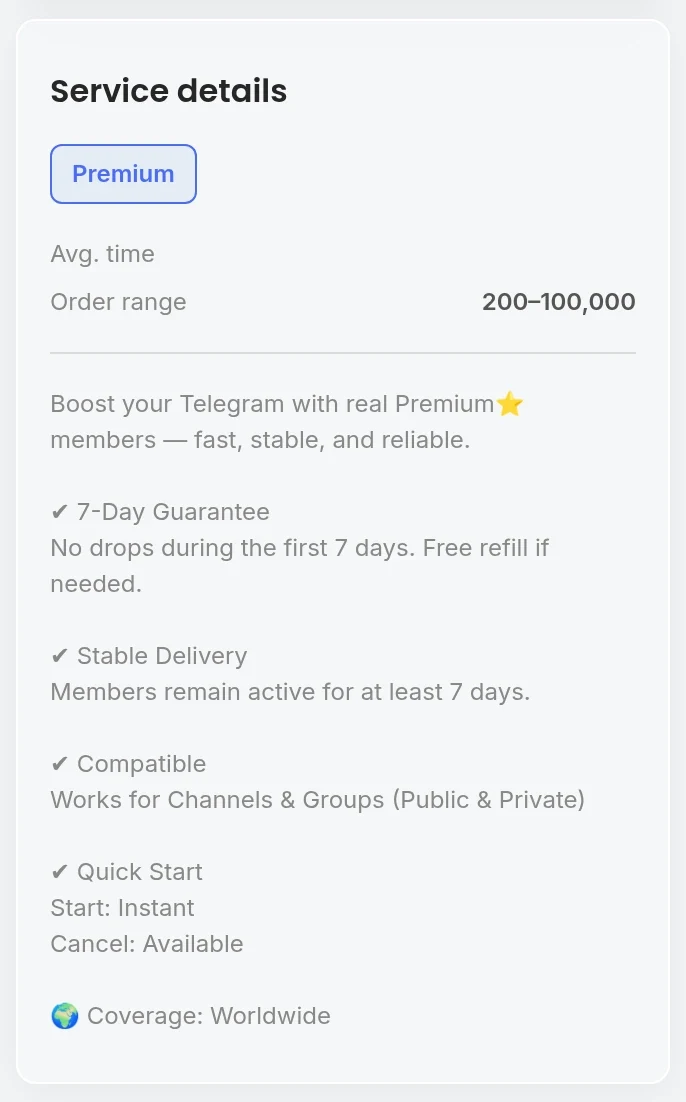
What "non-drop" realistically means in a quality panel listing:
- Low initial drop — the delivered members have a significantly lower drop rate than economy services, typically under 5% in the first 30 days
- Refill included — if members do leave, the provider replaces them at no additional cost within the warranty period
- Higher-quality accounts — the accounts used are less likely to be flagged and removed by Telegram's own anti-spam systems
The honest definition: True non-drop does not exist. "Non-drop" in SMM context means "low drop rate with refill protection." A service listing that claims 0% drop with no refill warranty is making a claim it cannot back up. A service that offers a 30-day refill guarantee is making a provable, enforceable promise.
Why Telegram members drop after delivery
Understanding why drop happens helps you evaluate which non-drop claims are credible:
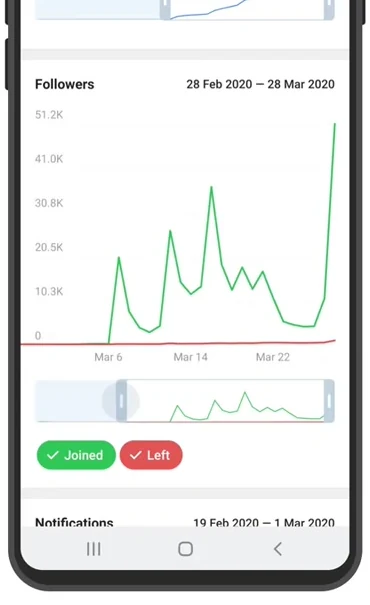
- Telegram account purges — Telegram periodically removes inactive or low-quality accounts from its platform, as part of the anti-spam measures described in Telegram's FAQ. When an account used to join your channel gets deleted by Telegram, the member count drops.
- Anti-spam detection — if Telegram identifies a batch of accounts as coordinated inauthentic behaviour, it may remove those accounts from channels they joined recently. With 2.5 million new users joining daily, Telegram actively monitors for spam patterns among new account registrations.
- Manual leaves — some accounts are operated by real people running bulk operations. They may leave channels after a period if they clean up their join history.
- Provider account recycling — lower-quality providers reuse the same accounts across many channel orders. When a channel using those accounts bans them or they become inactive, the count drops.
The first two causes (Telegram purges and anti-spam) affect even high-quality accounts occasionally. The last two (manual leaves and recycling) are provider-quality issues that non-drop and premium services minimise by using better account pools.
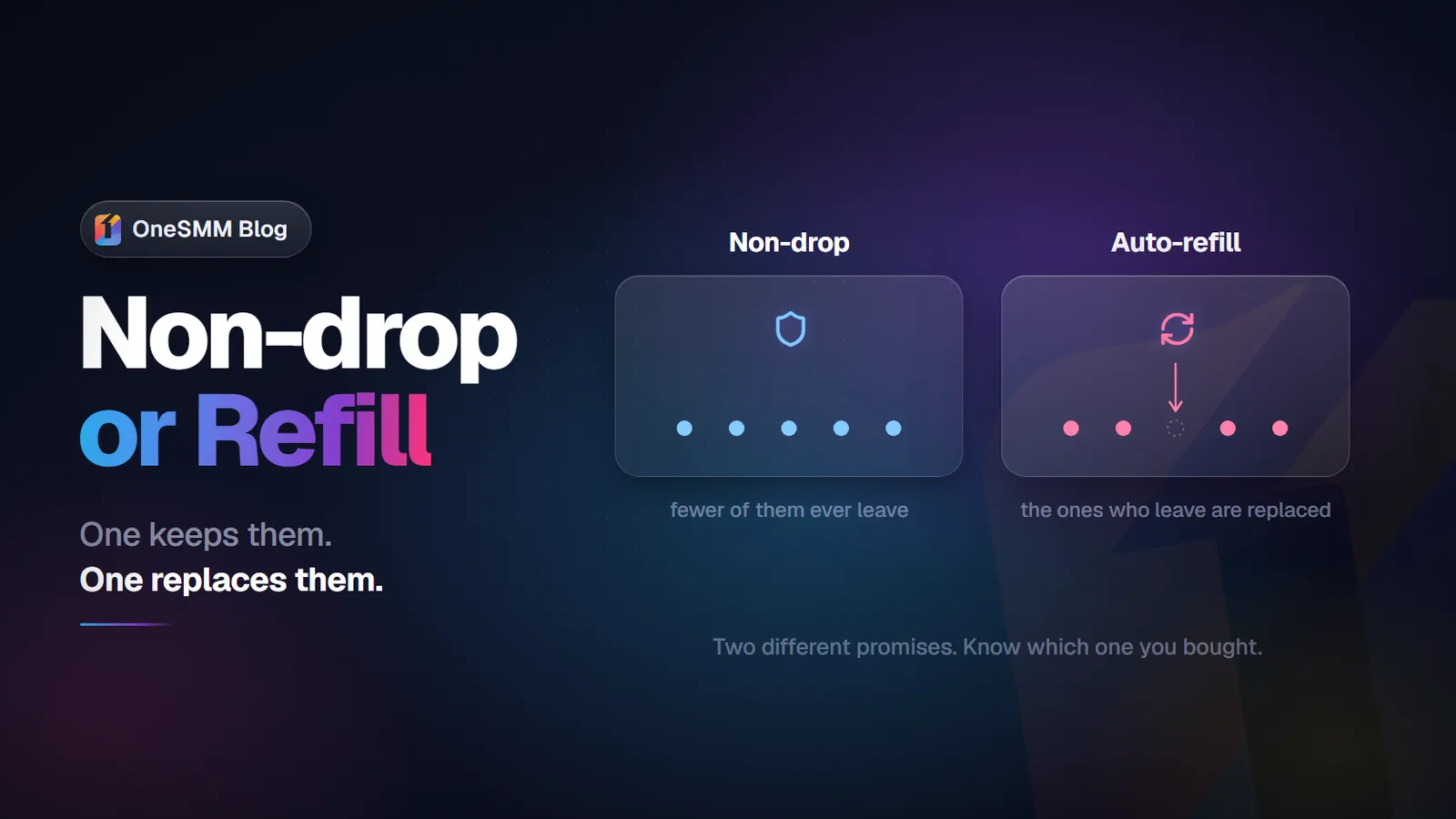
Non-drop vs auto-refill: the difference
These two terms appear in panel listings and are often confused. Our guide to automatic and manual refill terms explains what to check before relying on a refill warranty:
| Term | What it means | How it works | What to check |
|---|---|---|---|
| Non-drop | Low inherent drop rate from high-quality accounts | Members simply stay because account quality is higher | Is there a refill warranty if it does drop? |
| Auto-refill | Automatic top-up when count drops below delivered amount | Provider monitors your channel and refills proactively | How long is the warranty? 7, 14, or 30 days? |
| Manual refill | Refill available on request within warranty period | You submit a refill request when you notice the drop | Is there a response time guarantee? |
| Drop-safe | Marketing term — usually means refill-guaranteed | Varies by provider | Read the fine print for the warranty terms |
The best services combine both: high-quality accounts (non-drop) with an auto-refill warranty as a backstop. You can read how drop protection works in practice in our guide on why Telegram members drop and how to build a stable audience.
How to verify a non-drop claim before large orders
Do not take "non-drop" at face value in a listing. Verify it with this process:
- Order 200–500 members from the service listed as non-drop
- Record the subscriber count when delivery completes — note the exact number
- Check at 48 hours — drop above 5% at 48 hours indicates the service is not genuinely low-drop
- Check at 7 days — quality non-drop services retain 95%+ at one week
- Check at 30 days — if a 30-day refill warranty is claimed, verify the count again near the end of that period
- If drop occurred and the service has refill — submit a refill request and measure how long it takes and whether the count is restored fully
This verification process costs very little (a small test order) and gives you data to make a confident scaling decision. The same logic applies when evaluating any new panel for the first time, as covered in our guide on testing SMM services before committing to large orders.
When non-drop members are worth the extra cost
Non-drop services typically cost 20–50% more than economy services. That premium is worth paying in these situations:
- Established channels with an existing audience — a visible drop in subscriber count on a channel that has been stable for months is noticed by real subscribers and can damage credibility.
- Client deliverables with ongoing monitoring — if a client is watching their subscriber count and will notice drops, the refill warranty protects your reputation as a reseller.
- Channels with active post engagement — if your channel has real subscribers who engage with content, a high drop rate from economy members creates a skewed subscriber-to-view ratio that looks suspicious.
- Long campaigns requiring stable counts over 30+ days — economy services need reordering. Non-drop with refill handles this automatically.
Economy services without refill are fine for new channels, short-term campaigns, and situations where drop is either irrelevant or acceptable. For everything else, the cost of non-drop is typically offset by the cost of reordering after drop occurs. For a full breakdown of how to evaluate the true cost, see our guide on cheap Telegram subscribers and the true cost calculation.
Frequently asked questions
How long does a non-drop Telegram members warranty typically last?
Most panels offer 7, 14, or 30 days. Thirty days is the standard for services marketed as drop-protected or non-drop with refill. Some providers offer lifetime refill on premium-tier orders, though this is less common and usually comes at a higher price point.
Does non-drop mean the members will engage with my posts?
No. Non-drop refers to count stability, not activity. Members from SMM services — whether economy or premium — do not open posts, react, or forward content in meaningful numbers. Post view counts are driven by your organic audience. If you need views alongside member count, order them separately from the Telegram services catalog.
Can I get a refill if my channel goes private mid-warranty?
Typically no. Delivery requires a public channel or valid invite link. If you make your channel private during the warranty period, the provider cannot deliver refill members. Keep the channel public or accessible via the same invite link throughout the warranty period.
What happens to my non-drop members if Telegram purges bot accounts?
If the accounts that joined your channel are caught in a Telegram-wide purge, they will leave — this is outside any panel's control. Reputable providers monitor this and handle mass purge events under their refill warranty. If you experience an unusual bulk drop unrelated to your order age, contact the panel's support with your order ID and the drop count.
Drop-protected Telegram members on OneSMM
OneSMM lists non-drop and drop-protected Telegram member services with 30-day auto-refill warranty. Economy, standard, gradual, and premium HQ tiers available. No admin rights required — invite link or username only.