How Often Should You Post on a Telegram Channel?
For most non-news Telegram channels, one useful post on each planned publishing day is a sensible starting point. Daily posting can work if you can keep the standard high. If that pace forces filler, publish fewer, better posts. News, alerts, and live-event channels may need several updates a day because immediacy is part of the product.
Telegram does not publish a universal posts-per-day rule. The right cadence depends on why people joined, how quickly the topic changes, and whether readers still open, react to, share, or mute your posts. Choose a baseline you can maintain, hold it long enough to compare similar periods, then adjust one variable at a time.
Start with the channel's job
Frequency follows the promise you made to subscribers. A breaking-news channel that posts once a week is not doing its job. A weekly research digest that sends six minor updates every day is breaking its promise in a different way.
| Channel type | Practical starting cadence | What to watch |
|---|---|---|
| News, alerts, or live events | Post when a meaningful update happens. Several posts a day can be appropriate. | Notification mutes, weak late-day posts, and repeated updates that could be combined. |
| Education or expert analysis | Three to five strong posts a week, or one per day when the material supports it. | Reading depth, forwards, saves, replies, and whether quality falls as volume rises. |
| Deals, products, or service updates | Post when there is a real offer or useful change; avoid manufacturing daily promotions. | Clicks and conversions, unsubscribes after promotional runs, and offer fatigue. |
| Community companion channel | Use a predictable mix of announcements and discussion prompts. | Whether prompts lead to useful conversation in the linked group rather than noise. |
| Personal or creator channel | Choose a pace the creator can sustain without repeating the same thought. | Consistency, audience replies, and whether gaps or bursts cause weaker return visits. |
These are testing baselines, not Telegram limits. A small specialist channel may perform well with two thoughtful posts a week. A market-alert channel may need many posts during active hours. Judge the cadence against the channel's job rather than a generic social-media calendar.
Run a clean cadence test
Do not change frequency, format, topic, and promotion at the same time. You will not know what caused the result. Pick a publishing pattern, keep the content mix reasonably stable, and compare equivalent periods.
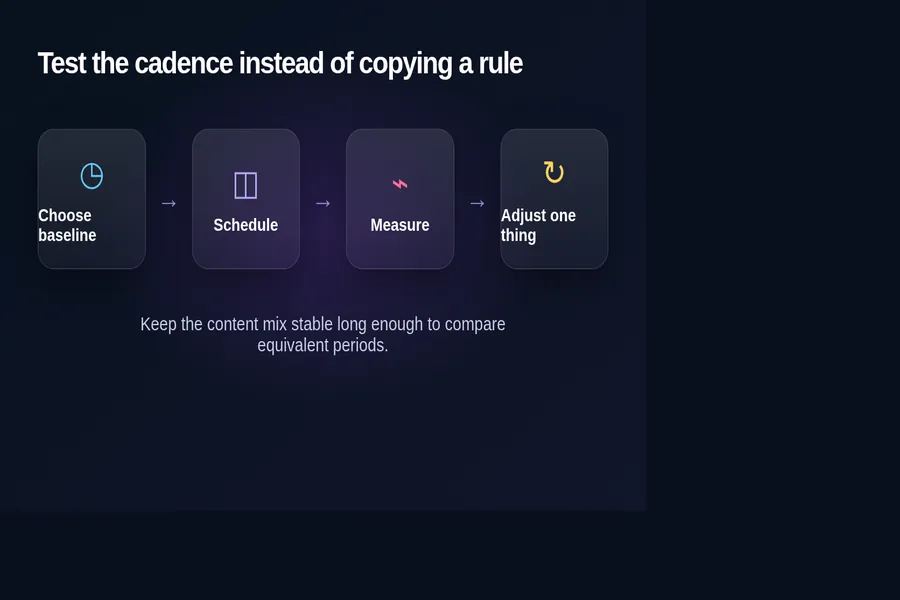
- Choose the baseline. Set the number of publishing days and the usual spacing between posts.
- Schedule the work. Telegram's official scheduling control lets you hold the Send button, choose Schedule Message, and set a future time.
- Hold the pattern. Give readers a stable experience instead of switching from silence to a burst of posts.
- Measure the response. Compare post views at the same age, shares, reactions, link actions, joins, leaves, and notification mutes when those statistics are available.
- Change one thing. Add or remove a publishing slot, then repeat the comparison.
Comparing views after the same amount of time matters. A post published yesterday has had longer to collect views than one published an hour ago. The same principle applies to weekday versus weekend posts and promoted versus unpromoted posts.
Watch for frequency that is too high
More posts can raise total output while lowering attention per post. A 2025 Postmypost article reported that later posts in a day often received fewer views as daily frequency increased. The article does not disclose enough sampling detail to turn its exact percentages into a universal benchmark, but the pattern is worth testing on your own channel.
- Later posts repeatedly receive much weaker reach than the first post of the day.
- Subscribers mute notifications or leave during high-volume periods.
- Several posts repeat one idea that would work better as a single edited update.
- Your team fills slots with weak material because the calendar demands it.
- Important posts are buried before readers have had time to see them.
Watch for frequency that is too low
Posting less is not automatically better. A channel can become easy to forget when weeks pass without useful material, especially if its description promises regular news or offers.
- The channel looks abandoned to a new visitor.
- Time-sensitive information arrives after it is useful.
- You promote the channel while the recent feed gives people little reason to join.
- Every post has to reintroduce the channel because there is no familiar rhythm.
If capacity is the problem, narrow the content plan before adding volume. One repeatable format, such as a weekly market note or a practical checklist, is easier to sustain than an ambitious calendar full of unrelated post types.
Separate timing from frequency
Posting at the right time cannot rescue an unnecessary post, and a strong post does not require a mythical universal hour. Frequency asks how often; timing asks when your audience is available. Test them separately.
Use the method in our best time to post on Telegram guide to choose time windows from your audience and channel data. Then use the Telegram channel analytics guide to compare growth and post-performance signals.
Build a schedule your team can maintain
A realistic cadence includes production time. Count research, writing, editing, design, approval, and moderation. Agencies should also define who can change a scheduled post and who checks replies after publication.
A simple weekly planning routine
- List the few topics that genuinely need a post this week.
- Choose the strongest format for each topic instead of forcing every idea into text.
- Place the important posts first and leave room for timely updates.
- Schedule completed work, but review time-sensitive details before it goes live.
- At the end of the period, keep, remove, or move one publishing slot based on evidence.
Growth services do not solve a weak publishing rhythm. Extra members or views cannot make repetitive posts useful, and promotion is easier to waste when a visitor opens the channel and sees an erratic or empty feed.
Sources: Telegram's official Scheduled Messages announcement and Channels tour; Postmypost's 2025 posting-frequency observation. OneSMM treats the third-party figures as directional, not a universal Telegram rule.