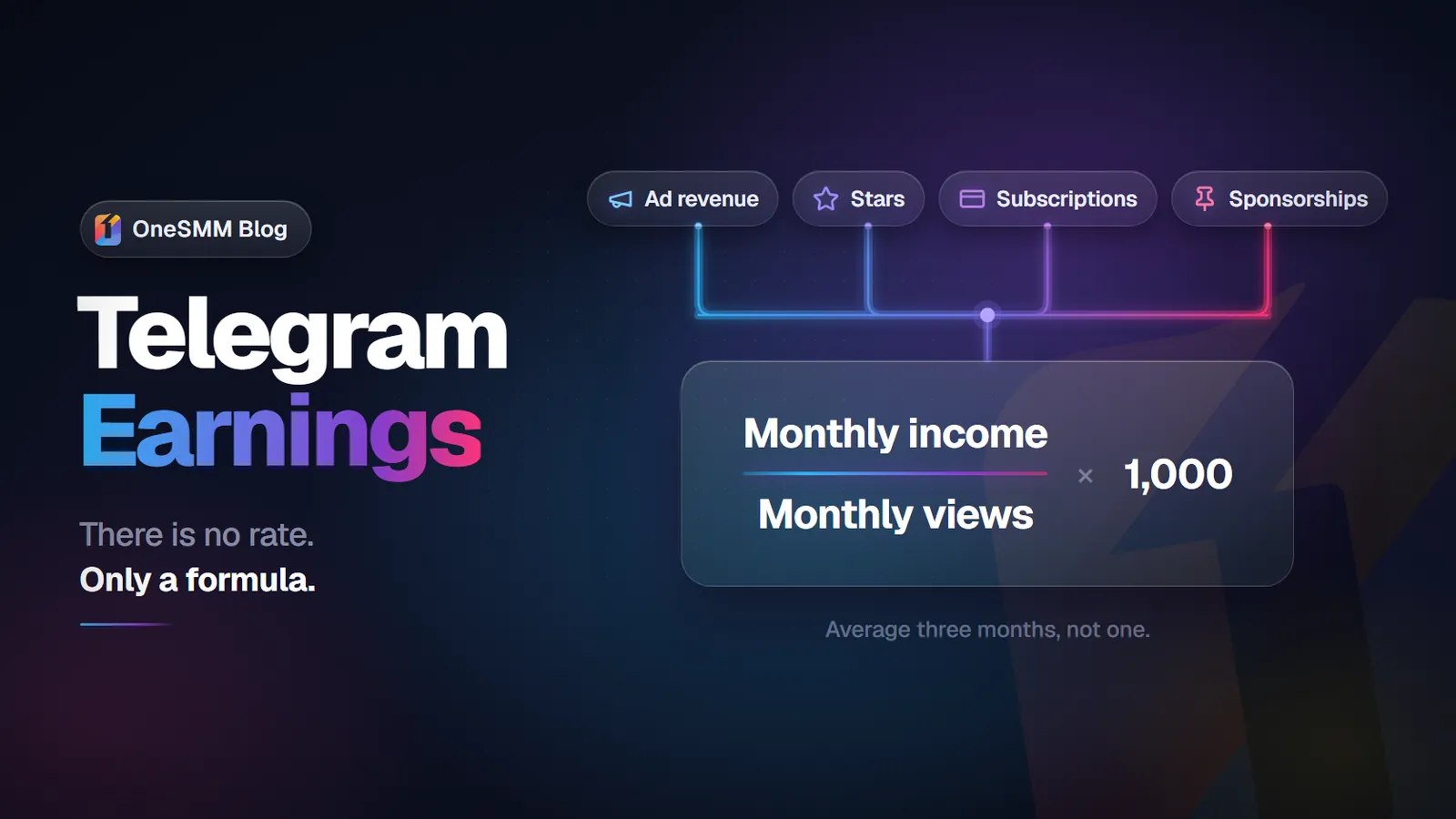
How Much Can a Telegram Channel Earn Per 1,000 Views?
There is no Telegram equivalent of a YouTube RPM. Telegram does not pay channel owners per post view, and no official "earnings per 1,000 views" rate exists. What does exist is a set of income lines that you can measure against your view count — which turns "how much per 1,000 views" into a number you calculate for your own channel rather than one you look up.
This guide covers the one rate Telegram actually publishes, the four ways channels earn, and the formula that turns your own numbers into a per-1,000-views figure you can trust.
Video summary

The only payout rate Telegram publishes
Telegram's official channel monetization program shares ad revenue with channel owners. Two figures come straight from Telegram's own announcement:
- 50% of the revenue from ads displayed in your channel goes to you.
- Your public channel needs at least 1,000 subscribers to qualify.
- Withdrawals are handled through Fragment.
Notice what that 50% is a share of: revenue from sponsored messages shown in your channel. It is not a payment per post view. Two channels with identical view counts can earn very different amounts depending on how many sponsored messages are served to their audience and what advertisers pay to reach that audience.
The short answer: anyone quoting you a fixed dollar figure per 1,000 Telegram views is guessing. The honest answer is a formula, not a rate — and the rest of this article is that formula.
Why "per view" is the wrong unit on Telegram
On YouTube, a view triggers an ad impression, and the ad impression triggers a payment. The chain is direct. On Telegram the chain is broken in two places.
First, a post view is not an ad impression. Someone can scroll your channel, read ten posts, and never be served a sponsored message. Second, most Telegram income does not come from Telegram at all — it comes from deals you arrange yourself, where the buyer cares about your audience, not your view counter.
That is why channels with 50,000 views per post sometimes earn less than channels with 5,000. The smaller channel may sit in a niche where one subscriber is worth far more.
The four income lines behind the number
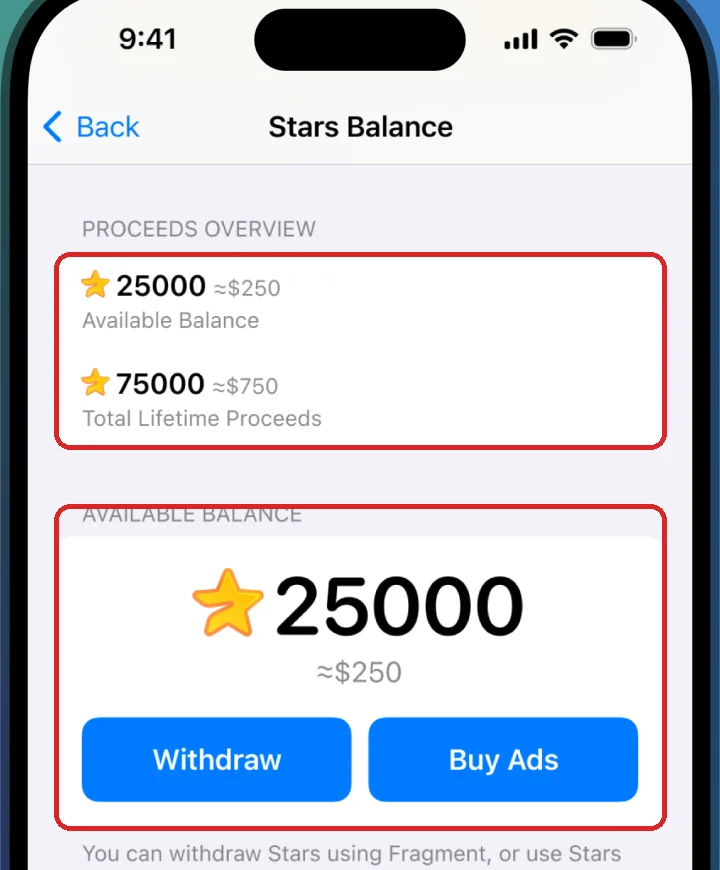
1. Telegram ad revenue share
Passive, requires 1,000+ subscribers, and pays 50% of ad revenue earned in your channel. It is the only line where Telegram itself is the payer. Treat it as a baseline, not a plan.
2. Telegram Stars on locked posts
You can put an individual post behind a Stars paywall so readers unlock it one at a time. This scales with how badly people want that specific post, not with how many people saw it.
3. Paid subscriptions
A recurring monthly charge for a private channel. This is the most predictable line of the four because it decouples income from view volume entirely — a thousand loyal members can out-earn a hundred thousand passive ones.
4. Direct sponsorships
You sell a post to a brand yourself. Rates are negotiated, and the leverage is your audience quality — niche, country, and how often your readers actually act on what you post. For most mid-size channels this is the largest line.
The formula
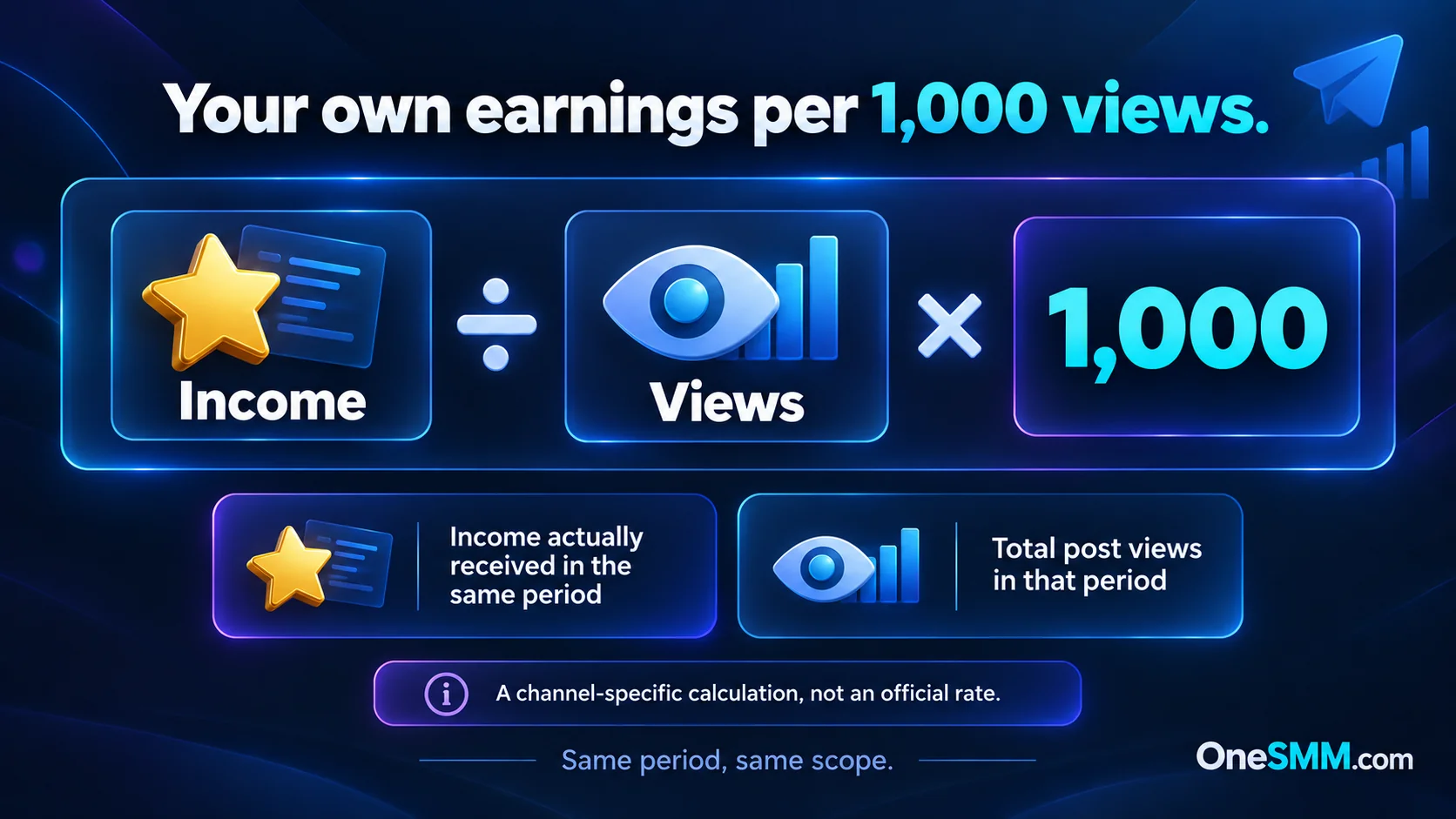
Once you know what you earned, the per-1,000-views figure is arithmetic:
Earnings per 1,000 views = (total monthly income ÷ total monthly post views) × 1,000
Work it in three steps:
- Total monthly views. Open Channel Statistics and add up the view counts of every post you published this month. Use the real number, not your subscriber count.
- Total monthly income. Add all four lines above for the same month. Count money received, not money promised.
- Divide and multiply. Income divided by views, times 1,000.
Run this for three consecutive months before you trust the result. A single sponsored post can double a month and make the figure meaningless. The three-month average is the number you can plan against — and it is the number to quote when a sponsor asks what a post in your channel is worth.
If you would rather not do the arithmetic by hand, the free Telegram revenue estimator walks through the same inputs, and the campaign ROI calculator does the reverse: what a given spend needs to return to break even.
What actually moves the number
Niche. A finance or B2B software channel commands sponsor rates a general meme channel never will, at identical view counts. This single factor swings the result more than anything else on this list.
Country. Advertisers pay very differently to reach different markets. A channel whose audience sits in a high-spend market earns more per view than one with the same reach spread thinly across many countries.
Action rate. Sponsors renew when their link gets clicks. Views are what you sell the first time; clicks are what you sell the second time.
Publishing rhythm. Total monthly views is posts multiplied by views per post. Channels that post more often have a larger denominator, which pushes the per-1,000 figure down even when total income goes up. That is not a problem — it just means the metric rewards concentration, so compare yourself against yourself, not against channels with a different cadence.
Watch the denominator. Anything that inflates views without adding people who might buy, subscribe, or click will lower your earnings per 1,000 views. The metric is a ratio, and padding the bottom half makes it worse, not better.
Where paid growth fits — honestly
Buying views does not create income. It creates a bigger denominator. Used carelessly it makes your channel look worse to a sponsor who checks engagement rate rather than raw reach.
Where paid services genuinely help is earlier in the chain: crossing the 1,000-subscriber threshold that unlocks ad revenue share, giving a new channel enough social proof that organic joiners do not bounce off an empty room, and keeping a member count stable while you build the content that retains people. That is a starting push, not a business model.
If you go that route, the two things that decide whether it helps or hurts are retention and refill. Members who drop out within a week leave you with the inflated denominator and none of the audience. Our guides on verifying non-drop claims and why members drop cover how to check before you spend, and what "real" actually means is worth reading before any first order.
So what is the answer?
For your channel, it is whatever the three-month average of that formula says. For Telegram in general, there is no single figure — and any article that hands you one without asking about your niche, your country, and your income mix is selling confidence rather than information.
The useful move is to run the calculation this month, write the number down, and run it again in ninety days. If it went up while your view count stayed flat, you are building an audience worth reaching. That is the only direction that matters.
Ready to cross 1,000 subscribers?
Ad revenue share only unlocks at 1,000. OneSMM runs Telegram-only services from $0.01 per 1K with 30-day refill — no password required, only your channel username.