How to Write a Telegram Channel Description That Helps People Join
By Ashkan — Telegram Growth Team
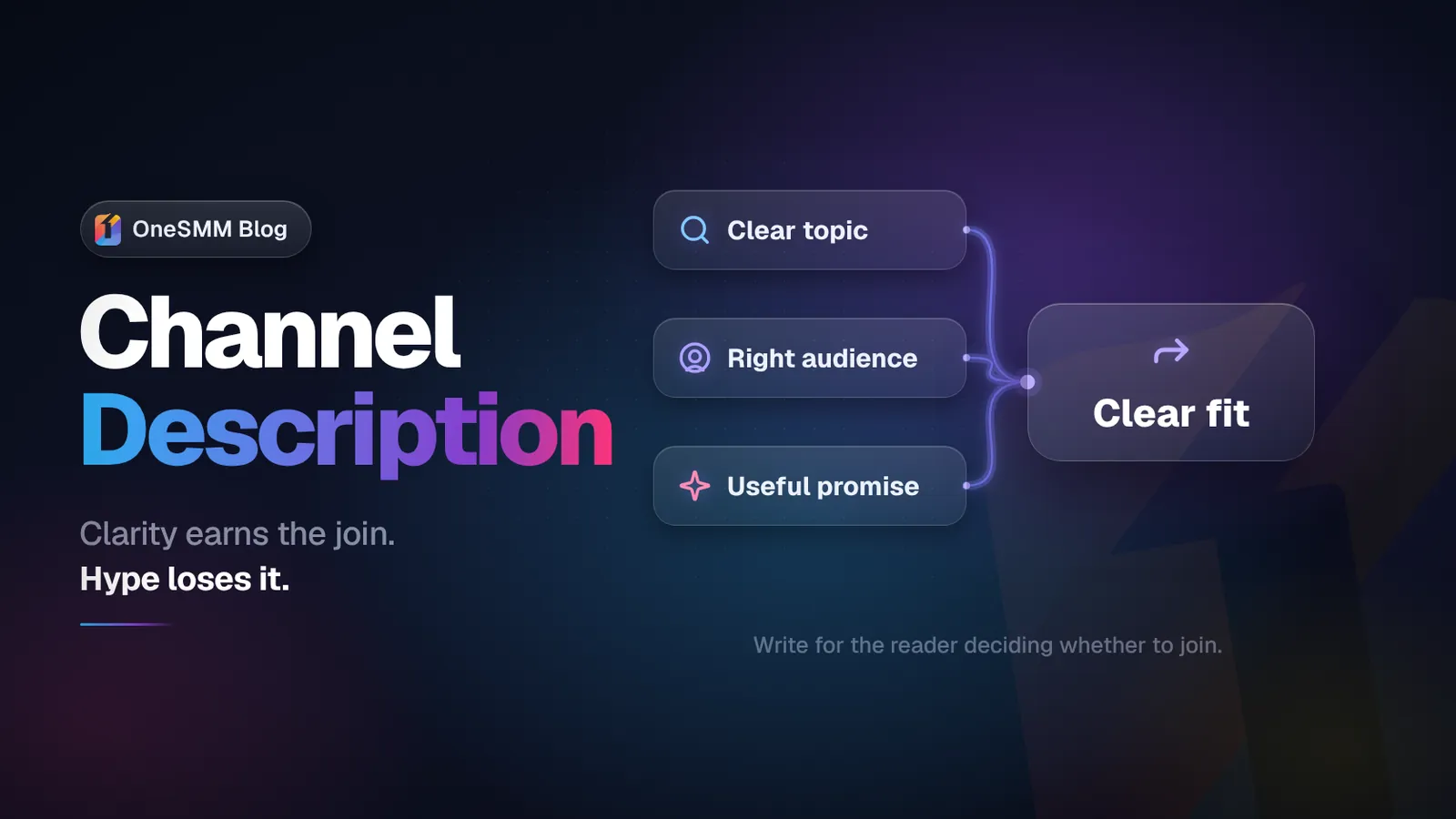
A useful Telegram channel description tells a visitor what the channel covers, who it serves, and what they will receive if they join. Write those answers before you add emojis, slogans, links, or search phrases. A short, specific description is more useful than a crowded one that makes several promises without explaining the channel.
Start with one plain sentence: “Practical bookkeeping guidance for UK freelancers, with weekly tax reminders and worked examples.” A stranger can identify the topic, audience, and expected content without reading a pinned post. That clarity is the job of the description.
Give each channel field one job
Your channel name, username, description, and pinned message should work together rather than repeat the same phrase. Telegram's public-link settings explain that a public channel can be found in search and joined by anyone, while its deep-link documentation uses the public username in the channel's link.[1][2] Telegram does not publish a complete public formula for ordering channel search results, so no wording can guarantee placement.
| Field | Primary job | What to avoid |
|---|---|---|
| Channel name | Identify the subject quickly while preserving the brand people already know. | A clever label that gives a new visitor no clue about the topic. |
| Username | Create a readable public handle and shareable Telegram link. | Extra punctuation, hard-to-hear spelling, or a handle unrelated to the channel. |
| Description | Explain the topic, audience, useful outcome, and any important expectation. | A keyword list, unsupported authority claims, or promises the posting schedule cannot keep. |
| Pinned message | Handle the detail that does not fit in the description: rules, navigation, resources, or a fuller welcome. | Repeating the description word for word. |
If the username is still undecided, check whether the handle is available with the free Telegram username checker. Keep the broader discovery plan in the guide to how people find Telegram channels.
Write the description in four passes
State the topic in ordinary language
Use the words your intended reader uses. “Daily football transfer news for Arsenal supporters” is clearer than “Your home for everything that matters.” Specific language helps a visitor understand the channel even if it does not change search visibility.
Name the intended audience
A description can filter as well as attract. “For first-time Etsy sellers” signals a different level from “For established ecommerce teams.” This prevents the channel from sounding broad while publishing for a narrow group.
Promise only the content you actually publish
Describe the recurring value: market summaries, local alerts, short tutorials, product updates, or moderated discussion. Mention a cadence only when the channel follows it. “Every weekday” becomes a trust problem when posts arrive twice a month.
Add one useful expectation or next step
A public news channel may name its source policy. A learning channel may point to a pinned curriculum. A business channel may direct support questions to an official account. Use one next step, not a row of links competing for attention.
Use a compact description template
Draft with this structure, then remove any part the reader does not need:
[Topic] for [audience]. [What you publish and why it helps]. [Cadence or expectation, only if true]. [One next step].
Here are three examples written for different channel jobs:
- Local updates: “Road closures, council notices, and weekend events for Bristol residents. Sources are linked in each post. Start with the pinned weekly guide.”
- Professional education: “Short Excel lessons for finance teams, with downloadable examples and one practical exercise each week.”
- Product updates: “Release notes and maintenance notices for Acme Cloud customers. For account support, use @AcmeSupport.”
These examples are templates, not evidence of real channels. Replace the audience, content, cadence, and contact route with facts you can maintain.
Edit vague wording until a stranger can predict the next post
A useful test is whether someone can guess what the next few posts will contain. If they cannot, the description is probably about the brand's aspirations rather than the channel's content.
| Vague draft | Clearer rewrite | Why the rewrite helps |
|---|---|---|
| “The best place for business growth.” | “Pricing, hiring, and cash-flow lessons for independent design studios.” | It identifies the subjects and the audience without an unsupported “best” claim. |
| “News, tips, updates and more.” | “Daily Android app updates, security notices, and short setup guides.” | The visitor can predict the content and decide whether it fits. |
| “Join our amazing community.” | “Peer discussion for junior data analysts. Portfolio feedback on Fridays; job spam is removed.” | It explains who participates and what behaviour to expect. |
Use keywords for clarity, not repetition
Include the central topic when it belongs naturally in the sentence. A channel about remote accounting jobs should say “remote accounting jobs,” not rotate through every variation of jobs, vacancies, careers, hiring, and work. Repetition makes the description harder to read and cannot guarantee discovery.
Keep the channel name, username, and description aligned around the same subject. If the name says “Manchester Food Deals,” the description should not suddenly position the channel as a national restaurant-industry newsletter. Search wording cannot repair a mismatch between the identity fields and the posts.
Review the description on a phone after saving. Check the first line, link readability, line breaks, and any emoji. An emoji should label a real category or action; decoration that pushes the subject out of view is not helping.
Check the channel before sending more traffic
The description is one part of the visitor's decision. Recent posts, posting consistency, public view counts, reactions, and the pinned message all affect whether the promise looks credible. Run the free Telegram channel audit for a public-channel check, then confirm the result with Telegram's own administrator statistics when those reports are available.
Before changing the description, save the current wording and a dated baseline. After the change, compare equivalent periods and keep promotion activity in the record. A change in joins may coincide with new wording, but that alone does not prove the description caused it.
If a paid growth test fits the channel after the identity and recent content are ready, read the current conditions in the live OneSMM service catalog. The description should set an honest expectation before any visitor arrives; promotion cannot compensate for an unclear channel.
Final review checklist
- The first sentence names the topic without relying on the channel name.
- The intended reader can tell that the channel is for them.
- Every cadence, credential, result, and access claim is true today.
- The description is not a list of search phrases.
- The username and public link are readable when spoken or typed.
- Detailed rules and navigation live in the pinned message when they do not fit cleanly.
- There is one clear next step, or none when the description already does its job.
Open the description without the channel title and read it as a stranger. If you still know what the channel publishes, who it helps, and what to do next, the wording is ready.