How to Monetize a Telegram Channel in 2026
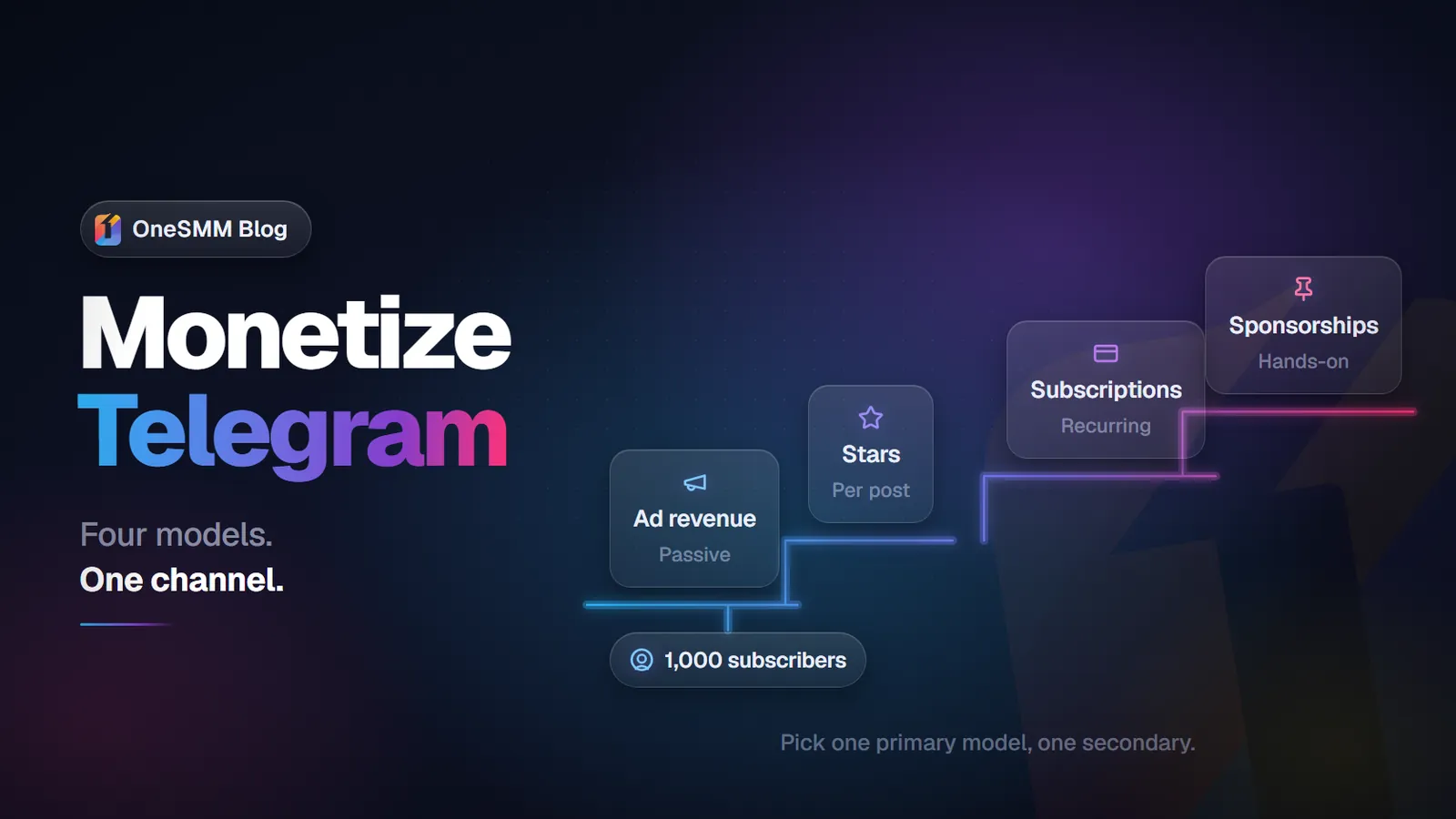
Monetizing a Telegram channel is less about unlocking a hidden feature and more about picking the model your audience will actually pay for. There are four, they suit very different channels, and only one of them is paid by Telegram itself.
This guide covers what each model requires, what it realistically returns, and how to tell which one fits the channel you have today rather than the one you hope to have.
Video summary

First: the 1,000-subscriber gate
Telegram's own revenue-share program has a hard entry requirement. From Telegram's announcement: channel owners receive 50% of the revenue from ads displayed in their channels, and the channel must be public with at least 1,000 subscribers. Withdrawals run through Fragment.
Below 1,000 subscribers, that door is closed — but the other three models have no threshold at all. A 300-member channel can sell a subscription or a sponsored post today. Do not treat 1,000 as a starting line for monetization in general; it is the starting line for one specific model.
Model 1: Telegram ad revenue share
Effort: near zero. Control: near zero. Ceiling: low.
Once you qualify, Telegram serves sponsored messages to your channel and splits the revenue with you. You can restrict which ad categories appear, which matters if you run a channel where certain advertisers would embarrass you.
The appeal is that it needs no selling and no relationship management. The limit is that you do not set the price. Your earnings track how much advertisers are willing to pay to reach your audience, which is mostly a function of your niche and your readers' countries — neither of which you can change quickly.
Treat this as a floor. It is the money that arrives whether or not you do anything, and for most channels it will not be the largest line.
Model 2: Telegram Stars on locked posts
Effort: per post. Control: high. Ceiling: depends entirely on demand for the specific post.
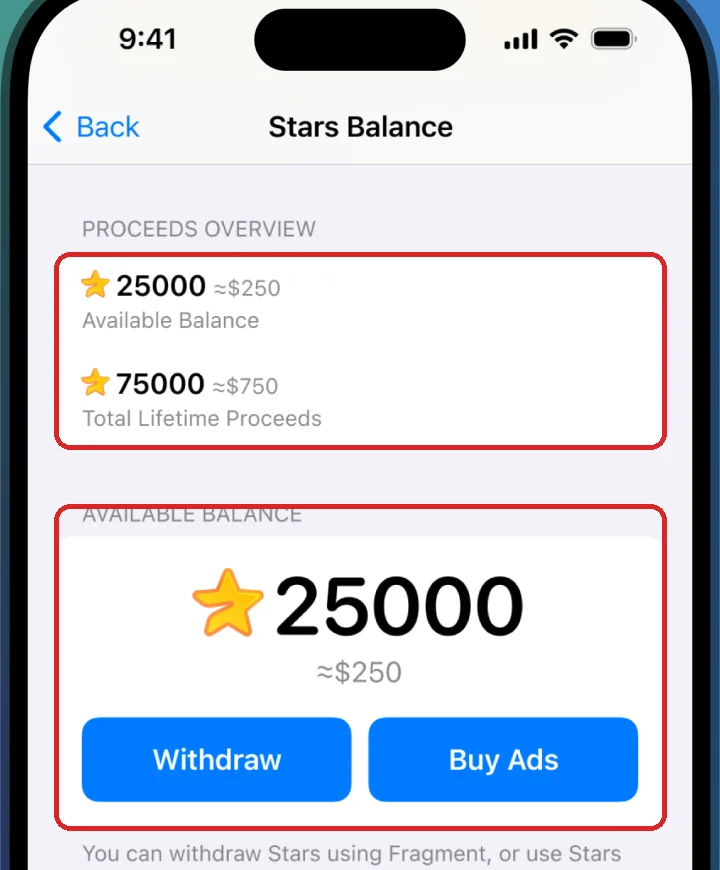
Stars are Telegram's in-app currency. You can put an individual post behind a Stars paywall so readers pay to unlock that one piece of content. For the difference between purchased balances, creator revenue, gifting, spending, and withdrawals, see the Telegram Stars guide.
This works when a post has standalone value someone would pay for on the spot — a data set, a full analysis, a template, a leak-of-the-week. It does not work for commentary, because nobody pays to unlock an opinion they cannot preview.
The practical lesson from channels that use this well is that lower prices unlocked far more often beat higher prices unlocked rarely. Price to be an impulse, not a decision.
Model 3: Paid subscriptions
Effort: ongoing. Control: high. Ceiling: the most predictable of the four.
You run a private channel and charge a recurring monthly fee for access. The public channel becomes the funnel; the private one becomes the product.
This is the model that decouples income from reach. A thousand people who pay every month are worth more, and are far easier to plan around, than a hundred thousand who scroll past. It is also the only model where your income does not collapse the month you stop posting to the public channel.
What it demands in return is a promise you can keep every single month. Subscription churn is brutal when the private channel goes quiet for two weeks. Before launching one, be honest about whether you can sustain the cadence — the failure mode is refunds and public complaints, not just lost income.
Model 4: Direct sponsorships
Effort: high. Control: total. Ceiling: highest of the four.
You sell a post directly to a brand at a price you negotiate. For most mid-size channels this ends up being the biggest line by a wide margin, because you capture the full amount instead of a share, and because you can price on value rather than on impressions.
What sponsors actually buy is not your view count. It is evidence that your readers act. Come prepared with:
- Views per post, averaged over the last 30 days — not your best post.
- Audience country breakdown from channel statistics.
- Click-through evidence from a previous placement, even an unpaid one.
- A clear, single-sentence description of who your readers are.
That last one closes more deals than any number. "Fourteen thousand self-hosting sysadmins in Germany" sells; "14k tech channel" does not.
Which model fits your channel
- Under 1,000 subscribers: sponsorships or a small subscription. Ignore ad revenue share until you qualify.
- Broad-interest channel, large but shallow: ad revenue share plus occasional sponsorships. Subscriptions rarely convert here.
- Narrow niche, smaller but engaged: subscriptions first, sponsorships second. This is where per-reader value is highest.
- Original research or data: Stars on locked posts, because the content has standalone value.
Do not stack all four at once. A channel running ads, paywalled posts, a subscription pitch and a sponsored placement in the same week reads as a billboard. Pick one primary model and one secondary.
What quietly kills monetization
Every model above is priced off audience quality, and three of the four involve a human on the other side who will check your channel before paying.

A sponsor comparing two channels with 20,000 members each will look at views per post. If one shows 800 views on a 20,000-member channel, they will assume the members are not real and move on — and they will usually be right. Inflated membership does not just fail to help here; it actively costs you the deal.
The same logic applies to subscriptions. People decide whether to pay based on whether the free channel feels alive: recent posts, real reactions, comments that read like people. None of that comes from a member counter.
If you do use paid growth to get off the ground — which is reasonable, especially to clear the 1,000-subscriber gate — the things that decide whether it helps are retention and refill, not price. Read what "real" actually means and how to test a service before paying first, and keep the growth proportionate to your view count so the ratio stays believable. Pricing for every Telegram service sits on the Telegram SMM panel, and Telegram members is the page most channels start from when clearing the 1,000 gate.
A sensible order of operations
- Get the channel to a state where a stranger would subscribe after reading three posts.
- Reach 1,000 subscribers and switch on ad revenue share. It is free money and requires nothing further.
- Run one unpaid or cheap sponsored placement and measure clicks. That number becomes your sales pitch.
- Once you have a repeatable posting rhythm, launch a subscription — not before.
- Use Stars for individual high-value posts as they arise.
Most channels that fail to monetize did not pick the wrong model. They tried to sell access to an audience that had not yet been given a reason to care. Fix that first; the rest is mechanics.
Need to clear the 1,000-subscriber gate?
OneSMM is Telegram-only: members, views, reactions and premium, from $0.01 per 1K with 30-day refill. No password required — just your channel username.