Country-Targeted Telegram Members: When Location Matters
Country-targeted Telegram members are accounts supplied from a service pool labelled for a particular market. That label can be useful when your channel serves one country, but it does not prove that every delivered account currently lives there, speaks the same language, or will read your posts.
Choose this type of service only when the exact listing names the country, explains what the label means, supports your channel or group link, and gives you terms you can verify after delivery. If geography is not part of the campaign, a broader member tier is usually easier to test and compare.
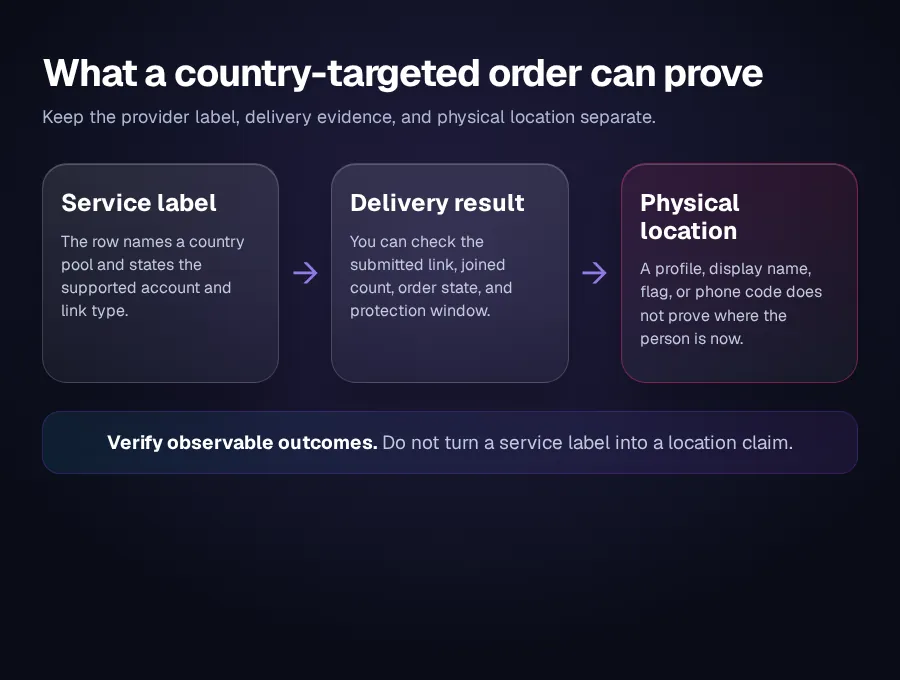
Start with the limit: a country label is not live location
Telegram accounts are created with phone numbers, but a phone number's country code is not the same as a person's current residence. People keep numbers after moving, use travel or business SIMs, and may choose any display name. Telegram's own privacy-label explanation says display names are not verified and location is not shared by default.
Telegram can process location when a user actively shares Live Location or enables a nearby-discovery feature. That private, conditional signal is not a public field that a channel owner can inspect for every subscriber. A country-targeted service therefore needs an honest operational definition, such as accounts or numbers assigned to the named market. It should not be presented as GPS verification.
Country, language, Premium status, and interest are separate attributes
A buyer can easily combine four different questions into one. Keep them separate:
| Attribute | What the listing may specify | What you should not infer |
|---|---|---|
| Country | A named account or phone-number pool tied to a market. | Current residence, citizenship, or precise physical location. |
| Language | A separate language-labelled pool when the service explicitly says so. | That every account reads or prefers the country's dominant language. |
| Premium status | Accounts that the service row describes as having Telegram Premium for a stated plan or guarantee window. | Organic interest, post reading, reactions, or comments. |
| Membership | Accounts joining the submitted channel or group through the supported link type. | That they will become customers, remain forever, or engage with future posts. |
When location targeting is worth the extra constraint
A country-specific pool makes the most sense when the visible audience mix affects a real decision. A local news channel may want its early member list to resemble the market it covers. A regional business directory may need a country-labelled test before it spends on broader promotion. An agency may also have a client brief that names an exact market.
The label matters less for a global crypto community, an English-language resource with readers in many countries, or a new channel that only needs a stable starting count. In those cases, narrowing the pool can add another variable without solving the main growth problem.
Country targeting also does not replace distribution. If you need people who are actually interested in the subject, use content, partnerships, search-friendly channel naming, ads, or community promotion to recruit them. A member service supports visible scale; it does not create audience intent.
Read the exact service row, not the category name
OneSMM's live catalog currently has a dedicated country-targeted Premium members category with individual market rows. The rows are not interchangeable. They can differ in minimum quantity, Premium-plan duration, guarantee wording, and whether public and private links are accepted.
That means “country-targeted members available” is not enough information to place an order. Before paying, record these fields from the selected row:
- Named country or market: confirm the row names the place you need. “Worldwide,” “mixed,” and a specific country are different products.
- What is targeted: look for a clear statement about the account or number pool. Do not supply your own definition.
- Premium plan: if Premium matters, note the plan duration and the period the listing actually guarantees that status.
- Supported destination: check channel versus group support and whether the row accepts a public username, a private invite link, or both.
- Quantity and order controls: save the current minimum, maximum, start notes, cancellation status, and refill or replacement terms.
Service catalogs change. The current OneSMM catalog is the source for today's row-level terms; this article explains how to interpret them without freezing volatile prices or limits into the guide.
Public and private links need different checks
A public channel or supergroup can use a public username and a t.me/... link. A private destination uses an invite link. Telegram's official invite-link documentation shows that private links can have expiration dates, usage limits, revocation, or join-request approval.
If the service accepts private links, create a link that remains valid for the expected delivery window and does not run out of uses before the order finishes. If the link requires admin approval, the service row must support that flow. Otherwise, pending requests are not completed membership.
Never submit a Telegram password, login code, or session. A member order should need only the supported channel or group destination. The Premium versus regular members guide covers the separate question of account capability; the link requirement still comes from the exact service row.
How to run a clean country-targeted test
- Save the baseline. Record the current member count and the exact service row before ordering.
- Use a small valid quantity. Stay within the row's live minimum and choose the smallest test that can answer your question.
- Keep the destination stable. Do not change the public username, revoke the private invite, or start a second order on the same destination during the test.
- Verify membership delivery. Compare the count before and after, the order quantity, and the order's final status.
- Inspect only observable attributes. If visible profiles or Premium badges are part of the specification, sample them. Do not claim nationality or residence from a display name, flag, bio, or phone code.
- Track retention separately. Recheck the count during the stated guarantee or refill window. Country fit and retention are different questions.
For a broader test protocol covering delivery, status, drops, and support evidence, use the guide to testing Telegram growth services before scaling.
What you can verify after delivery
A useful audit sticks to evidence the buyer can actually observe. You can verify the selected service row, submitted link, ordered quantity, delivered count, order state, visible Premium badges where relevant, and whether the result persists through the listed protection window.
For private invite flows, Telegram's API model also distinguishes the invite used, join date, request status, and approval information. Those fields can establish how an account joined. They still do not expose the person's live location.
If country fit is commercially important, ask the provider what signal defines the pool and keep that answer with the order record. A vague answer such as “targeted users” is weaker than a row that names the country, account type, link support, and guarantee terms.
Common mistakes that make the result impossible to judge
- Ordering a worldwide row and expecting a country-specific result because the channel content is local.
- Treating a flag or display name as proof. Telegram does not verify display names, and profile styling is not location evidence.
- Mixing language with geography. A country may have several major languages, while one language may span many countries.
- Running several member orders together. You lose the ability to attribute the visible result to one service.
- Changing the invite link mid-order. Expired, revoked, capped, or approval-gated links can interrupt delivery.
- Judging engagement from the member count. Membership, views, reactions, comments, and sales are separate outcomes.