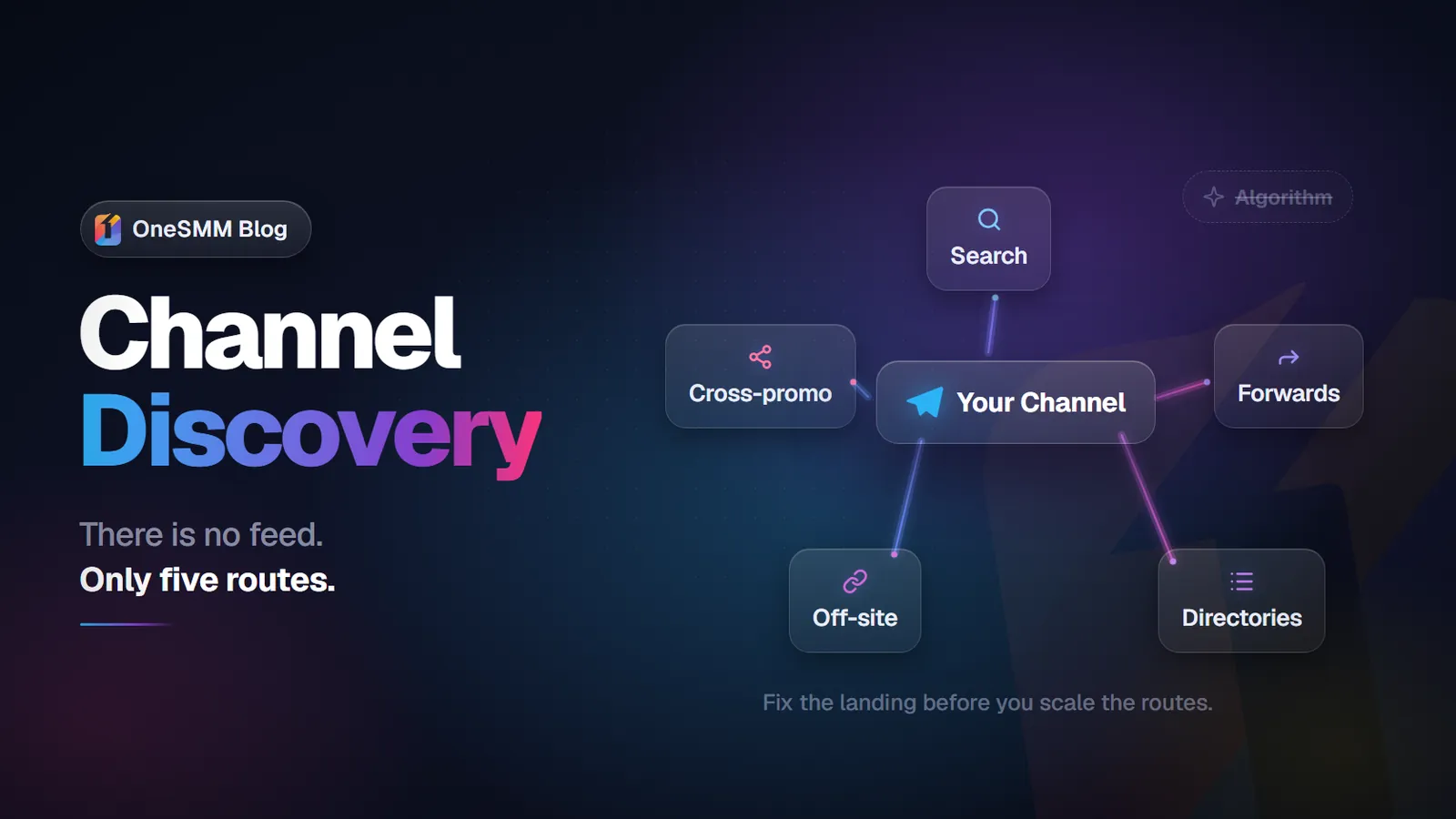
How People Actually Find Telegram Channels (There Is No Feed Algorithm)
People arrive at Telegram from platforms where a recommendation engine decides who sees what, and they ask the same question here: how do I get the algorithm to show my channel to more people?
Telegram does not have a TikTok-style discovery feed that continuously distributes public-channel posts to strangers. But it does have discovery surfaces: search, Similar Channels, forwards, mentions, paid placements and links from outside Telegram. Telegram says Similar Channels are selected automatically for public channels based on similarities in their subscriber bases. Telegram’s Similar Channels announcement explains where that recommendation appears.
Discovery is still more route-based than feed-first. You can improve the fields people search, the content they forward, the places that mention you and the destination experience after someone arrives. Similar Channels is the exception: Telegram chooses those recommendations, so treat it as a surface to observe rather than a ranking you can guarantee.
Route 1: Telegram search
People search inside Telegram for topics the way they search a directory. What they match against is limited — principally your channel name, your username, and your description. Your post content is not a meaningful search surface for non-members.
This makes the name field disproportionately valuable. "Daily Alpha" tells search nothing. "Daily Alpha — Solana Trading Signals" can be found by someone typing "solana signals". You are not writing a brand mark; you are writing the only line a search engine has to work with.
Two practical notes: pick a username that is readable and typeable, because it is also what people paste into chats, and check availability before you settle on a name — the free username checker saves the false start. Then use the Telegram channel description guide to turn the topic, audience, and content promise into clear copy.
Route 2: Forwards
This is the largest organic engine on Telegram by a distance. Someone reads your post, forwards it to a group or another channel, and everyone who sees the forward sees your channel name attached to it.

Forwards are Telegram's version of virality, and unlike an algorithm they are entirely content-driven. Posts that get forwarded tend to share three traits:
- They stand alone. A post that only makes sense if you read yesterday's post cannot travel.
- They are useful or surprising in the first two lines. The forwarder is vouching for you; they will not forward something that needs explaining.
- They are self-contained in one message. A thread of five messages loses four of them on forward.
If you write one post a week engineered to be forwardable rather than seven engineered to fill a schedule, your discovery improves more than any other single change.
Route 3: Mentions, cross-promotion and sponsored messages
Another channel can link to yours through a direct paid placement or a mutual swap. Telegram also has an auction-based sponsored-message system with its own creative, destination and review rules. If you are comparing that route, use the Telegram advertising guide to separate official sponsored messages from deals negotiated directly with channel owners.
The failure pattern is swapping with anyone who says yes. A promotion into an unrelated audience produces a spike of joiners who never read a post and leave within days, and it teaches you nothing. The useful version is narrow: channels adjacent to yours, similar in size, where you would genuinely subscribe to their content yourself.
Check the partner the way a buyer would — views per post against member count. A channel with 40,000 members and 900 views per post will not send you real people, because it does not have them.
Before you agree to a placement, use the Telegram channel analytics checklist to compare ordinary reach, audience language, traffic sources, reader response and one trackable campaign outcome.
Route 4: Off-platform links
Every place you already exist can point at the channel: a website, a video description, a bio on another network, an email signature, a printed sticker. This route is underrated because it requires no permission from anyone.
It is also the route with the highest intent. Someone who taps a Telegram link from your website already knows who you are and has decided to hear more. Those subscribers retain far better than any promotion-sourced joiner.
Two things make it work: a clean invite link and, for anything physical or on-screen, a scannable code. Both are free — the invite link generator and the QR code generator handle both in a few seconds.
Route 5: Directories and catalogs
Third-party sites list Telegram channels by category. Quality varies enormously and most send very little, but the good ones cost nothing but a submission. Treat this as a background task, not a strategy.
Where social proof fits
None of the five routes bypass the moment that actually decides your growth: a stranger has landed on your channel and is deciding whether to tap Join.
They are looking at three things — recent posts, member count, and whether posts have views and reactions. A channel with 30 members and no reactions reads as abandoned no matter how good the writing is, and the visitor leaves. This is the real reason early-stage channels stall: the discovery routes work, and the landing converts at nearly zero.
The order matters. Fix the landing before you scale the routes. Driving traffic into a channel that looks empty just burns the traffic — and, if it came from a cross-promotion, burns the relationship too.
Diagnosing which route is broken
Telegram's channel statistics break new subscribers down by where they came from. That report is the diagnostic:
- Almost everything from links: your off-platform presence is carrying you and Telegram-native discovery is untouched. Work on forwards.
- Almost everything from search: your name is doing well. Your content is not travelling — make posts more forwardable.
- Almost everything from other channels: you are renting growth. It stops the day you stop paying. Build one of the other routes.
- Flat everywhere: the problem is not distribution, it is the offer. Read why channels stall before doing anything else.
Healthy channels show a mix. Dependence on any single route is fragile, and dependence on paid cross-promotion is the most fragile of all.
Fix the landing, then scale the routes
OneSMM focuses on Telegram growth services. If paid support fits your plan, compare the current member, view, reaction and Premium service details in the live service catalog; conditions vary by service.