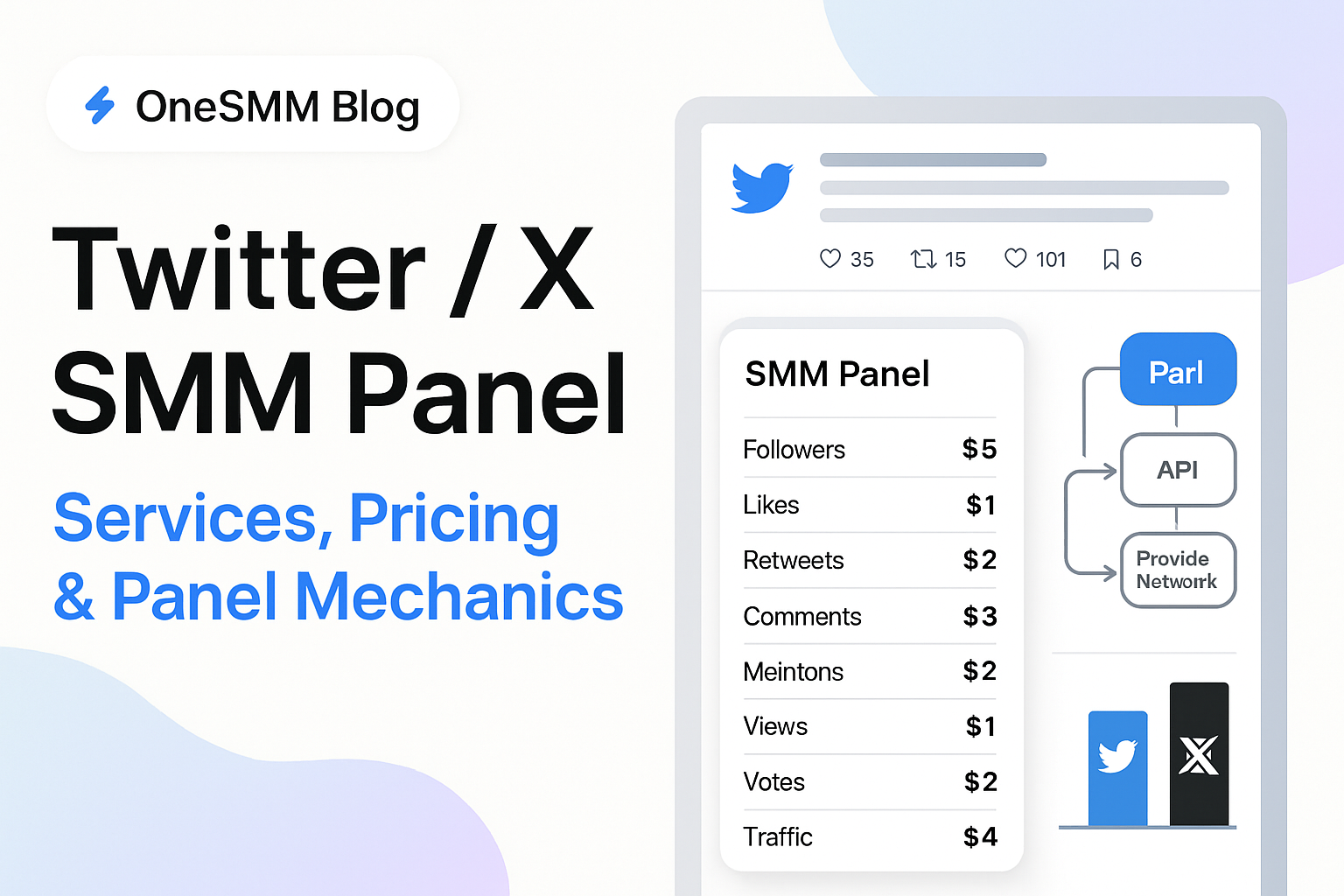
Twitter SMM Panel: How X Growth Panels Work, What They Offer, and How to Choose One
Twitter SMM Panel: How X Growth Panels Work, What They Offer, and How to Choose One
Looking for a Twitter SMM panel that actually delivers? A Twitter SMM panel is a platform where you order social media marketing services for X (Twitter) — followers, likes, retweets, impressions, replies, and more — through a self-service dashboard. You submit a username or tweet URL, choose a service, pay, and the order is fulfilled automatically. Whether you're growing your own account or reselling services to clients, understanding how these panels work internally helps you avoid the bad ones and get real value from the good ones.
On OneSMM, our Twitter services cover every engagement type X supports — from basic follower orders to targeted Space listeners. We process over 2,000 Twitter orders weekly across all tiers, and our resellers typically mark up 2-3x on wholesale pricing to build sustainable businesses. Below you will find the mechanics of how SMM panels for Twitter operate, what services they typically offer, how pricing works, what separates a reliable panel from a scam, and how to evaluate whether a panel fits your specific use case.
In This Guide
What a Twitter SMM Panel Actually Is
An SMM panel is a web-based marketplace for social media growth services. Think of it as a wholesale platform where the product is social media engagement. The panel operator aggregates services from multiple upstream suppliers, sets retail pricing, and provides a user-friendly ordering interface.
For Twitter/X specifically, a panel connects you to networks of accounts that can follow profiles, like tweets, retweet content, post replies, and generate impressions. You don't interact with these account networks directly — the panel handles routing, quality control, and delivery tracking. X's own Business platform is built for ad campaigns with big budgets; SMM panels fill the gap for everyone else who needs measurable growth without a five-figure ad spend.
The key distinction between a panel and hiring a social media manager is automation and scale. A social media manager builds organic engagement manually. A panel delivers quantified engagement programmatically. Different problems entirely. Panels are for volume and speed, not for strategy or content creation.
Who Uses Twitter SMM Panels?
- Marketers and agencies — boosting client accounts, launching campaigns with visible social proof, amplifying branded content.
- Influencers and creators — maintaining engagement rates that attract sponsorship deals, pushing key tweets for visibility.
- Businesses — establishing credibility for new brand accounts, ensuring important announcements get seen.
- Resellers — buying services wholesale from panels and reselling to end clients at markup, often through their own branded panel or freelance services.
- Political campaigns and advocacy — amplifying messaging during specific events or news cycles.
Twitter/X Services Panels Typically Offer
A full-service Twitter SMM panel covers more than just followers. Here's the standard service catalog and what each product does:
| Service | What It Does | Input Required | Typical Volume Range |
|---|---|---|---|
| Followers | Accounts follow your profile | Profile URL or @username | 100 – 100,000 |
| Likes | Accounts like a specific tweet | Tweet URL | 50 – 50,000 |
| Retweets | Accounts retweet a specific tweet | Tweet URL | 50 – 10,000 |
| Impressions / Views | Increases the view count on tweets or video posts | Tweet URL | 1,000 – 1,000,000 |
| Replies / Comments | Accounts post replies to a specific tweet (custom or random text) | Tweet URL + optional comment text | 10 – 500 |
| Poll Votes | Votes on a specific option in a Twitter poll | Tweet URL + option number | 100 – 10,000 |
| Space Listeners | Accounts join a Twitter Space as listeners | Space URL | 50 – 5,000 |
| Bookmarks | Accounts bookmark a tweet (engagement signal) | Tweet URL | 50 – 5,000 |
Most panels also segment these services by quality tier and geographic targeting. You might see "Twitter Followers — USA" as a separate product from "Twitter Followers — Worldwide" at a different price point. Geographic targeting matters for accounts that need followers from specific regions — a US-focused business account benefits more from US-based followers than a generic global mix.
How Order Fulfillment Works Behind the Scenes
Understanding the supply chain behind a Twitter followers panel helps you evaluate quality. Here's how it typically works:
The Supply Chain
- Upstream suppliers — these are the companies or individuals who maintain the actual account networks. They invest in creating, aging, and maintaining Twitter accounts that can perform actions (follow, like, retweet). Some use automation; others manage incentivized real user networks.
- The panel operator — aggregates multiple upstream suppliers, builds the ordering interface, handles payments, and provides customer support. Good operators test their suppliers regularly and switch when quality degrades.
- The end user or reseller — that's you. You order through the panel's interface, and the panel routes your order to the appropriate supplier.
Why Multiple Suppliers Matter
A panel that relies on a single upstream supplier is fragile. If that supplier's account network gets purged by X, every order on the panel fails or delivers garbage quality until they rebuild. Panels with multiple suppliers can route orders to whichever source is currently performing best.
You can test this by ordering the same service twice, a few days apart. If the delivery pattern and account quality are noticeably different between orders, the panel is likely routing to different suppliers — that's a good sign.
API vs Manual Panels
Larger panels offer API access for resellers. This means you can programmatically submit orders, check status, and receive delivery notifications without using the web interface. API panels are designed for volume users — if you're reselling Twitter services through your own website or dashboard, API access is essential. OneSMM provides API documentation for resellers integrating Twitter and other platform services. For a deeper look at how X structures its developer ecosystem, the X Developer documentation is worth reading — it shows what data the platform exposes and how third-party tools interact with it.
Understanding Twitter SMM Panel Pricing
SMM panel pricing follows a consistent structure. Understanding it prevents you from overpaying or mistaking cheap prices for good value.
Cost Per Thousand (CPM) Model
Most services are priced per 1,000 units. "Twitter Followers — $3.00" means $3.00 per 1,000 followers. Minimum orders are typically 100–500 units. Maximum orders vary by panel but usually cap at 100,000 for followers and 50,000 for engagement.
Price vs Quality Correlation
| Price Range (per 1K followers) | Expected Quality | Typical Retention (30 days) |
|---|---|---|
| $0.50 – $1.50 | Bot accounts, high drop rate | 20–40% |
| $1.50 – $4.00 | Aged accounts, moderate quality | 50–70% |
| $4.00 – $10.00 | Active accounts, good profiles | 70–85% |
| $10.00 – $25.00 | Real/targeted users, premium quality | 80–95% |
Reseller math: If you buy Twitter followers at $3.00 per 1,000 and resell at $8.00, your margin is $5.00 per 1,000. At 50 orders per month averaging 2,000 followers each, that's $500/month margin from a single service type. This is why the Twitter reseller panel model works — volume creates meaningful revenue even at modest per-order margins.
How to Evaluate and Choose a Panel
There are hundreds of SMM panels offering Twitter services. Most are reselling from the same handful of upstream providers. Here's how to separate the reliable ones from the noise:
1. Test Before Committing
Order the cheapest service available (usually 100 followers or 100 likes). Evaluate delivery speed, account quality (check follower profiles), and whether support responds when you have questions. A $0.50 test tells you more than any amount of website reviews.
2. Check Service Variety
A panel offering only 2–3 Twitter services probably has a single supplier and limited capabilities. A panel with 10+ Twitter services (different quality tiers, geo-targets, speed options) has invested in multiple suppliers and can handle varied use cases.
3. Evaluate Refill Policies
The best panels offer automatic refills — if followers or engagement drops within a guaranteed period, the panel replaces them without you filing a ticket. Manual refill policies (you have to report the drop) are acceptable. No refill policy at all is a warning sign.
4. Look for Transparent Pricing
Panels that display prices publicly (before account creation) are more trustworthy than panels that hide pricing behind a login wall. Transparent pricing means the panel is confident in its value proposition. Hidden pricing often means inflated rates for uninformed buyers.
5. Verify Payment Security
Reputable panels accept standard payment methods: credit cards (through Stripe or similar processors), PayPal, and cryptocurrency. Panels that only accept crypto or only accept bank transfers may be harder to dispute if something goes wrong.
Using a Panel as a Reseller
The reseller model is one of the most common reasons people search for a Twitter SMM panel. Here's how it works in practice:
Option 1: Buy and Manually Resell
You take client orders through any channel (your website, social media, freelance platforms), then manually place orders on the panel. This works at low volume but doesn't scale well beyond 20–30 orders per week.
Option 2: Set Up Your Own Panel
Many panel platforms (like Perfect Panel, JEYLABS, or similar) let you create your own branded SMM panel. You connect it via API to a wholesale panel like OneSMM, set your retail markup, and your customers order directly through your branded interface. The upstream panel fulfills automatically. Honestly, this is probably the best passive income setup in the SMM space right now. We see resellers running five-figure monthly revenue with nothing more than a branded front-end and our API doing the heavy lifting.
Option 3: White-Label Services
Some panels offer white-label arrangements where they fulfill orders under your brand name. You handle marketing and customer relationships; they handle fulfillment. This works for agencies that want to offer social media growth as part of a broader service package without building the infrastructure themselves.
For all three models, the core requirements are the same: reliable upstream fulfillment, competitive wholesale pricing, and a panel that doesn't have extended downtime. Test your chosen panel with real orders for at least 2 weeks before committing to a reseller arrangement. X also publishes platform rules and policies that are worth reviewing — understanding what X enforces helps you advise clients and set realistic expectations.
Frequently Asked Questions
What's the difference between a Twitter SMM panel and a Twitter growth service?
A "growth service" is managed — someone handles your content scheduling, targeted following, and engagement campaigns. An SMM panel is self-service: you choose exactly what you want (500 followers, 200 likes on a specific tweet) and order it directly. Panels give you more control and lower per-unit pricing. Growth services cost more but handle strategy. Many professionals use both.
Do Twitter SMM panel services work after X's algorithm changes?
Yes. The core mechanics remain intact — X still prioritizes engagement velocity, still recommends content with high engagement rates, and still amplifies tweets from consistently active accounts. What has changed is that bot detection has improved, so low-quality bot engagement is more likely to be discounted or removed. Panel quality matters more than it did in 2023, but panels delivering engagement from decent-quality accounts remain effective. We monitor algorithm shifts closely and adjust our supplier mix when we see delivery patterns change — that is part of what separates a maintained panel from a set-it-and-forget-it operation.
How much does a Twitter SMM panel cost to use?
No subscription fee — you pay per order. Twitter followers run $1-$10 per 1,000 depending on quality tier. Likes are $1.50-$8 per 1,000. Retweets are $2-$12 per 1,000. Some panels offer bulk discounts (deposit $100, get 10% bonus balance). A typical small business spends $50-$200 per month for a single account.
Can I target followers from specific countries on a Twitter panel?
Yes. Common options include USA, UK, Brazil, India, Middle East, and worldwide. Geo-targeted followers cost 2-5x more because the account pool is smaller and the accounts are more valuable. For business accounts, geo-targeting is worth the premium — followers from your target market contribute to genuine engagement over time. For personal branding or general social proof, worldwide followers at a lower price point are usually sufficient. On our panel, USA-targeted followers are the most popular geo option by a wide margin.
Is it safe to give my tweet URL to an SMM panel?
Completely safe. A tweet URL and your public @username are publicly available information. Never share your account password, email, or login credentials with any panel. If a service requests login access to "deliver followers," walk away.
Explore Twitter/X Growth Services
OneSMM offers a full range of Twitter services — followers, likes, retweets, impressions, and more. Test with a small order and see the quality yourself.