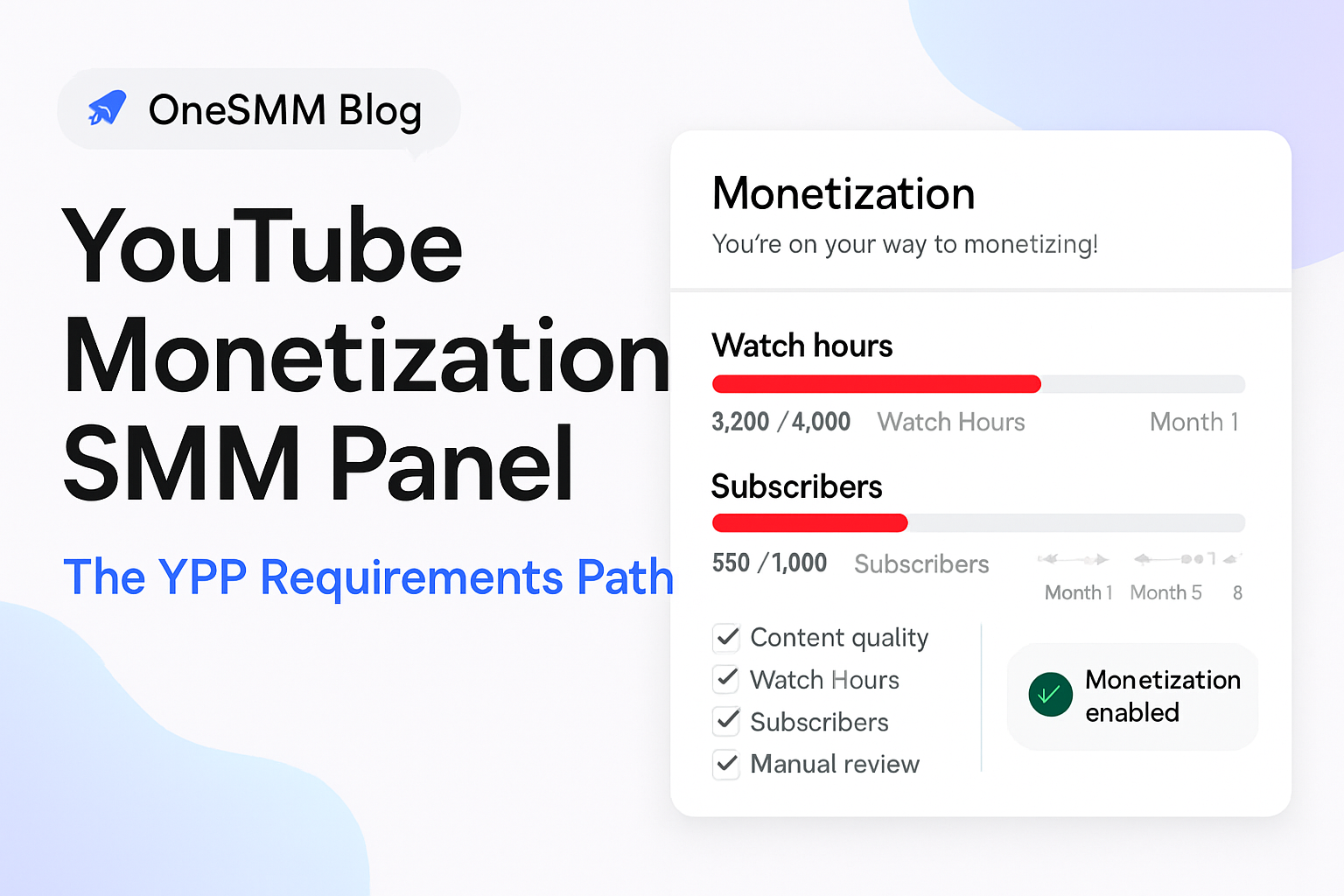
YouTube Monetization SMM Panel: Using Panels to Hit 4,000 Watch Hours and 1,000 Subscribers
YouTube Monetization SMM Panel: Using Panels to Hit 4,000 Watch Hours and 1,000 Subscribers
You've been uploading for 8 months. Analytics show 2,100 watch hours and 750 subscribers. You're halfway there and running out of patience. Every week you check the YPP dashboard, and every week the numbers creep forward at a pace that makes you question whether consistent uploading alone will ever get you across the finish line.
YouTube's Partner Program requires two milestones hit simultaneously: 1,000 subscribers and 4,000 hours of public watch time in the past 12 months. For most small channels, the subscriber threshold is reachable through consistent uploading, but the watch time requirement is brutal. A channel with 50 videos averaging 5 minutes each and 200 views per video generates about 833 hours per year — not even close to 4,000.
That math is why YouTube monetization SMM panels exist. These panels sell both subscriber services and watch time hours specifically packaged for creators trying to reach YPP eligibility. But there's a critical nuance most panel buyers miss: YouTube doesn't just count raw hours — it evaluates the quality of those hours during the manual review that follows your YPP application.
We've helped hundreds of creators reach YPP thresholds through OneSMM, and the patterns we see are consistent. Creators who rush the numbers in a single week get rejected. Creators who spread their orders across 6–10 weeks with drip-feed delivery almost always pass review on the first application.
YouTube Partner Program Requirements in 2026
YouTube offers two monetization paths in 2026:
| Tier | Subscribers | Watch Time | OR Shorts Views | What You Get |
|---|---|---|---|---|
| Standard YPP | 1,000 | 4,000 hours (past 12 months) | 10M Shorts views (past 90 days) | Ad revenue, memberships, Super Chat, merch shelf |
| Expanded YPP | 500 | 3,000 hours (past 12 months) | 3M Shorts views (past 90 days) | Fan funding only (no ad revenue) |
The standard tier is where ad revenue lives. To qualify, you need both thresholds simultaneously: 1,000 subscribers and 4,000 public watch hours within the trailing 12 months. Private, unlisted, deleted, and ad-campaign-driven views don't count. YouTube's official YPP requirements page details additional eligibility criteria including having no active Community Guidelines strikes and an active AdSense account linked to your channel.
What Monetization Panels Sell
A YouTube monetization package on an SMM panel typically bundles two or three services:
- Watch time hours — The panel sends accounts to watch your videos for extended durations. The key variable is average view duration (AVD). Low-quality services play your video for 5–10 seconds and move on. High-quality services watch for 3–8 minutes per session, generating real watch time that YouTube counts. For a full breakdown of watch time quality tiers and delivery mechanics, see our watch time SMM panel guide.
- Subscribers — Accounts subscribe to your channel to push you past the 1,000 mark. Quality ranges from bot accounts (cheap, high drop) to aged accounts with activity history (expensive, low drop). We cover subscriber tier differences in depth in our YouTube subscribers panel guide.
- Views — Optional but useful. High-retention views make your analytics look natural. A channel with 4,000 watch hours but unusually low view counts relative to that number looks suspicious.
Watch Time Quality and the YPP Review
YouTube tracks how watch time accumulates. During the YPP manual review, reviewers can see your analytics. What separates watch time that passes from watch time that gets flagged comes down to five signals:
| Metric | Passes Review | Gets Flagged |
|---|---|---|
| Average view duration | 30–60% of video length | Under 10% of video length |
| Traffic source diversity | Mix of Browse, Search, Suggested, External | 100% from one source (usually External) |
| Geographic distribution | Multiple countries matching your content language | 100% from one obscure country |
| Growth pattern | Gradual accumulation over weeks/months | Sudden spike from zero to 4,000 in 3 days |
| Viewer engagement | Some likes, occasional comments alongside watch time | 4,000 hours with zero likes and zero comments |
Critical: Channels have had YPP applications rejected specifically because their watch time analytics showed unnatural patterns. YouTube doesn't tell you "we detected purchased watch time" — they say "your channel doesn't meet the spirit of the YouTube Partner Program." You can reapply after 30 days, but the same analytics are still visible to the next reviewer.
Based on our order data, creators who use drip-feed delivery over 8+ weeks have significantly higher YPP approval rates. The difference is stark: a single bulk order of 4,000 hours delivered in 72 hours creates a spike that any reviewer would notice. The same hours spread over two months blend into an upward growth trend that looks like a channel gaining traction.
Subscribers for Monetization — What Passes and What Doesn't
The 1,000-subscriber threshold is the easier milestone, but the quality of those subscribers matters for the YPP review. Specifically, YouTube reviewers look at the ratio between your subscriber count and your per-video viewership. A channel with 1,000 subscribers but 10 views per video raises immediate suspicion.
For a complete comparison of subscriber quality tiers — bot, high-quality, and targeted — read our subscriber panel guide. For monetization purposes, the only thing that matters is this: invest in high-quality or targeted subscribers for the first 1,000, not bot-tier. The cost difference between 1,000 bot subscribers ($0.50) and 1,000 high-quality subscribers ($5.00) is only $4.50 — trivial when your goal is unlocking ongoing ad revenue.
Our most common monetization order is the 4,000-hour watch time package paired with 1,200 subscribers for safety margin. We recommend over-ordering by 10–20% on subscribers specifically because some drop is inevitable over the weeks between ordering and actually applying for YPP.
The Manual Review — What Reviewers Actually Check
After you apply for YPP, a human reviewer evaluates your channel. Their checklist:
- Content originality — Is this original content or reused/scraped from other creators?
- Community Guidelines compliance — Any strikes or warnings?
- Watch time legitimacy — Do the analytics patterns look organic? Is watch time concentrated on a few videos or spread naturally?
- Subscriber engagement ratio — Do subscribers actually watch your videos?
- Content volume — Does the channel have enough content to sustain a monetized channel? YouTube prefers channels with 15+ videos.
Your panel strategy needs to account for all five checkpoints, not just hitting the subscriber and watch time numbers. The YouTube Creator Academy monetization section emphasizes that "quality and consistency" are the primary factors in review decisions — which is polite corporate language for "we reject channels that clearly bought their way to the threshold without producing real content."
A Practical Ordering Timeline
A structured approach that maximizes YPP approval chances:
Weeks 1–4: Foundation
- Upload 15–20 videos (5–15 minutes each). Quality content is non-negotiable.
- Order 300–500 high-quality subscribers via drip-feed (spread over 2 weeks).
- Order 500–800 hours of watch time spread across your best 5–10 videos. Use a high-retention service with 30%+ AVD.
Weeks 5–10: Growth Phase
- Continue uploading 2–3 videos per week.
- Order another 300–500 subscribers to reach 800–1,000 total.
- Order 1,500–2,000 more watch hours distributed across all your videos — not concentrated on one or two.
- Order 5,000–10,000 high-retention views to balance your view count against your watch hours.
Weeks 11–14: Application Push
- Top up subscribers to 1,100–1,200 (buffer for drops).
- Order remaining watch hours to reach 4,200–4,500 (buffer for the rolling 12-month window).
- Order 50–100 likes spread across your videos for engagement signals.
- Wait 5–7 days after your last delivery completes, then apply.
Budget estimate: Following this plan costs approximately $50–$150 total depending on service quality. That's a one-time investment to unlock ad revenue that can generate $100+/month on a moderately performing channel.
What Panels Cannot Solve
Look — we'll be honest. If your content is genuinely bad, no amount of panel services will save your YPP application.
Panels push your numbers past the threshold. They cannot fix these problems:
- Bad content — Panels can get you monetized, but your ad revenue will be minimal if organic viewers bounce within 15 seconds.
- Community Guidelines violations — Strikes block YPP eligibility regardless of your numbers. A single active strike means automatic rejection.
- Long-term ad revenue — Panel watch time generates zero ad impressions. The viewing accounts don't see ads. Your actual revenue depends entirely on organic viewership after monetization.
- Algorithm boost — Unlike organic views with engagement, watch time from panels doesn't improve your video's recommendation ranking. It counts toward the threshold but doesn't supercharge organic reach.
The YouTube Help Center's monetization policies page states that channels must demonstrate "sustained organic engagement" — another way of saying that hitting the numbers is necessary but not sufficient.
Start Your Monetization Journey
OneSMM offers YouTube watch time, subscribers, and views at wholesale rates. Build your YPP foundation with quality services. Browse YouTube services at OneSMM.com
Frequently Asked Questions
Can I get monetized using only an SMM panel?
You can reach the numerical thresholds — 1,000 subscribers and 4,000 watch hours — using a panel. But you still need original content that passes YouTube's manual review. The panel handles the numbers; you handle the content quality. Both are required, and neither substitutes for the other.
Will YouTube remove watch hours purchased from a panel?
YouTube periodically audits watch time and can remove hours it classifies as artificial. High-retention watch time from quality panels is significantly less likely to be removed than low-retention bot views. The key factor is average view duration — services delivering 30%+ AVD create watch time that is statistically indistinguishable from organic viewing behavior in YouTube's backend metrics. Always verify the retention rate before ordering.
How long does it take to reach monetization using a panel?
Plan for 3–4 months if you're starting from near zero on both metrics. Rushing the numbers in under 30 days creates analytics patterns that dramatically increase rejection risk during manual review.
What's the cheapest way to get 4,000 watch hours?
Budget watch time services cost $1–$3 per 1,000 hours, putting the total cost at $4–$12 for 4,000 hours. However, the cheapest services have low retention rates and are more likely to be flagged or stripped during audits. Mid-tier services ($3–$8 per 1,000 hours) offer a better cost-to-risk ratio for monetization. We've seen creators save $5 on cheap hours and then wait an extra 30 days for reapplication after rejection — not worth it.
Can my channel get banned for using a monetization panel?
No. YouTube doesn't terminate channels for having purchased subscribers or watch time. The consequence is YPP application rejection or, in rare cases, demonetization of channels that were already approved. Channel bans are reserved for severe violations like repeated copyright strikes, spam behavior, or Community Guidelines violations. The realistic worst case from panel usage is a rejected application that you can resubmit after 30 days with improved analytics patterns.
Should I order watch time or subscribers first?
Subscribers first, in small batches. A channel with subscribers but growing watch time looks natural — it signals an audience building over time. A channel with 4,000 watch hours but 50 subscribers looks like something went wrong. Start with 300–500 subscribers in week one, then layer in watch time orders starting week two or three.