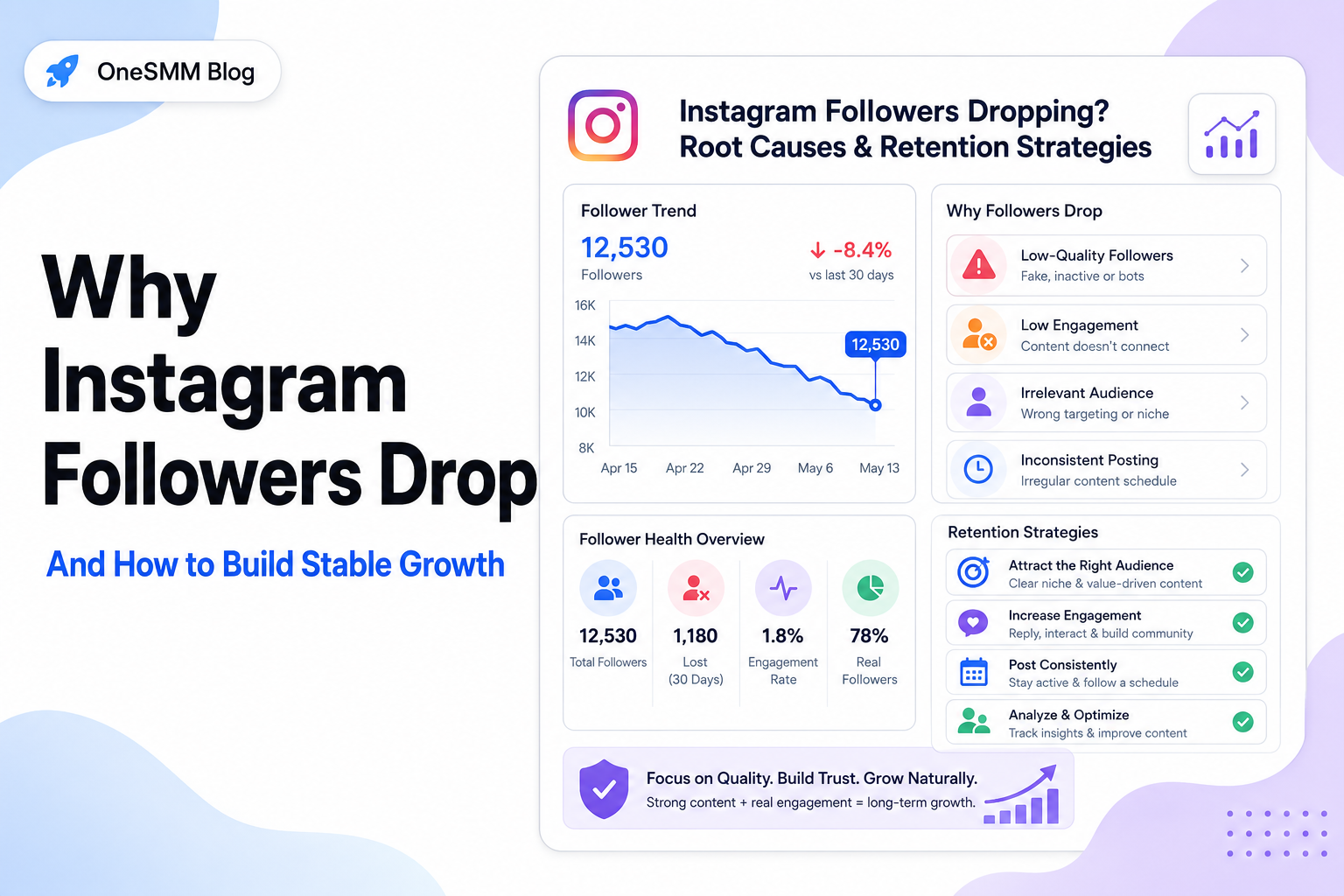
Why Instagram Followers Drop (And How to Build Stable Growth)
Why Instagram Followers Drop (And How to Build Stable Growth)
Instagram follower drop is the net loss of followers over a measured period, distinct from normal churn. Healthy Instagram accounts experience 1-3% monthly attrition, but accounts seeing drops above 5% per month typically face one of five root causes: feed fatigue from overposting, content quality decline, algorithm suppression due to bot followers, audience mismatch from poorly targeted growth, or Instagram's periodic purges of inactive and fake accounts. In May 2026, Instagram executed what media outlets called the "Great Purge of 2026", removing millions of bot and spam accounts overnight — with most creators seeing 2-5% drops and some high-profile accounts losing millions. Any panel-sourced followers without retention guarantees are particularly vulnerable to these sweeps.
You had 12,000 followers last month. Now you're at 11,500. And you don't know why.
Unlike Telegram, Instagram's algorithm actively suppresses inactive accounts. With over 2 billion monthly active users, Instagram's competitive landscape makes unfollowing extremely easy (one tap), creating faster churn if something's wrong. Telegram channels face a similar member-drop problem, but the causes and fixes are different.
The good news: If you understand why people unfollow, you can fix it quickly.
The Five Reasons Followers Leave Instagram
Reason 1: Feed Fatigue (You're Posting Too Much or Too Little)
Too much: More than once per day, every day, often leads to feed fatigue. Followers mute or unfollow to reduce noise.
Too little: Haven't posted in 3+ weeks? Instagram pushes you out of the algorithm. Followers think your account is dead and unfollow.
The sweet spot: 4-7 posts per week (roughly 1 per day average). Stories 2-3x daily is fine (they don't count toward feed saturation).
Reason 2: Content Quality Degradation
People followed you because they liked your content. If it suddenly gets worse, they leave.
Common quality drops:
- Less effort in captions (went from thoughtful to lazy)
- Lower visual quality (phone photos instead of professional)
- Off-topic content (started posting about things unrelated to your niche)
- Too many promotional posts (felt like ads, not value)
- Inconsistent style (looks nothing like what they followed for)
Reason 3: Algorithm Suppression (You're Not Engaging Enough)
Instagram's algorithm notices accounts that don't engage with others. If you:
- Post but never like/comment on other accounts
- Ignore comments on your posts
- Use automation tools that are obvious (generic comments)
Then Instagram suppresses your visibility. Followers see fewer of your posts. They forget about you. They unfollow.
Reason 4: Audience Mismatch (Wrong Growth)
This usually happens after using growth services.
You buy 500 followers for cheap. 400 of them aren't your real target audience. They unfollow within days because your content isn't relevant to them.
Reason 5: Account Inactivity (You Disappeared)
If you take a break (vacation, illness, burnout), followers clean out their follows list. When you come back, half might be gone.
Diagnosing Your Specific Churn Problem
Check #1: When Did the Drop Start?
Sudden drop (lost 500+ in one week): Usually a feed quality issue, algorithm suppression, or bad growth service followers leaving.
Gradual decline (losing 10-20 per day consistently): Content quality or engagement consistency issue.
Drop after posting a specific post: That post didn't resonate or went against your niche. Followers left because of it.
Check #2: What's Your Engagement Rate?
Calculate: (Likes + Comments) / Followers × 100
- Below 1% = Low engagement. Followers aren't interested. Churn is normal. (The 2026 platform-wide average is around 0.50%, so this is more common than you think.)
- 1-3% = Average. Losing 0.5-1% of followers monthly is normal here.
- Above 3% = Strong. Loss above 0.5% monthly is unusual and needs investigation.
Check #3: When Was Your Last Post?
Haven't posted in 2+ weeks? Your churn is probably unavoidable. Resume posting and it should stop.
Solutions by Problem Type
If It's Feed Fatigue (Posting Too Much)
Fix: Reduce post frequency to 4-7 per week (not daily).
What to do with excess content:
- Post as Stories instead (don't trigger feed fatigue)
- Create a Reel (Reels get more distribution, followers appreciate quality over quantity)
- Save it for next week (batching content is fine)
Expected result: Churn stops within 1-2 weeks.
If It's Content Quality Drop
Audit your recent posts: Do they maintain the same quality, topic, and style as posts from 3 months ago?
If no: You've drifted. Followers left because you're no longer the account they followed.
Options:
- Go back to your original focus (realign with what made you successful)
- Evolve intentionally (tell your audience why you're changing + what to expect)
- Accept the followers you lose (they weren't right fit anyway)
Expected result: Churn stops and engagement improves within 2-4 weeks if you fix the content.
If It's Algorithm Suppression (Low Engagement on Your Part)
Fix: Engage 30 minutes daily
- Find 10-20 accounts in your niche
- Like their recent posts (5-10 likes per account)
- Leave thoughtful comments (not generic "nice!" but actual thoughts)
- Do this consistently for 2-4 weeks
Expected result: Instagram's algorithm recognizes you as active. Your visibility increases. Followers stabilize.
If It's Bad Growth Service Followers
Accept the loss. Those weren't real followers. Them leaving is actually good (cleans your audience).
Going forward: Only use quality growth services that deliver real followers with high retention. Our guide to avoiding fake Instagram growth services walks through every red flag. Or skip growth services entirely and focus on organic.
If It's Account Inactivity (You Were Gone)
Resume posting immediately. Post 3-4 times in first week to remind followers you exist.
Expected result: You'll lose 20-30% of inactive followers over next month. That's normal. Then growth stabilizes as you rebuild momentum.
The Long-Term Retention System
Once you've fixed the acute problem, use this system to maintain healthy retention:
- Weekly engagement audit: Check your engagement rate. Is it stable or declining?
- Content consistency check: Are posts matching your established brand? Quality stable?
- Posting schedule consistency: Are you posting on a predictable schedule?
- Monthly audience surveys: Ask followers what they love. Ask what could be better.
Instagram vs. Telegram Churn (Key Difference)
Telegram churn: Mostly about content quality and expectations. Slow decline.
Instagram churn: Often about algorithm suppression and feed quality. Faster, more visible drops.
This means Instagram requires MORE active management. You can't just post and hope. You need to engage, pay attention to metrics, and stay consistent. If you are looking for a reliable provider to rebuild momentum, compare options on our cheap Instagram followers panel breakdown.
The Numbers That Matter on Instagram
Track these weekly:
- Engagement rate: Should be stable or improving
- Follower gain/loss per week: Should be positive overall
- Reach per post: Should be growing as your audience grows
- Saves and shares per post: Indicate how valuable your content is
If any of these are declining: Something's wrong. Investigate and fix.
Red Flags That Require Immediate Action
- 🚩 Engagement rate drops more than 1% in one week
- 🚩 Reach per post cuts in half suddenly
- 🚩 Losing 50+ followers daily with no posting break
- 🚩 Comments are mostly spam or generic (sign of bad followers or bot activity)
- 🚩 Instagram sends you a warning about unnatural activity
Build Real Instagram Growth
onesmm's Instagram service delivers real followers who stay and engage. No bots, no churn spikes, just stable growth that compounds.