Instagram Algorithm Guide 2026: How It Works & How to Beat It
Instagram Algorithm Guide 2026: How the Instagram Algorithm Works & How to Beat It
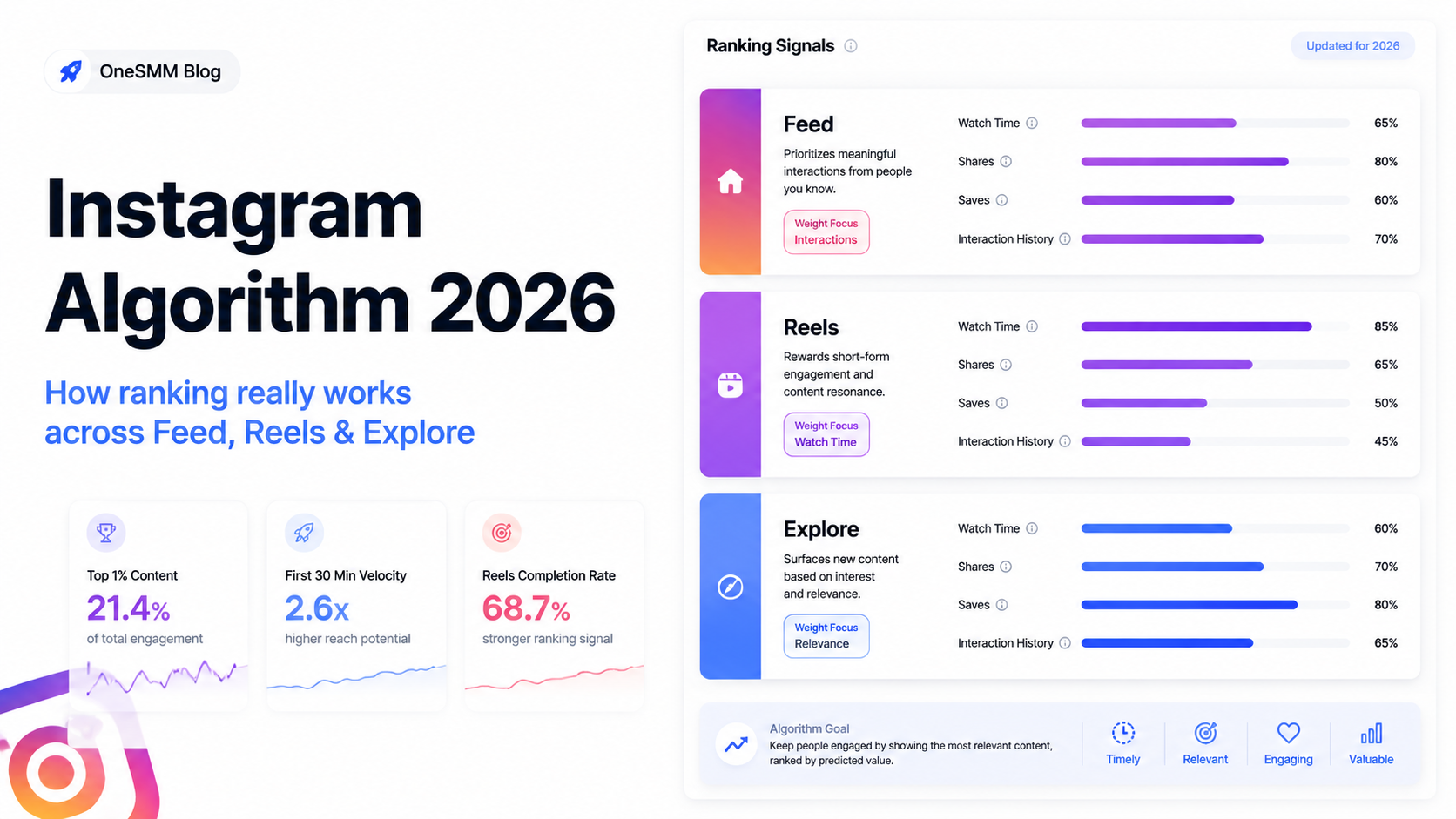
Instagram Algorithm Guide explains how the platform ranks content across Feed, Reels, Stories, Explore, and Search. Instagram does not use a single algorithm; instead, it operates multiple AI-driven ranking systems that score posts based on user behavior, with the top 1% of content capturing roughly 70% of total engagement. To grow on the platform in 2026, creators must understand the specific ranking signals—like watch time, send-to-share rates, and keyword relevance—that dictate who sees their posts.
Every week, our support team at OneSMM gets tickets from creators asking why their reach suddenly dropped. They often assume a shadowban or a broken metric. Nine times out of ten, the drop happens because Instagram rolled out a quiet update to how it weighs specific interactions—usually prioritizing shares and saves over simple likes. When we audit their accounts, we trace the decline back to a shift in their content format or posting cadence.
One recent client, a fitness creator, saw her Reel views plummet from 40,000 to under 2,000 in a single week. She hadn't changed her content, but Instagram had updated its Reels ranking to heavily penalize low-resolution clips with static watermarks from other apps. Once she adjusted her production workflow to remove watermarks and optimize her initial hook, her reach recovered entirely. Understanding these mechanics is the difference between guessing and growing. If you want to map out a safe, long-term growth strategy, you can use our social media growth planner to structure your approach.
How Does the Instagram Algorithm Work in 2026?
Instagram operates using distinct algorithms for different surfaces of the app—Feed, Stories, Explore, and Reels—rather than one unified system. Each surface evaluates thousands of signals to predict how likely a user is to interact with a post, ranking content based on the probability of positive engagement.
According to Instagram's engineering team, the platform uses machine learning models that adapt to user behavior in real time. The system categorizes content based on what it displays, then orders posts by the likelihood that a user will spend time with them, like them, share them, or learn more about the creator. Meta, Instagram's parent company, continues to invest heavily in AI research to improve these predictive models, as outlined in their Meta AI blog.
When we test content velocity across recent orders on OneSMM, we consistently see that posts receiving immediate, relevant engagement within the first 30 minutes signal high value to the algorithm, pushing them out to broader discovery surfaces like Explore. The algorithm is essentially a massive prediction engine, and your job as a creator is to feed it the right signals.
Instagram Feed Algorithm: Ranking Signals
The Feed algorithm prioritizes content from accounts a user follows, ranking posts based on signals like likelihood to comment, like, spend time, and tap on profile. It weights interactions differently, meaning a comment carries significantly more algorithmic value than a passive view.
The Core Feed Signals
- Information about the post: How many likes a post has, how long ago it was posted, its location, and its format (video vs. photo).
- Information about the author: How often the user has interacted with this specific creator over the past few weeks.
- User activity: What the user has liked, saved, or commented on recently.
- Interaction history: How likely the user is to engage with the author's content generally.
Feed is where the algorithm cares most about relationships. If a user frequently DMs a creator or searches for their handle, that creator's Feed posts will dominate their timeline. If your engagement metrics need a jumpstart to signal this relationship to the algorithm, utilizing genuine Instagram likes can help establish that baseline relevance without triggering spam filters.
How the Instagram Reels Algorithm Ranks Content
The Reels algorithm focuses on discovery, ranking short-form videos based on watch time, completion rate, and the likelihood a user will reshare the Reel to their Story or send it in a DM. Reels are primarily designed to help users find new content, so follower count matters far less than pure entertainment and engagement value.
What Kills Reels Reach
Based on OneSMM panel data, analyzing thousands of growth campaigns, we have identified specific factors that instantly throttle Reels distribution:
- Low-resolution video or visibly stretched aspect ratios.
- Static watermarks from third-party editing apps or rival platforms.
- Excessive text cluttering the bottom fifth of the screen, covering UI elements.
- Politically charged or borderline policy-violating content that triggers automated demotion.
For Reels, the "Send" metric is king. According to social media benchmarks from Later, shares and saves are the strongest indicators of value to the algorithm. If a user shares your Reel to a friend's DM, the system interprets it as highly valuable content. You can amplify this initial visibility by ensuring your video gets an organic-looking boost in watch time—using a tool to get free Instagram views helps kickstart that momentum for new uploads.
Instagram Explore Algorithm: How Discovery Works
The Explore algorithm serves content from accounts a user does not follow, ranking posts based on historical engagement data and topic affinity. Explore relies heavily on seed accounts; if a user likes a specific creator, Explore will serve content from accounts that share a similar audience overlap.
Explore is much more volatile than Feed. To appear here, a post needs a sudden spike in engagement from your existing audience. A common support ticket we handle at OneSMM involves creators wondering why their posts never hit Explore. Usually, their core audience is too passive. By driving initial interaction—whether through organic community building or strategic metric boosts via our Instagram SMM panel—you give the algorithm the velocity needed to test your post in Explore batches.
Instagram Stories Algorithm: Viewership and Stickers
The Stories algorithm ranks content based on how often a user views, replies to, or shares an author's Stories. Direct messages sent in response to a Story are the strongest ranking signal, signaling an active, two-way conversation.
Stories are a retention tool. The algorithm measures tap-back rates (users re-watching a specific Story frame) and dwell time. Using interactive stickers—polls, quizzes, and sliders—forces a micro-interaction that the algorithm reads as high engagement. Stickers also keep users lingering on your frame longer, increasing dwell time, which boosts the probability of your next Story appearing at the front of their tray.
How Instagram Search and SEO Work
Instagram Search operates as a keyword-based discovery engine, ranking results based on the relevance of keywords in an account's name, username, bio, and captions. In 2026, SEO on Instagram is mandatory for organic discovery, as the platform actively pushes users to search for topics rather than just hashtags.
Instagram's official help center states that the platform considers account authority, meaning verified accounts or profiles with high engagement on specific topics rank higher in search results. To optimize for Instagram SEO, you must include your primary keywords naturally in your display name, bio, and alt text for images.
Instagram Algorithm Signals Comparison
Different surfaces of the app prioritize different metrics. Understanding these variations is critical for tailoring your content strategy. Below is a comparison of how the algorithm weights specific signals across Feed, Reels, and Explore.
| Ranking Signal | Feed Priority | Reels Priority | Explore Priority |
|---|---|---|---|
| Comments | High | Medium | High |
| Likes | Medium | Low | High |
| Shares / Sends (DMs) | Medium | Very High | Medium |
| Watch Time / Completion | N/A | Very High | Low |
| Saves | High | Medium | Very High |
| Profile Taps | Low | High | Medium |
Key: Reels prioritize raw consumption (watch time) and virality (shares), while Feed values community interaction (comments, saves), and Explore acts as a discovery engine driven by sudden spikes in saves and likes.
Common Mistakes That Reduce Your Reach
Making algorithmic mistakes is the fastest way to kill your account's growth. We see the same recurring errors across hundreds of accounts, and most of them stem from outdated advice from 2018.
1. Buying Fake, Bot Engagement
Flooding your account with bot followers or automated comments from suspicious IP addresses will destroy your engagement rate. The algorithm tracks the ratio of engaged followers to total followers. If you have 50,000 followers but only 20 likes per post, the system flags your content as low-quality. If you need a baseline, use safe, high-quality sources like free Instagram followers that mimic organic growth patterns, and always focus on gradual delivery.
2. Inconsistent Posting Cadence
The algorithm favors accounts that train it on a schedule. If you post daily for two weeks and then vanish for a month, your momentum resets. The platform stops indexing your content for priority placement because it cannot predict your behavior.
3. Ignoring Video Formats
Posting square, static images without leveraging Reels or carousels limits your surface area. Instagram has explicitly stated that video formats are the primary vehicle for discovery.
Proven Strategies to Beat the Instagram Algorithm
To beat the algorithm, you must align your content strategy with the platform's primary goal: keeping users on the app for as long as possible. This means creating content that drives saves, shares, and watch time.
Optimize the First 3 Seconds
For Reels and video content, the first three seconds dictate your completion rate. Start with a hook—a bold statement, a visual anomaly, or a direct question. Avoid long intro sequences or lower-thirds that delay the payoff.
Drive Saves Over Likes
Saves are the algorithm's ultimate signal of evergreen value. Create educational content, step-by-step tutorials, or resource lists that users will want to reference later. Every save acts as a super-like, pushing your content further into Explore.
Use Keywords, Not Just Hashtags
Hashtags still have minor utility, but Instagram's search engine now parses natural language. Weave your target keywords into your captions as if you were writing for Google. If you are a travel creator, write descriptive captions like "A complete budget travel guide to Lisbon" rather than relying solely on #travel.
Leverage Strategic Metric Boosts
When you publish a high-effort piece of content, you need immediate social proof to trigger the algorithm's velocity check. By using a reliable social media growth service to secure initial views or likes, you bridge the social proof gap. The algorithm sees early engagement, assumes the content is valuable, and pushes it to a wider organic audience. This is the exact methodology we use at OneSMM to help accounts break out of stagnant follower counts.
FAQ
Does Instagram shadowban accounts?
Instagram does not officially use the term "shadowban," but it does reduce the reach of content that violates its recommendation guidelines. This includes borderline content, spam-like behavior, or using banned hashtags. The restriction is usually temporary and lifts after a few days of clean posting.
How long does it take for the algorithm to push a Reel?
A Reel typically undergoes its first algorithmic test within the first 30 to 60 minutes. If it performs well with your immediate followers—achieving a high watch time and share rate—it gets pushed to a broader audience. However, Reels can also experience a "second wind" days or weeks later if the algorithm suddenly matches it to a new audience cluster.
Do carousels perform better than single photos?
Yes, carousels generally outperform single photos in the Feed. They encourage users to swipe, which increases dwell time. If a user swipes through all frames, the algorithm counts that as a highly engaged session. If they don't finish the carousel, Instagram may even re-serve the post later with the next slide as the cover, giving you a second chance at engagement.
Is it safe to buy Instagram likes and views?
It is safe to buy engagement if the service provides high-quality, drip-fed metrics that mimic organic growth. The danger lies in buying thousands of bot likes instantly, which creates an unnatural spike that the algorithm easily detects and penalizes. Always choose gradual delivery and real-looking accounts.
Ready to Beat the Instagram Algorithm?
Stop fighting the algorithm with guesswork. Give your content the initial engagement signals it needs to rank and get discovered. Check out our dedicated Instagram SMM panel to safely boost your followers, likes, and views with gradual, high-quality delivery designed to work with the 2026 algorithm.