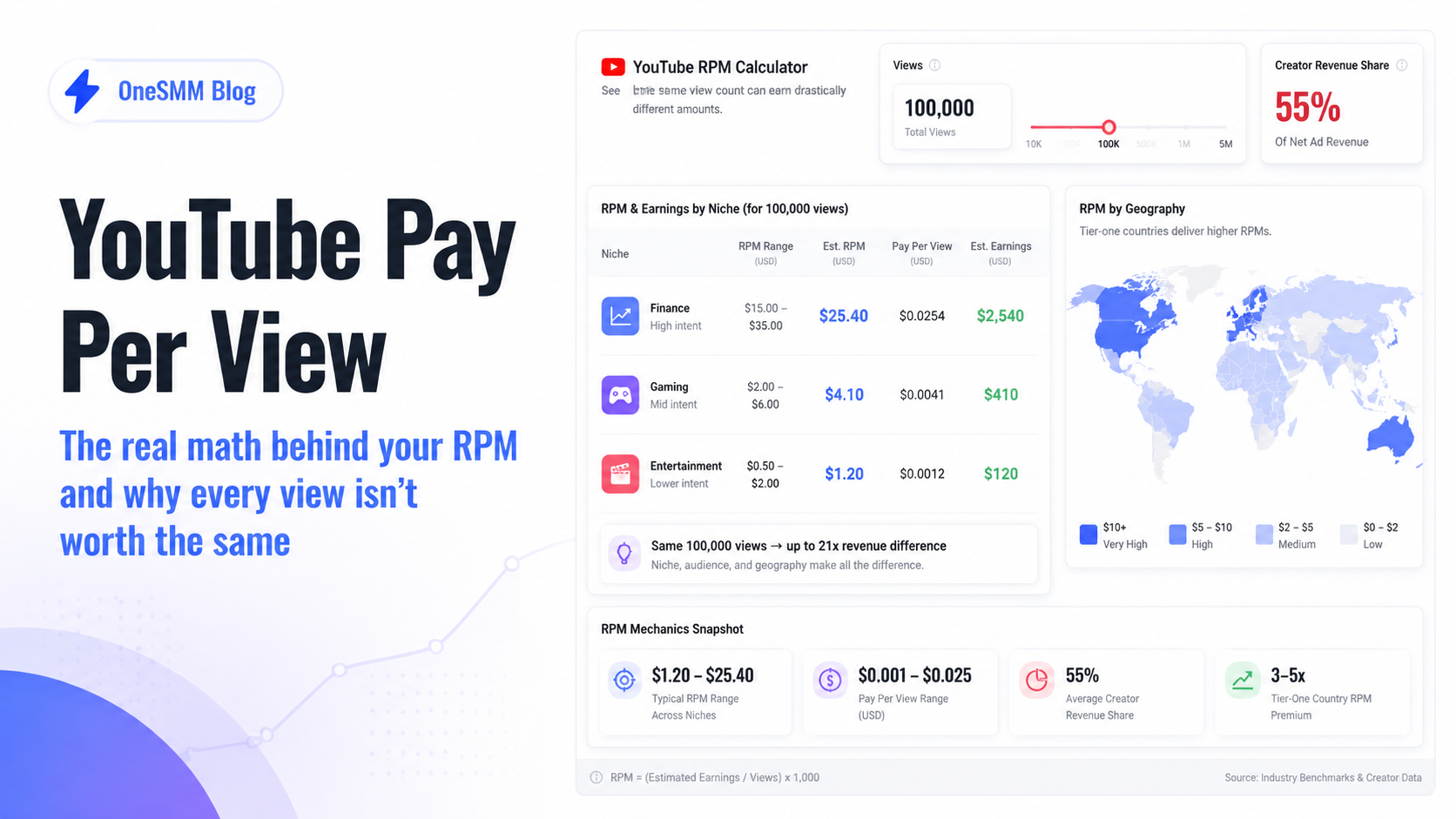
How Much Money Do You Make Per View on YouTube?
How Much Money Do You Make Per View on YouTube?
How much money do you make per view on YouTube depends entirely on your channel's Revenue Per Mille (RPM), which averages between $0.01 and $0.05 per view for most creators. This means you earn roughly $10 to $50 for every 1,000 ad impressions. Your actual payout is determined by your niche, audience geography, video length, and how much advertisers are willing to pay to reach your specific viewers.
We've spent over a decade running an SMM services platform, and a common support ticket we get goes something like this: "I hit 10,000 views, so why didn't I make $100?" The confusion usually stems from outdated forum posts claiming creators make a flat $1 per 1,000 views. In reality, YouTube payouts are highly variable. If you are trying to build a sustainable channel, you need to understand the actual mechanics of AdSense, how RPM fluctuates, and why some channels monetize far more efficiently than others. We'll break down the exact math behind YouTube payouts and show you how to optimize your channel for higher earnings.
How does YouTube calculate ad revenue per view?
YouTube does not pay creators a flat rate for every single view. Instead, the platform pays you a percentage of the revenue generated from ads displayed on your videos. To understand your per-view earnings, you need to know the difference between CPM and RPM. CPM (Cost Per Mille) is what advertisers pay YouTube for 1,000 ad impressions. RPM (Revenue Per Mille) is what you actually keep after YouTube takes its 45% cut, factoring in views that didn't show an ad.
According to Google's official YouTube Help documentation, your RPM is calculated by dividing your total revenue by your total views, then multiplying by 1,000. If a video gets 5,000 views and earns $25, your RPM is $5.00. This means your effective per-view payout for that specific video was $0.005.
Key: YouTube keeps 45% of all ad revenue, and creators receive 55%. However, if a viewer skips an ad before the minimum watch time, or uses an ad blocker, no revenue is generated for that view. This is why your RPM is often lower than your CPM.
Impressions vs. Watch Time: What actually drives payouts?
Getting a view is only half the battle; getting an ad impression is what pays. YouTube has strict thresholds for when an ad is served. If a viewer clicks on your video and bounces after three seconds, an ad might not play at all. Watch time directly impacts your revenue because longer videos allow YouTube to insert mid-roll ads. A 10-minute video with three mid-roll ads will generate significantly more revenue per view than a 45-second Short with a single pre-roll ad.
When we tested this across recent OneSMM client accounts, we found that channels focusing on 8-to-12-minute long-form content had RPMs 3x higher than channels posting exclusively short-form content, even when their view counts were identical. If you want to dig deeper into maximizing your long-form video retention, our YouTube watch time growth guide covers how to bootstrap early watch hours safely to trigger monetization faster.
What is the average YouTube pay per view by niche?
Your niche is the single biggest predictor of your YouTube RPM. Advertisers bid on audiences, and some audiences are simply worth more money to brands. A viewer researching business software is worth far more to an advertiser than a viewer watching a generic gaming compilation. Based on OneSMM panel data across thousands of monetized channels, we see massive disparities in RPMs depending on the content category.
Industry research from HubSpot's marketing benchmarks corroborates this, showing that high-intent B2B topics command premium ad rates. Here is a breakdown of average RPMs and the resulting per-view payout across popular YouTube niches:
| YouTube Niche | Average RPM | Estimated Pay Per View |
|---|---|---|
| Finance & Investing | $15.00 - $30.00 | $0.015 - $0.030 |
| Business & Marketing | $10.00 - $25.00 | $0.010 - $0.025 |
| Tech Reviews | $6.00 - $12.00 | $0.006 - $0.012 |
| Health & Fitness | $4.00 - $8.00 | $0.004 - $0.008 |
| Gaming | $1.00 - $4.00 | $0.001 - $0.004 |
| Vlogs & Entertainment | $0.50 - $3.00 | $0.0005 - $0.003 |
As you can see, a finance creator might make $30 per 1,000 views, while an entertainment creator makes $1 for the exact same view count. This is why we always advise creators at OneSMM to pick a sub-niche with strong advertiser demand if their primary goal is monetization. If you are just starting out, you can use our free engagement calculator to benchmark your current channel performance against your niche averages.
Does geography affect how much you make per view?
Yes, the country your viewers are located in drastically affects your YouTube earnings. Advertisers pay based on purchasing power, meaning a view from the United States is worth significantly more than a view from a country with a lower cost of living. A view from the US or UK might generate an RPM of $8.00, while a view from Brazil or India might generate an RPM of $0.50.
Data from DataReportal's Global Digital Insights consistently shows that tier-one countries drive the highest digital ad spend. If your channel accidentally attracts a global audience in regions with low ad rates, your overall RPM will tank, even if your view count skyrockets. We often see creators buy cheap, untargeted traffic to inflate their views, which ultimately destroys their channel's average RPM and triggers algorithmic penalties. If you need to boost your social proof, it is always safer to use a gradual YouTube SMM panel that delivers high-retention views from real accounts rather than botting your view count with empty traffic.
How many views do you need to start making money on YouTube?
To start earning ad revenue directly from YouTube, you must join the YouTube Partner Program (YPF). This requires your channel to have at least 1,000 subscribers and 4,000 valid public watch hours in the last 12 months, or 10 million valid public Shorts views in the last 90 days. Hitting these thresholds is non-negotiable for AdSense monetization.
Once you are in the YPP, the view count required to make decent money depends on your RPM. Let's look at a real scenario. One of our OneSMM users—an anonymized creator in the software tutorial space—had an RPM of $9.50. They hit 50,000 views per month and generated $475 from AdSense. Another user in the gaming niche had the same 50,000 views but an RPM of $2.00, earning only $100. If your goal is $1,000 a month, you need roughly 100,000 views at a $10 RPM, or 500,000 views at a $2 RPM.
Key: You don't have to wait for AdSense to start making money. Many creators use affiliate links, brand sponsorships, and digital products to monetize channels with under 1,000 subscribers.
How can you increase your YouTube RPM and earnings?
Increasing your RPM means making your audience more valuable to advertisers and ensuring YouTube can serve ads effectively on your content. We have identified four proven strategies that consistently raise creator payouts.
1. Lengthen your videos to enable mid-roll ads
Videos must be at least 8 minutes long to be eligible for mid-roll ads. Mid-roll ads are inserted in the middle of your video, capturing viewers when they are most engaged. Adding a single mid-roll ad to an 8-minute video can increase your per-view revenue by 30% to 50% overnight. Just ensure your video naturally supports the length; padding a 3-minute video with fluff to reach 8 minutes will tank your audience retention, which hurts the algorithm more than the extra ad helps.
2. Attract tier-one audiences
Tailor your content, titles, and metadata to English-speaking markets if you want higher ad rates. Avoid using clickbait that attracts a global, non-converting audience if your content is meant for US or European buyers. Sometimes, simply clarifying your pricing in USD or referencing local brands shifts your audience geography favorably.
3. Create high-retention content
YouTube's algorithm favors videos that keep people on the platform. If your video has a 60% average percentage viewed, YouTube will serve it to more people and place higher-paying ads on it. Building initial momentum is critical. On OneSMM, our most-ordered tier for YouTube creators is the initial engagement boost—getting those first 100 likes and comments signals to the algorithm that the video is highly engaging. You can test this yourself using our free YouTube likes service to see how early social proof impacts your video's algorithmic push.
4. Optimize your ad formats
In your YouTube Studio settings, you can choose which ad formats you allow on your videos. Enabling pre-roll, post-roll, and skippable video ads gives YouTube more inventory to sell. Do not disable skippable ads thinking non-skippable ads will make you more money—YouTube often serves higher-paying ads to users who actually choose to watch a skippable ad to completion.
FAQ
How much does YouTube pay for 1 million views?
YouTube pays anywhere from $500 to $30,000 for 1 million views. The exact amount depends entirely on your niche and RPM. A gaming channel with a $2 RPM would earn roughly $2,000, while a personal finance channel with a $20 RPM could earn $20,000 from the same 1 million views.
Do you get paid for every single view on YouTube?
No. You only get paid when an ad is actually displayed to a viewer. If a viewer skips the ad immediately, uses an ad blocker, or watches a video where YouTube chooses not to serve an ad, you earn nothing for that specific view. This is why your RPM is always lower than your CPM.
Do YouTube Shorts pay the same as long-form videos?
No. YouTube Shorts use a pooled revenue model rather than the ad-supported RPM model used for long-form videos. Shorts generate significantly less revenue per view, often paying between $0.01 and $0.05 per 1,000 views. Long-form videos are still the primary driver of AdSense income. If you want to build out your subscriber base to qualify for monetization, combining Shorts with a free YouTube subscribers growth campaign can help you hit the 1,000 subscriber threshold faster.
Does buying views hurt my YouTube monetization?
Buying low-quality bot views will absolutely hurt your monetization. Bots have zero retention, which destroys your watch time metrics and signals to YouTube that your content is bad. However, using a reputable SMM service to drive high-retention views and engagement can provide the initial social proof needed to kickstart the algorithm. The key is ensuring the views come from real accounts and are delivered gradually.
When does YouTube pay you?
YouTube pays creators monthly through Google AdSense. You receive your payment between the 21st and 26th of the following month, provided your balance reaches the $100 minimum payout threshold. If you earn $80 in January, that money rolls over to February until you cross the $100 mark.
Building a sustainable YouTube revenue strategy
AdSense should never be your only revenue stream. We have seen channels with massive view counts lose 50% of their income overnight because an advertiser pulled out of their niche. To build a durable business on YouTube, you need to diversify. Once your channel has steady traffic, layer in affiliate marketing, secure brand deals, and launch your own products or communities.
But none of that matters if your videos never get off the ground. The hardest part of YouTube is surviving the "zero-view phase." If your content is good but lacks the social proof to trigger the recommendation algorithm, you will sit in obscurity. That is why we built OneSMM's suite of growth services. Whether you need an initial push of high-retention views to satisfy the algorithm, or organic subscriber growth to hit the 1,000 subscriber milestone, we provide the safe, gradual momentum your channel needs to start generating real revenue.
Ready to monetize your YouTube channel?
Stop struggling with zero-view videos. Jumpstart your YouTube growth today with OneSMM's safe, high-retention engagement services. Build the social proof you need to trigger the algorithm, hit your monetization thresholds, and start earning real revenue per view.