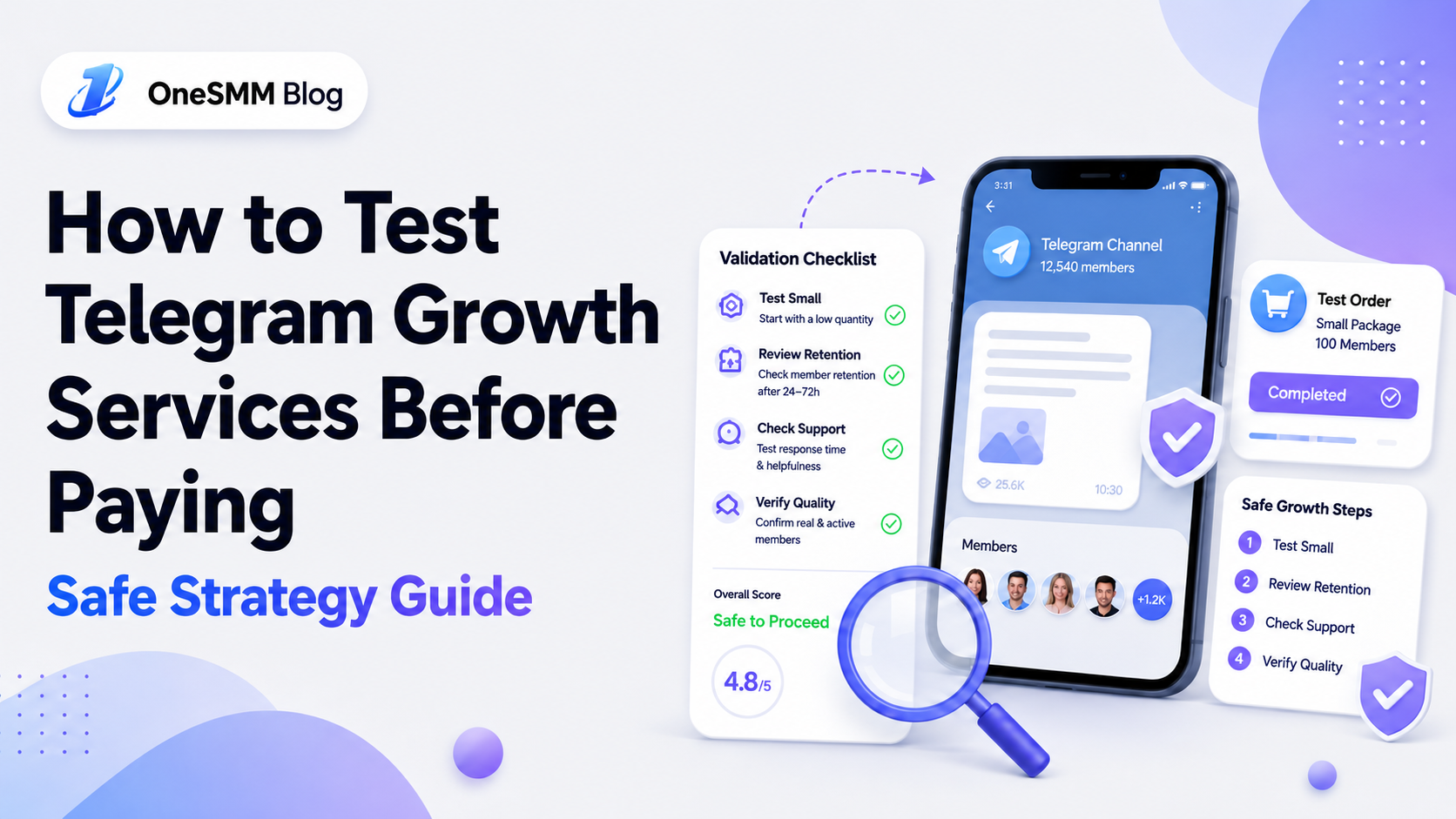
How to Test Telegram Growth Services Before Paying (Safe Strategy Guide)
How to Test Telegram Growth Services Before Paying (Safe Strategy Guide)
You're skeptical. Good. You should be. The Telegram growth service space is full of scams, bots, and overhyped promises.
So before you spend a single dollar, you need a way to test if a service actually delivers what it claims. This guide gives you the exact framework to validate any growth service—without risking your channel or your money.
Why Testing Matters (What You're Actually Risking)
Buying the wrong growth service can hurt your channel in ways that take months to recover from:
- Bot members: Fake accounts that tank your engagement rate and hurt your channel's credibility
- Algorithm penalties: Telegram notices suspicious member patterns and deprioritizes your content
- Money wasted: Paying for members who leave within days
- Scams: Worst case, you lose money and your channel gets compromised
The right service? It brings real, engaged members who stay and interact. The difference is massive, but you need a way to spot it before committing.
The Pre-Testing Checklist: Does This Service Even Deserve a Test?
Before you test anything, verify the service itself passes basic credibility checks:
Red Flag 1: No Clear Pricing
If they don't publish clear pricing, they're hiding something. Legitimate services show exactly what you get for what price.
Red Flag 2: Promises of "Guaranteed" Growth
"Guaranteed 10,000 members" doesn't exist. Real growth varies based on content quality, niche, timing. Anyone promising guarantees is lying.
Red Flag 3: Pressure to Act Fast
"Limited time offer! Buy now!" is a manipulation tactic. Real services are confident their product speaks for itself. They don't use artificial scarcity.
Red Flag 4: No Real Contact or Support
Can't find an email, chat, or support contact? Can't find reviews or case studies? Walk away.
Red Flag 5: Too Cheap
If members cost $0.10 each when the industry standard is $2+, you're buying bots. Real members cost real money.
If the service fails any of these checks, don't test it. You're wasting time. Only test services that look legitimate on the surface.
The 3-Phase Testing Framework
Phase 1: Research & Verification (Week 1)
Step 1: Check for Real Reviews
- Google the service name + "review"
- Look for honest reviews (not on their own website)
- Reddit communities, tech forums, Telegram communities discussing growth services
- What do real users say about quality, support, retention?
Step 2: Verify Their Claims
- Do they show real case studies with real channels?
- Can you see before/after member counts and engagement?
- Red flag: Generic case studies that could apply to anyone
Step 3: Test Their Support Before Buying
- Send them a question via their support channel
- Do they respond quickly and helpfully?
- Or do they send generic replies?
- Support quality indicates how they'll treat you if something goes wrong
Phase 2: Micro-Test (Week 2, ~$50-100 budget)
Order a small test package. Most reputable services let you buy 100-500 members as a first order. This is your risk-controlled test.
What to measure in your test:
- Speed: How long before new members arrive? (Usually 1-7 days)
- Quality: Do the new members look real? (Check profiles, see if they have other channels, real names vs. bot-like names)
- Engagement: Do they interact with your posts? (Check first week engagement rate change)
- Retention: After 30 days, how many are still there?
- Support: Any issues? How responsive is the service?
The test results you want to see:
- ✅ Members arrive gradually over 3-5 days (not all at once—that's a bot signal)
- ✅ Member profiles look realistic (bio, profile picture, activity history)
- ✅ 10-20% of new members engage within first week
- ✅ After 30 days, 40-60% of new members are still active subscribers
- ✅ Your overall engagement rate doesn't drop (or drops minimally)
The test results that mean "stop immediately":
- ❌ All members arrive on same day (bots)
- ❌ Profiles are obviously fake (no bio, bot-like usernames, no profile pictures)
- ❌ Zero engagement from new members
- ❌ 80%+ of members disappear within 30 days
- ❌ Your engagement rate drops sharply
Phase 3: Evaluation & Decision (Week 3)
Compare your test results to expectations:
If the test went well (members look real, reasonable retention, engagement stable or improved):
- ✅ The service is likely legitimate
- ✅ Safe to scale to bigger orders if you want
- ✅ Monitor future orders the same way
If the test was mediocre (some concerns but not complete failures):
- ⚠️ Try one more test with feedback to the service
- ⚠️ Ask them to explain retention/quality metrics
- ⚠️ If they can't articulate their quality standards, move on
If the test failed:
- ❌ Stop using them
- ❌ Request a refund
- ❌ Move on to next option
Safety Metrics: What Numbers Actually Tell You
The Engagement Rate Test
Before testing: Calculate your current engagement rate. (Total interactions this week / member count × 100)
After buying members: Calculate again 7 days later.
Expected: Similar or slightly better (because you now have more followers to engage)
Red flag: Drops by more than 20%. This signals the new members aren't real or aren't engaging.
The Bot Check
Manually review 20 new members:
- Do they have profile pictures? (Real accounts: 80%+ have pictures)
- Do they have bios? (Real accounts: 40%+)
- Are they subscribed to other channels? (Real accounts: 60%+)
- Do names look realistic? (Real accounts: mix of first names, full names, no obvious bot patterns)
Count how many look obviously fake. If more than 3 out of 20 (15%), quality is questionable.
The Retention Calculation
Note exactly how many members the service delivered on day 1. (Let's say 250)
Count how many of those specific members are still there after 30 days. (Let's say 150 still there)
Retention = 150/250 = 60%
Target: 40-50%+ for quality services. Below 30% means members leave fast (likely low quality or not a good fit for your content).
The Red Flags You Can't Ignore
- Service demands your password: Legitimate services never ask for passwords. They use Telegram's official API.
- Sudden spike in members (1000+ in one day): Real growth services spread deliveries over time. Spikes indicate bots.
- Service stops responding after purchase: They only care about the sale, not the result. Bad sign.
- Your channel gets flagged/restricted by Telegram: Telegram penalizes channels with suspicious member patterns. If this happens, the service was using bots.
- Friends/followers ask "why are these people following you?": Bots are usually obvious to people who know you
How Long Should Testing Take?
The full testing cycle takes 30 days:
- Days 1-7: Research, pre-checks, contact support
- Days 8-15: Micro test (order small package, members arrive)
- Days 16-30: Monitor retention and engagement
- Day 31: Make go/no-go decision
This feels slow, but it's the only way to get real data. Quick decisions = bad outcomes.
What If You Can't Test Because You're Too Small?
If you have fewer than 1000 members, testing is harder because small metric changes are harder to measure. In that case:
- Skip paid services for now
- Focus on organic growth (it's more valuable when you're small anyway)
- Once you hit 1000+ members, revisit services
- Then do the full testing framework
There's no shame in bootstrapping organic growth first. It builds better foundations.
Should I test multiple services?
Only if the first passes all tests and you want options. Testing takes time. If one service works, stick with it until you have a clear reason to switch.
Can I test for free?
Most services don't offer free trials. Some offer very small packages (100 members for $20-50). That's your free trial equivalent.
What if retention is 30%? Is that bad?
It depends on context. If your overall engagement is solid and members are clearly real, 30% retention might be fine (it means 30% found long-term value). If combined with signs of bots, 30% is a failure.
The Bottom Line
Never trust a service's promises. Trust data. And the only data that matters is what happens on your channel after you buy.
The testing framework above takes 30 days and costs $50-100. That's a small price for knowing whether a service is worth scaling to bigger orders ($500+).
Most people skip testing and waste thousands. Don't be that person. Test first. Scale after validation.
Want a Service You Can Trust?
onesmm is built on transparency and real results. Try a small test package—real members, real engagement, real support. See for yourself.