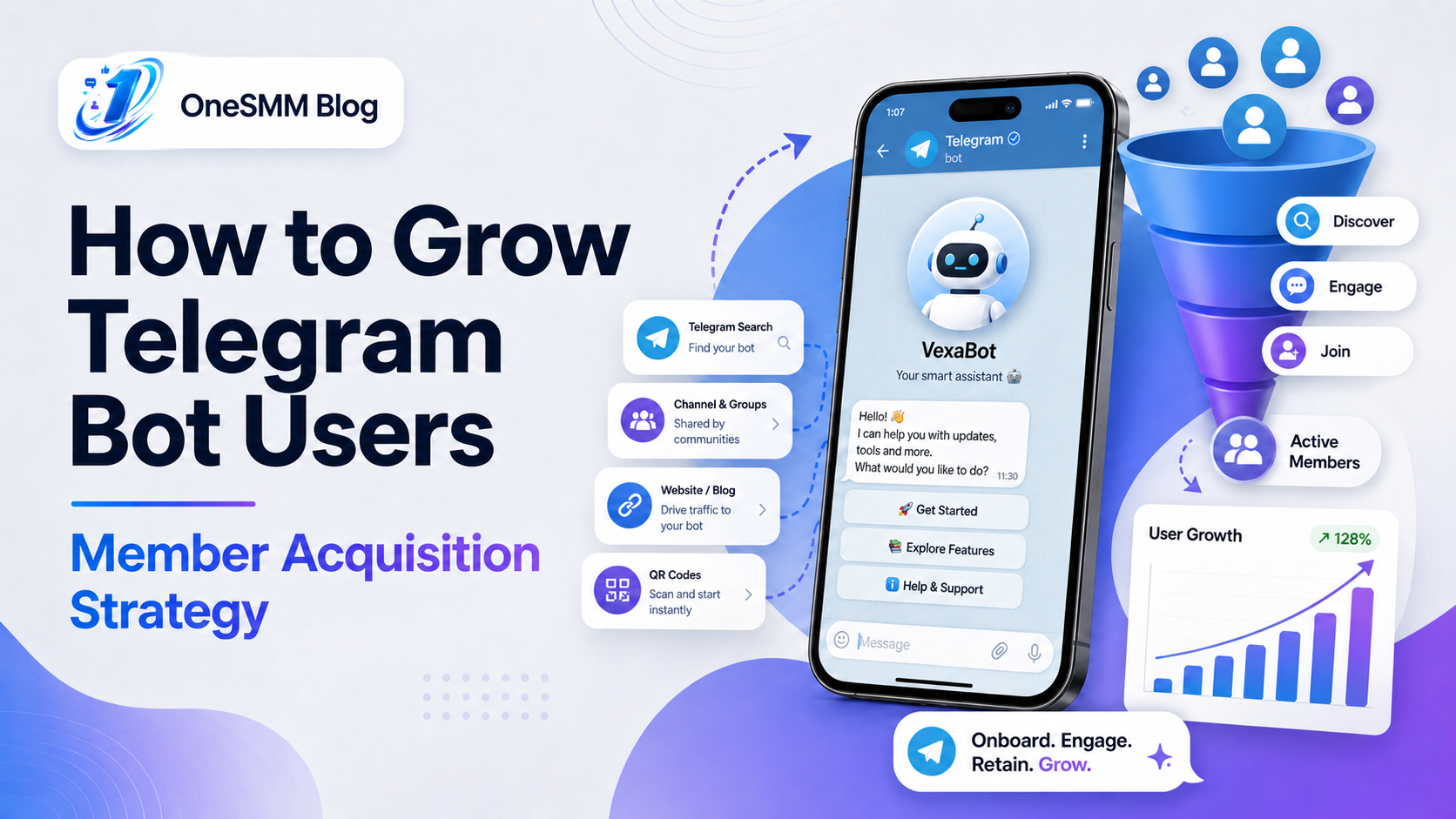
How to Grow Telegram Bot Users (Member Acquisition Strategy)
How to Grow Telegram Bot Users (Member Acquisition Strategy)
Telegram bots are different from regular channels. They're not broadcast-only. They're interactive tools.
This creates different growth challenges and opportunities. You can't grow a bot the same way you grow a channel. Discovery works differently, retention metrics are different, and the entire monetization model depends on whether users actually use the bot — not just whether they started it.
This guide covers the complete strategy: setting up your bot for growth, the five acquisition methods that work, how to retain users after they join, and when paid growth services make sense.
Before You Grow: Set Up Your Bot for Discoverability
Most bot creators jump straight to promotion before optimizing the basics. These elements determine whether users who find your bot understand it fast enough to stay:
- Bot name and username: Should clearly describe the function. @CryptoTrackerBot ranks better in Telegram search than @CT_Bot_v2. Include the primary keyword users would search.
- About description: BotFather allows a short description shown before users start. Write one sentence that says what the bot does and who it's for. "Track crypto prices and get alerts. Type /start to begin."
- Commands menu: Set up your command list in BotFather. Users who see a clear command menu (/help, /start, /price, /alert) understand the bot faster and use it more.
- Welcome message: The first message a user receives after /start is your only chance to explain the bot. Make it short, clear, and include the two or three most useful commands.
- Profile photo: Bots with a recognizable icon look legitimate. Bots without a photo look abandoned or unfinished.
A bot that is confusing in the first 30 seconds loses most users before they experience any value. Optimize the onboarding before spending any effort on promotion.
Why Bots Are Hard to Grow
Regular channels: "Join for daily tips!" Easy to pitch.
Bots: "Use this tool!" Much harder to pitch without a clear use case.
The challenge: People use bots when they need a specific tool, not when they're casually browsing. This makes discovery harder. A channel subscriber might join out of curiosity. A bot user only starts the bot if they have a specific need it can meet right now.
The Five Ways to Grow Bot Users
| Method | Expected Users/Month | Effort | Best For |
|---|---|---|---|
| Embed in existing channel | 10–20% of channel size | Low (one-time promo) | Creators with existing audience |
| Solve a specific problem | 50–200 organic | Medium (product quality) | Utility bots with clear use case |
| Bot directories | 20–100 | Low (one-time submission) | All bots; baseline visibility |
| Cross-promotion | 50–300 per partnership | Medium (outreach) | Bots with complementary tools |
| Paid promotion | 100–500 per campaign | Low (budget-driven) | Proven bots with good retention |
Method 1: Embed in Another Channel
If you own a channel with 1000+ members, promote your bot there. A single pinned post with "Try our bot: @YourBotName" is the highest-conversion promotion method available. Channel members already trust you. When you recommend the bot, the conversion rate is 10–20% — far higher than cold discovery through directories or ads.
Method 2: Solve a Specific Problem
Bots that solve a clear, searchable problem grow through word of mouth and organic discovery. A crypto price tracker, a grammar checker, a currency converter — users who find real value share it. They tell a colleague: "There's a bot for that." This growth is slower but produces users who actually use the bot regularly. Target one problem with one bot. Multi-purpose bots are harder to discover and harder to explain.
Method 3: Bot Directories
Submit your bot to Telegram bot directories — StoreBot, Telegram's internal bot recommendations, and third-party directories. These directories are browsed by people specifically looking for bots. Your listing quality matters: write a clear description, include relevant categories, and accumulate ratings. A bot with 50 ratings and a 4.5 average will outperform a bot with 500 users and no ratings in directory rankings.
Method 4: Cross-Promotion
Find bots that serve a complementary need and negotiate mutual recommendations. A scheduling bot and a reminders bot share the same user profile — people who want automated task management. Cross-recommendation inside the bot itself ("Check out @RelatedBot for X") has a 5–15% click-through rate because users are already engaged with an automated service when they see the recommendation.
Method 5: Paid Promotion
Pay to advertise in channels or groups where your target users spend time. A developer tools bot should advertise in programming channels, not general growth channels. Cost-per-start ranges from $0.50–$5.00 depending on how targeted the audience is. Confirm the promotion converts before scaling — 100 users from a targeted channel is more valuable than 500 from an untargeted one.
Bot Retention: Keeping Users Engaged After They Join
Acquisition brings users in. Retention determines whether your user count grows or leaks. Most bots lose 60–80% of new users within the first week because the value isn't immediately clear or the bot isn't used regularly enough to become habitual.
Tactics that improve bot retention:
- Scheduled interactions: Bots that push useful messages at predictable times (daily price reports, weekly summaries) become habits. Users who receive value without asking for it stay engaged.
- Onboarding flow: Walk new users through the most important command on their first session. Don't assume they'll read a manual — guide them.
- Feedback prompt: After 7 days, send a simple "Is this bot helping you?" message. Users who respond are your most loyal segment. Their feedback tells you what to improve.
- Feature announcements: When you add a new capability, tell existing users. It restarts the discovery process for people who had stopped using the bot.
- Deep linking: Create shareable links that open the bot with a specific command pre-filled (t.me/YourBot?start=command). These links make it easier for current users to share the bot with a specific use case already set up.
The Bot Growth Formula
Most important factors:
- Usefulness: Does your bot actually solve a problem? Not optional.
- User experience: Is it easy to use? Can someone figure it out in 10 seconds?
- Discoverability: Can people find it? (directory listings, recommendations, search)
- Viral coefficient: Do users tell their friends about it?
Without #1 and #2, #3 and #4 don't matter. You can drive 1000 users but if the bot disappoints, none stay.
Measuring Bot Success
Track different metrics than you'd track for a channel:
- New users/month: How many new people start using it?
- Active users/month: How many use it at least once monthly?
- Daily active users: How many use it every day?
- Churn rate: How many stop using it after 30 days?
- Feature adoption: Which commands do people use most?
Healthy bot metrics:
- 30–50% of people who start using it stay active after 30 days
- 10–20% use it at least 3 times per week
- Churn rate under 5% per week after the first two weeks
Common Bot Growth Mistakes
- ❌ Launching a bot nobody asked for (validate demand before building)
- ❌ Making it so complicated users give up (simplify to one core command first)
- ❌ Not writing clear instructions (users don't figure it out themselves)
- ❌ Changing core functionality without warning (users get confused and leave)
- ❌ No feedback mechanism (you can't improve what you don't measure)
- ❌ No scheduled messages (bots that only respond, never initiate, get forgotten)
Bot Growth Timeline
- Month 1–2: 10–50 users (friends, testing, first directory listings)
- Month 3–4: 50–200 users (early traction, word of mouth)
- Month 5–6: 200–500 users (directories, cross-promotions active)
- Month 6–12: 500–2000+ users (reputation compounds)
This assumes: Good product, consistent improvement, and some promotion effort.
When to Use Paid Growth for Bots
Growing a bot with paid services is more nuanced than growing a channel because:
- Not all new users will actually USE the bot
- Growth services add users who might not need your specific tool
- 100 active users are worth more than 1000 who never return
Use paid growth only when:
- ✅ Your bot has 100+ organic users with good retention (proof it works)
- ✅ You've validated demand (people are actively looking for this type of bot)
- ✅ You're paying to accelerate proven traction, not to manufacture demand
Bot vs. Channel Strategy
Channels: Growth → Engagement → Monetization (sell to loyal audience)
Bots: Useful tool → User base → Monetization through premium features, API access, or advertising
These are different business models. A channel builds an audience around content. A bot builds users around utility. The growth tactics differ, the retention metrics differ, and the revenue models differ. Don't confuse them — optimize each for what it actually is.
Growing a Bot Community?
If you have a bot that serves a specific user base and want to accelerate user acquisition, OneSMM's targeted growth services can help you reach the right audience. Real users who actually need your tool.