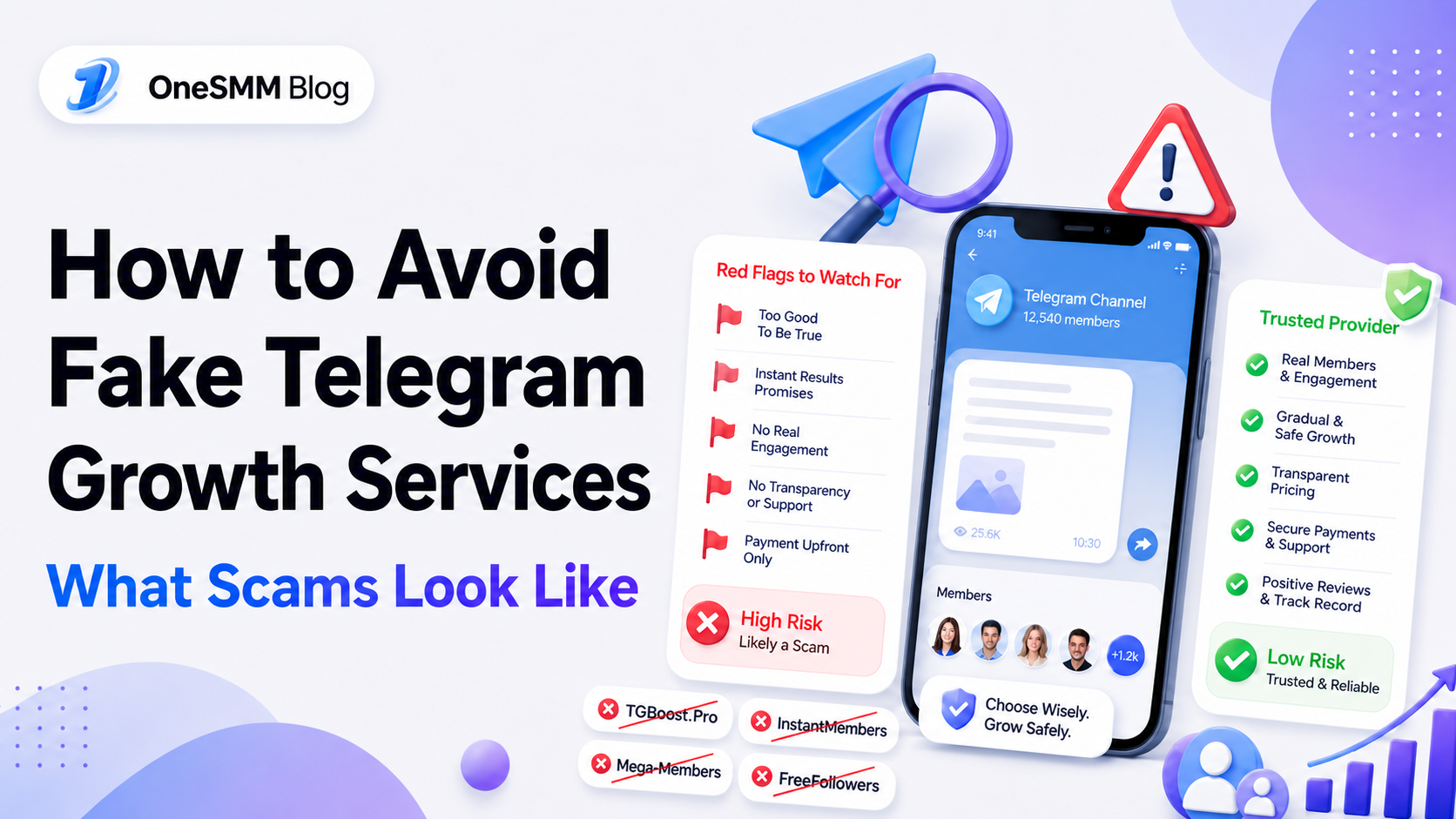
How to Avoid Fake Telegram Growth Services (What Scams Look Like)
How to Avoid Fake Telegram Growth Services (What Scams Look Like)
The Telegram growth service space has a problem: it's full of scams.
Fake bot services. Bait-and-switch pricing. Money stolen after "promising results." Channels compromised with suspicious member patterns that trigger Telegram's algorithms.
The worst part? Scammers are getting sophisticated. They look legitimate on the surface. A decent website. Testimonials. Pricing. But underneath, they're just harvesting money and delivering nothing.
This guide shows you exactly what scams look like—so you never fall for one.
Understanding the Scam Landscape
There are three types of fake growth services:
Type 1: Bot Services (The Most Common)
These deliver fake accounts—literally bots, not real humans.
How they work:
- You buy 1000 "members" for $50 (way cheaper than legitimate services)
- Thousands of fake accounts flood your channel
- They never engage, they're basically decorative
- If Telegram detects this, they can penalize or ban your channel
Why people fall for it: The price is irresistible. And it works instantly (because bots are instant).
Type 2: Theft/Scam Services (Less Common, More Harmful)
These are straight-up theft. You pay, nothing happens, money disappears.
Variations:
- Payment goes through, service vanishes before delivering members
- They request your channel admin access, then hijack the channel
- They ask for "proof of identity" or "payment verification," steal your info
Why it's dangerous: You lose money and potentially lose control of your channel.
Type 3: Low-Quality Services (The Sneaky Ones)
These deliver "real" members, but from the wrong audience or through deceptive methods.
How they work:
- They deliver real accounts, but not people who care about your niche
- Members leave after a few days
- Or they get members through spam techniques that trigger Telegram warnings
Why it's deceptive: You think you're getting real growth, but retention is terrible.
Red Flags: The Complete Checklist
Red Flag 1: Unrealistic Pricing
Sign: 1000 members for $20. Or "any package for 70% off."
Reality check: Real members cost money. Legitimate services charge $2-10 per member depending on niche. If it seems too cheap, it's bots.
What to look for: Transparent, market-rate pricing. Usually $50-500 per package. Clear price per member.
Red Flag 2: Guaranteed Results
Sign: "Guaranteed 10,000 members!" or "Money-back guarantee if you don't get exactly [X] members."
Reality check: Real growth varies. Your content quality, niche size, and timing all affect results. Anyone promising guarantees doesn't understand how growth actually works.
What to look for: Services that say "typical results" or "most clients get" but acknowledge variation.
Red Flag 3: No Clear Business Model
Sign: Can't explain where members come from. Vague descriptions like "growth hacking" or "secret methods."
Reality check: Legitimate services can explain: We target real Telegram users interested in X, send them your channel link. Simple.
What to look for: Services that clearly explain their method. Nothing mysterious about it.
Red Flag 4: Pressure to Act Fast
Sign: "Limited time offer! 50% off if you buy in next 24 hours!" or "Only 2 slots left!"
Reality check: Legitimate services are confident their product speaks for itself. They don't manufacture artificial urgency.
What to look for: Services that let you think about the decision. No countdown timers. No false scarcity.
Red Flag 5: Requesting Channel Admin Access
Sign: "We need admin rights to your channel to deliver members."
Reality check: They don't need your password or admin access. Legitimate services use Telegram's public APIs or send member links.
What to look for: Services that work without touching your channel admin settings.
Red Flag 6: No Customer Support
Sign: Can't find an email address, chat, or support contact. If you contact them with a question, no response.
Reality check: Real services have support because they stand behind their product.
What to look for: Responsive support. Email replies within 24 hours. Chat support available.
Red Flag 7: Generic/Stolen Testimonials
Sign: "Amazing results! 5 stars!" with no real details. Or testimonials that could apply to any service.
Reality check: Real testimonials are specific: "I went from 500 to 2500 members in 3 months with engaged followers."
What to look for: Specific before/after numbers. Real names and channels (you can verify them).
Red Flag 8: Inconsistent Information
Sign: Pricing changes depending on where you look. Different promises on website vs. sales email vs. chat.
Reality check: Legitimate services have consistent messaging across all channels.
What to look for: Same story everywhere. Website matches what the sales team says.
Red Flag 9: No Visible Track Record
Sign: No case studies. No public channels using them. Impossible to find any evidence they've actually helped anyone.
Reality check: Established services have a track record. You can find channels they've helped.
What to look for: Case studies with real channel names. Testimonials you can verify. Evidence of real results.
Red Flag 10: They Request Payment Via Untraceable Method
Sign: "Send Bitcoin" or "Wire transfer to this account" with no official invoice or receipt.
Reality check: Legitimate services use standard payment methods (Stripe, PayPal, credit card) so you have recourse if something goes wrong.
What to look for: Mainstream payment processors. Clear invoicing. Refund policy.
How to Verify a Service Is Legitimate
Step 1: Google + Research (15 minutes)
- Search "[Service Name] + review"
- Look for independent reviews (not on their website)
- Check Reddit communities about Telegram growth
- Look for any complaints about scams
Step 2: Contact Support (24 hours)
- Ask a detailed question: "How exactly do you deliver members? What's your targeting method?"
- Time their response (should be within 24 hours)
- Evaluate their answer (specific or vague?)
- If they avoid answering, that's a red flag
Step 3: Ask for References (48 hours)
- Request case studies with real channel names
- If they can provide them, look at those channels (check member count, engagement, activity timeline)
- If they can't provide references, that's a red flag
Step 4: Do a Micro-Test (Covered in Earlier Guide)
- Buy smallest package available ($50-100)
- Monitor delivery, quality, and retention
- If test passes, safe to scale
- If test fails, don't order again
Specific Scams to Avoid (Real Examples)
Scam Pattern 1: The Bait-and-Switch
How it works:
- Service advertises "real members" at fair price
- You buy
- You receive obvious bots (instant delivery of thousands)
- You complain. They say "this is normal" or ghost you
How to avoid: Test with small order. If instant delivery of thousands, it's bots. Don't scale up.
Scam Pattern 2: The Hijack
How it works:
- Service asks for "channel verification" or "admin access"
- You give them access (thinking it's normal)
- They add themselves as admin, change settings, add other accounts
- You lose control of your channel
How to avoid: Never give password or admin access to anyone. Ever. Legitimate services don't need it.
Scam Pattern 3: The Ghost
How it works:
- You pay for members
- Service disappears (website goes down, email stops responding)
- You have no way to contact them or get refund
How to avoid: Use credit card or payment method with purchase protection. Check if service has been around for 1+ year (new services are higher risk).
Scam Pattern 4: The Low-Quality Dump
How it works:
- Service delivers "real" members, but from wrong audience
- Members don't engage, leave within days
- Your engagement metrics drop, channel looks worse
- Service keeps your money, claims "results depend on content"
How to avoid: Monitor retention in micro-test. If 50%+ of members leave within 30 days, quality is poor.
What Legitimate Services Look Like
After learning what to avoid, here's what to look for:
- ✅ Clear, market-rate pricing ($2-10 per member)
- ✅ Transparent explanation of how they deliver members
- ✅ Real case studies with specific numbers and channel names
- ✅ Responsive customer support (replies within 24 hours)
- ✅ No requests for passwords or admin access
- ✅ Standard payment methods (credit card, PayPal, Stripe)
- ✅ Acknowledges that results vary based on content quality
- ✅ Allows you to test with small order
- ✅ Has been operating for 1+ year with consistent brand presence
- ✅ Explains member retention expectations realistically (40-60%)
If You've Been Scammed
If you've already fallen victim:
- If via credit card: Dispute the charge with your bank/credit card company. Request chargeback.
- If via PayPal: Open a dispute in PayPal. Provide evidence the service didn't deliver.
- If via wire transfer: Contact your bank immediately. May be recoverable if still in transit.
- If account compromised: Change Telegram password immediately. Check for unauthorized admin changes. Remove suspicious accounts.
- Report to Telegram: Tell Telegram about the service via their support. They track scammers.
The Bottom Line
The Telegram growth service space has real options and fake ones. The difference is usually obvious if you know what to look for.
Run through the red flags checklist. Do a test order. Check for real case studies. If something feels off, it probably is.
A good rule: If a service seems too good to be true, it is. Real growth takes effort, time, or money. No service gives you all three for cheap.
Want a Service You Can Verify?
onesmm's transparency is our brand. Real members, real numbers, real support. Try a test package and verify for yourself.