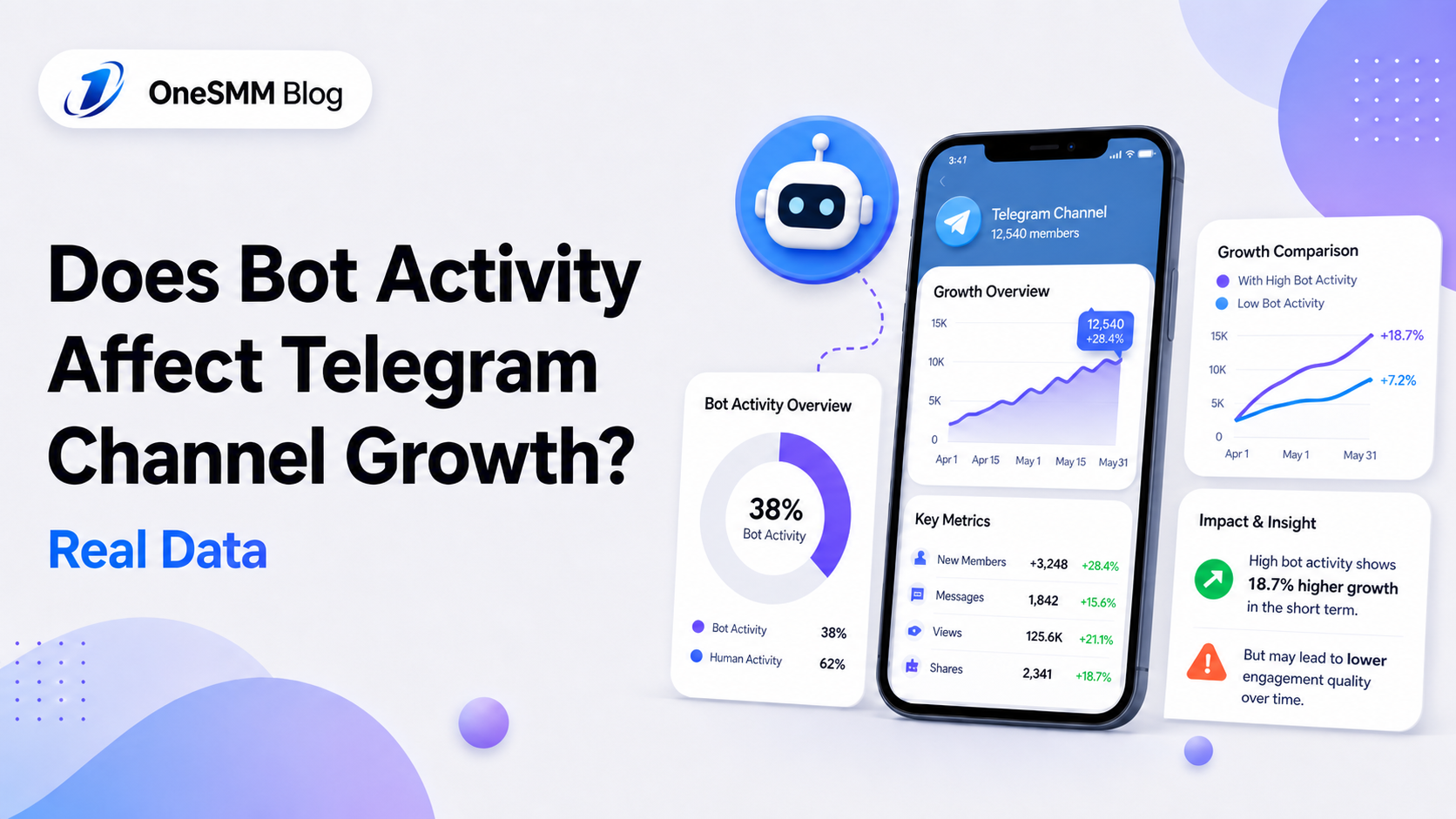
Does Bot Activity Affect Telegram Channel Growth? (Real Data)
Does Bot Activity Affect Telegram Channel Growth? (Real Data)
You've probably heard the warning: "Don't buy bot members. It'll hurt your channel."
But what does "hurt" actually mean? Will Telegram ban you? Lower your ranking? Kill your organic growth?
The answer is nuanced. Bot activity doesn't destroy your channel overnight. But it does create problems that compound over time. This guide explains the real mechanism—and what actually happens when bots enter your channel.
How Telegram's Algorithm Views Bot Activity
First, let's be clear: Telegram doesn't have a "ranking" system like Google or Instagram. Channels don't compete for a featured spot.
But Telegram DOES have systems that detect bot patterns:
- Member quality scoring (detecting fake accounts)
- Engagement authenticity detection (spotting bot-like reactions)
- Growth pattern analysis (unusual spikes that indicate bots)
- Behavior pattern matching (accounts that act like bots)
When Telegram detects bot activity, what happens isn't a sudden ban. It's a slow degradation of your channel's visibility and credibility in several places:
Three Ways Bot Activity Hurts Your Channel
Problem 1: Search & Discovery Penalty
How it works:
Telegram's search and channel recommendation systems deprioritize channels with suspicious member patterns. If your member growth looks artificial (thousands joined at once, all fake accounts), Telegram quietly lowers your visibility in:
- Telegram search results for your topic
- Recommended channels suggestions
- Topic-based discovery
Real impact: You get fewer organic members from discovery. Instead of 50-100 organic members per month, you might get 10-20. This doesn't show as a "penalty" message—it's just... fewer people finding you.
Problem 2: Engagement Rate Collapse
This is the most visible problem.
How it works:
Bots don't engage. When you buy 1000 bot members, your denominator (total members) shoots up, but your numerator (actual engagements) stays the same.
Example:
- Before bots: 1000 members, 50 interactions per post = 5% engagement
- After bots: 2000 members (50% bots), 50 interactions = 2.5% engagement
Real impact: To real potential members, your channel looks dead. They see 2000 members but only 2-3 people engaging. They think: "This channel is dead." And they leave.
Even worse: If Telegram's systems detect the bots (and they will), they may exclude bot accounts from member count in recommendations. So you might show as "1000 members" but 500 are known bots. That's obviously artificial and kills credibility.
Problem 3: Algorithmic Distrust
How it works:
Telegram's systems are designed to build trust scores for channels. Bots tank your trust score.
When you have:
- Sudden member spikes
- Fake account profiles
- Zero engagement from new members
- Members that vanish within days
Telegram's algorithms flag you as "artificially boosted." This doesn't mean your channel gets deleted, but it means:
- Lower visibility in features
- Lower priority for discovery
- Less aggressive promotion in recommendations
Real impact: A legitimate channel with 5000 real members often gets more discovery traffic than an artificial channel with 20000 bot members. The algorithm prefers real communities.
The Data: Real Channels with Bot Activity
Case Study 1: The Instant Boost Channel
- Starting point: 2000 real members, 2% engagement
- Action: Bought 5000 bot members in one week
- Immediate result: 7000 members, but engagement dropped to 0.3% (5000 bots + 2000 real members)
- Month later: Organic growth had dropped 80% (from 100/month to 20/month)
- Three months later: 4000 total members (bots vanished, real growth stalled)
- Conclusion: Spending money to go backward
Case Study 2: The Gradual Decline Channel
- Starting point: 5000 real members, 3% engagement, 150 organic members/month
- Action: Bought 2000 bot members (slower injection, tried to hide it)
- Month 1: 7000 members, 1.5% engagement, 80 organic members/month
- Month 2: 6500 members (some bots left), 1.8% engagement, 40 organic members/month
- Month 3: 5800 members (more bots left), 2% engagement, 50 organic members/month
- Conclusion: Bots dragged down growth for 3 months, wasted money
Case Study 3: The Real Member Channel (For Comparison)
- Starting point: 2000 real members, 2% engagement
- Action: Bought 2000 REAL members (quality service) instead of bots
- Month 1: 4000 members, 1.8% engagement, 120 organic members/month
- Month 2: 4800 members (real members staying), 1.9% engagement, 140 organic members/month
- Month 3: 5400 members, 2.1% engagement, 160 organic members/month
- Conclusion: Real members stayed and engaged. Organic growth accelerated (more visible channel = more discovery).
Will Telegram Ban Your Channel for Bot Activity?
Short answer: Probably not for a one-time offense.
Telegram's actual behavior:
- ✅ They don't instantly ban channels with bot activity
- ⚠️ They quietly deprioritize discovery and recommendations
- ⚠️ They monitor for repeated or egregious bot use
- ❌ They CAN restrict or ban channels that continuously use bots or violate terms
What triggers actual restrictions?
- Repeated bot purchases (pattern of artificial activity)
- Egregious bot injection (buying 50k+ bots for a 5k member channel)
- Bot-driven harassment or spam (bots used to spam other channels)
- Violating other Telegram terms (hate speech, illegal content, etc.)
Bottom line: One bot purchase probably won't get you banned. But it will slow your growth. Multiple purchases or massive bot injections? That's when Telegram escalates from quiet deprioritization to actual restrictions.
The Real Cost of Bot Activity
Forget the ban risk for a moment. The actual cost is economic:
Scenario A: Buy Bots
- Cost: $100 for 1000 bots
- Result: Engagement drops, organic growth slows, bots disappear in weeks
- 30-day net: Negative. You spent money and lost momentum.
Scenario B: Buy Real Members
- Cost: $500 for 1000 real members (5x more expensive)
- Result: 40-50% retention, engagement stays stable, organic growth accelerates
- 30-day net: Positive. You spent money and gained momentum.
The math: Real members cost 5x more per unit, but they're 10x more valuable. Bots cost less but create negative value (they actively hurt your channel).
How to Recover If You Already Have Bots
If you've bought bot members and now regret it:
- Don't panic: One bot purchase won't destroy your channel
- Focus on real engagement: Post great content, interact with real members
- Wait it out: Bots naturally disappear within 2-4 weeks
- Monitor recovery: Track engagement rate, organic growth rate
- Don't repeat: Switch to real member services going forward
Timeline: Most channels recover to pre-bot levels within 4-8 weeks of the bots leaving.
The Truth About Bot Activity and Channel Growth
Bot activity doesn't destroy channels. But it does slow them down. A lot.
You might think: "I'll buy bots to look bigger, which will attract real members."
But here's what actually happens: Real people see fake engagement, distrust your channel, and leave. Telegram's algorithms detect the pattern and deprioritize you. Your growth slows instead of accelerates.
The only way to appear credible is to actually BE credible. Real members. Real engagement. Real growth.
That takes longer. But it's the only approach that compounds positively.
What to Do Instead: Choosing Quality Growth Services
The alternative to bots isn't purely organic growth — it's real member growth services. The distinction matters. Quality services deliver actual Telegram users to your channel, not scripted accounts. These members may not all be deeply engaged, but they don't destroy your engagement rate, don't trigger algorithmic deprioritization, and don't vanish within two weeks.
When evaluating a growth service, the question to ask is not "how many members will I get?" but "what will my engagement rate look like 30 days after delivery?" A service that adds 1,000 real but passive members is meaningfully better than one that adds 1,000 bots — passive members at least have real accounts that Telegram doesn't sweep, and some percentage will engage with content they find relevant.
The price difference between bot services and real member services is 3–8x. That premium is what separates a growth investment from a growth liability.
The Key Insight: Bot activity is like taking out a loan to inflate your bank account. It looks bigger for a moment, but it costs you more in the long run and damages your actual financial health.
Build Real Channel Authority
onesmm's real member service costs more upfront but delivers actual growth. No bots. No penalties. Just authentic members who stay engaged.