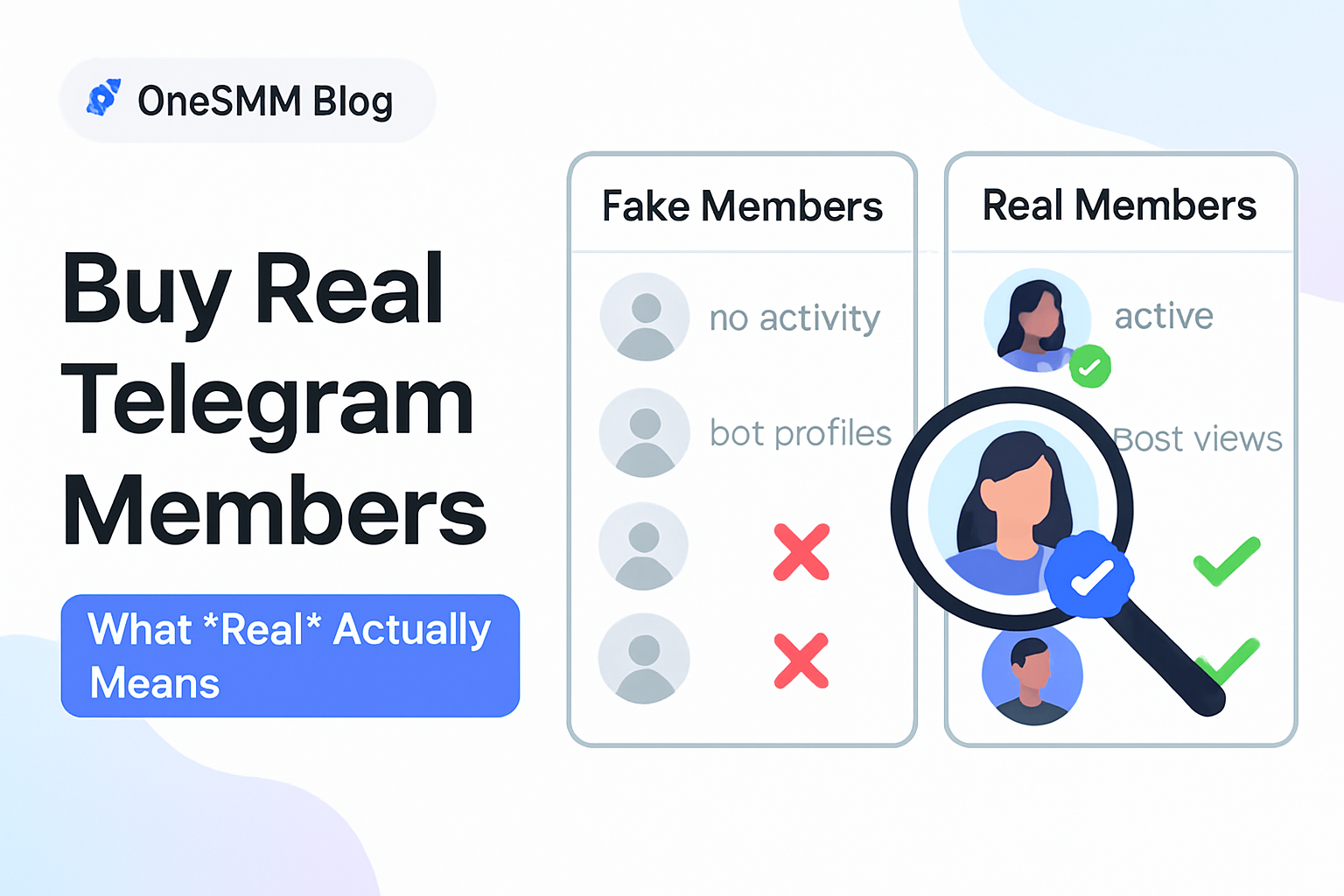
Buy Real Telegram Members: What "Real" Actually Means
Buy Real Telegram Members: What "Real" Actually Means
"Buy real Telegram members" is one of the most searched phrases in the Telegram growth space — and one of the most misleading. Every panel claims their members are "real." Very few explain what that word means in their context. Understanding the spectrum from economy accounts to high-quality accounts helps you make a buying decision based on substance rather than marketing copy.
This guide breaks down what "real" actually means across different service tiers, how account quality is sourced, which signals genuinely indicate quality, the red flags to look out for in listings, how to inspect quality after delivery, and what you should realistically expect from any Telegram member service regardless of how it's labelled.
Contents
- The quality spectrum: economy to HQ
- How real account quality is actually sourced
- What "real" means in a service listing
- Red flags in listings claiming "real" members
- Quality signals that are measurable
- How to inspect quality after delivery
- What no service delivers
- Choosing the right tier for your use case
- FAQ
The quality spectrum: economy to HQ
Telegram member services exist on a quality spectrum. Here's an honest breakdown of what each tier actually uses:
| Tier label | What the accounts look like | Typical retention at 30 days | Best for |
|---|---|---|---|
| Economy / Fast | Minimal: no photo, no username, no recent activity | 70–85% (without refill) | Volume, new channels, testing panels |
| Standard | Basic profile: name, some history | 85–92% | General growth, mid-size campaigns |
| HQ / Premium | Aged accounts with profile photo, username, post history | 90–97% | Established channels, client work, sensitive audiences |
| Non-drop with refill | Varies; refill covers any drop within warranty | Maintained at 100% within warranty period | Long campaigns requiring stable counts |
All of these tiers use real Telegram accounts — they all passed Telegram's phone verification. The difference is how much activity history and profile data those accounts have. An economy account is a real Telegram account; it just has no profile photo and minimal activity. A premium account is also a real Telegram account — one that's been used enough to have visible history attached to it.
How real account quality is actually sourced
Understanding where these accounts come from helps you calibrate what "real" means at each price point. The SMM account supply chain has a few distinct layers:
- Fresh registrations — accounts created specifically for SMM use. Each requires a unique phone number (real SIM cards or virtual numbers). These accounts have no history, no contacts, and minimal profile data. This is the base of most economy services. They're real accounts but new, with no organic behaviour behind them.
- Aged accounts — accounts registered months or years ago, maintained with some activity (joined legitimate groups, sent some messages). Aging costs money: the operator has to maintain the accounts, keep them active enough not to be purged by Telegram, and ensure they have enough history to look credible. This is what premium and HQ tiers are built from.
- Recovered or purchased accounts — accounts that were once used by real people and acquired through account marketplaces. These have the most genuine-looking history but are the most expensive to source and the hardest to verify as a buyer.
- Pool accounts — many providers maintain large pools of accounts that get reused across multiple orders. When you order 5,000 members, those accounts join your channel and potentially 50 other channels during the same week. This is fine from a functional standpoint, but it's why economy-tier accounts are more likely to be caught in bulk detection sweeps — they show up in anti-spam data more frequently.
The price difference between economy and HQ is almost entirely explained by the sourcing cost. An aged account with profile history costs significantly more to maintain in inventory than a fresh registration. That cost is passed through to the service price — which is why HQ services cost 3–5× more per 1,000 than economy.
What "real" actually means in a service listing
When a panel says "real Telegram members," they typically mean one of the following — and the listing rarely clarifies which:
- Real accounts (any quality) — legitimate Telegram accounts that passed phone verification. All tiers qualify under this definition.
- Real-looking accounts — accounts with enough profile data (photo, bio, username) to pass a casual visual inspection.
- Accounts with real activity history — accounts used for messaging or group participation before being added to your channel. These are harder to source and cost more.
- Not bots — the accounts are not Telegram Bot API accounts. A meaningful distinction, but it doesn't imply the accounts are active human users.
The honest frame: In the SMM context, "real" is not a synonym for "active human users who will engage with your content." No panel sells that — because engaged, genuine Telegram users can't be recruited in bulk to join your channel on demand. What SMM panels sell is count. "Real" describes the authenticity of the underlying accounts, not the intent of the people behind them. Any listing that implies otherwise is using the word as marketing, not as a specification.
Red flags in listings claiming "real" members
These phrases appear frequently in SMM listings and should prompt scepticism rather than confidence:
- "100% real members" — no qualifier on what "real" means. What's the drop rate? What's the account quality? This tells you nothing actionable.
- "From real people" — vague and unverifiable. Every Telegram account is registered to a phone number. That doesn't mean there's an engaged human behind it.
- "Organic-looking" — a design goal, not a verifiable property. Organic-looking accounts still leave at the same rate as regular SMM accounts when Telegram runs enforcement sweeps.
- "Lifetime guarantee" without a stated refill mechanism — how does a lifetime guarantee work operationally? If there's no refill process defined, the guarantee is likely unenforceable.
- "No drop ever" — physically impossible. Telegram removes accounts periodically. Any provider that can't be honest about this baseline reality is either uninformed or misleading.
- No delivery timeframe stated — quality services specify how long delivery takes. A listing without any delivery time estimate is a signal that the provider hasn't thought through the service specification.
The counterpart to these red flags: listings that say "drop rate under 5% at 30 days, 30-day refill warranty included" are making falsifiable, enforceable claims. That's what quality listing language looks like.
Quality signals that are actually measurable
Instead of asking "are these real members?", ask these questions when evaluating a listing:
- What is the stated drop rate? — A listing with "under 5% drop at 30 days" is making a verifiable claim. A listing that says "100% real" with no retention data is not.
- Is there a refill warranty? — 30-day refill guarantees are the standard for reputable services. Check what triggers a refill: any drop at all, or only drops above a threshold?
- What delivery speed is promised? — Instant delivery signals economy accounts. Gradual delivery (days, not hours) signals either higher quality or a deliberate pacing strategy to avoid detection.
- What's the minimum order? — Low minimums (100–500) allow you to run a test before committing volume. High minimums (5,000+) make quality testing expensive and are a signal to be cautious.
- Is the order traceable? — A quality panel shows you real-time order status. "Pending → processing → completed" tracking is a baseline expectation for any SMM panel.
- Does the panel have a refill or dispute process? — What happens if you receive fewer members than ordered? A defined support and resolution process is a signal of operational maturity.
How to inspect quality after delivery
Once your order completes, here's how to assess what you actually received — without needing any third-party tool:
- Check the member list in Telegram — for groups and public channels with accessible member lists, scroll through recent joins. Note whether profiles have photos, usernames, and visible names. Economy accounts will mostly be nameless with no photo. HQ accounts will have profile photos and usernames.
- Sample-check individual profiles — tap on 5–10 of the most recently joined accounts. Economy accounts typically: no profile photo, no username, account creation date unknown, no visible bio. Premium accounts typically: profile photo present, username set, bio text, and sometimes visible group memberships.
- Track the count at 24 hours, 7 days, 30 days — record the count when delivery completes. Economy tier: losing more than 10% at 7 days indicates poor account quality or aggressive Telegram enforcement. Standard tier: under 8% drop at 7 days is acceptable. HQ tier: under 4% at 7 days.
- Test refill responsiveness — if drop occurs within the warranty period, submit a refill request and note how quickly it's processed. A same-day or next-day refill confirms the panel's support is operational.
This inspection process costs you nothing and gives you a concrete quality score for the service you used. Apply it on every first order with a new panel or new tier. For the full protocol for evaluating any SMM service before scaling, see our guide on testing SMM services before committing to large orders.
What no Telegram member service delivers
To set accurate expectations, here is what you will not get from any Telegram member service regardless of how it's priced or labelled:
- Post views — members from SMM services do not open your posts. View counts are driven entirely by your organic audience. If you need views alongside member count, order them as a separate service.
- Reactions or comments — SMM members do not interact with content. Reactions and comments are separate service types on any panel.
- Long-term active engagement — no member service produces audience members who return to your channel month after month and engage with content. Sustainable engagement comes from organic growth strategy, not SMM services.
- Geographic or demographic targeting — you cannot specify that you want members from a specific country, language, age group, or interest category. SMM member services deliver count, not profiled audience segments.
- Follower intent — SMM members joined because an account they're associated with was instructed to join. They have no opinion about your content, no reason to return, and no interest in your niche.
If any of the above are requirements for your campaign, see our guide on what actually works for Telegram growth in 2026 for organic and hybrid approaches that address these needs more effectively.
Choosing the right tier for your actual use case
The right tier depends entirely on what the member count needs to accomplish:
- New channel, getting off zero → Economy tier. Drop is invisible when there's no established baseline. Optimise for cost efficiency.
- Established channel that needs a count boost → Standard or non-drop. A visible drop on an established channel is noticed by real subscribers. The extra cost is worth it.
- Client deliverable with ongoing monitoring → Non-drop with 30-day refill. The warranty protects your reputation if the client checks the count a few weeks after delivery.
- Channel with a tech-savvy or crypto audience who inspect member profiles → HQ tier. These audiences click on member profiles. Economy accounts fail that inspection; HQ accounts pass it.
- Long-term campaign (60+ days) → Non-drop with the longest available refill period. Economy services without refill require manual reordering to maintain count.
- Budget-sensitive reseller testing → Economy tier on a small order. Get data on delivery speed, drop rate, and support quality before committing to larger orders for clients.
For the full cost-versus-retention calculation that shows when spending more per unit is actually cheaper overall, see our guide on cheap Telegram subscribers and the true cost calculation.
Frequently asked questions
Can Telegram detect that members were bought from an SMM panel?
Telegram monitors for coordinated inauthentic behaviour but does not specifically flag channels for having high member counts. What Telegram does act on is suspicious account behaviour — accounts that join many channels in rapid succession may be flagged and deactivated. Reputable panels manage delivery pacing to reduce this risk. The channel receiving the members is not penalised; it's the accounts themselves that may be removed if Telegram's anti-spam systems identify them.
Why does the member count drop a few days after delivery?
Drop occurs when Telegram's platform-side moderation identifies and removes accounts that joined your channel. Economy accounts are more susceptible because they have less activity history and are more likely to be in bulk detection pools. Premium accounts drop less because they're more established. If drop is a concern, use a service with a 30-day refill warranty — any drop within the warranty period is covered automatically without additional cost.
Is buying Telegram members against Telegram's terms of service?
Telegram's terms prohibit spam and mass coordinated behaviour. Buying member services occupies a grey area — the accounts join your channel via standard invite links, not exploits or spam. Telegram does not ban channels for having high member counts or using growth services. The accounts themselves may be subject to enforcement if identified as bulk-operated, but the channel owner is not typically penalised. This is consistent with how platforms have historically treated this type of service.
How many Telegram members should I order for a new channel?
For a new channel beginning organic promotion, 1,000–5,000 is the typical starting range. This establishes a credible first impression for organic visitors without over-investing before you know whether the content strategy will retain organic members. Place that initial order, run organic promotion for 2–4 weeks, then scale based on what's converting organic viewers into joiners. See our guide on Telegram channel member services for the full service landscape.
Do more expensive "real" members actually boost post views?
No — and this applies to all tiers, including the most expensive HQ accounts. SMM members join your channel but do not open posts. Post views are driven by your organic subscriber base, not your total member count. If you need post views alongside member count, that requires a separate post views order. The relationship between member count and views is covered in our guide on buying Telegram post views.
Telegram member services on OneSMM
OneSMM carries economy, standard, HQ, and non-drop Telegram member services for channels and groups. 30-day auto-refill on eligible tiers. Test with a small order, scale what works. No admin rights required — invite link or username only.